How should you plan flashcard reviews before an exam date?
Start adding cards as soon as you know the exam date, so each card can come back in several space...
By Kamil
7 mins read

Start adding cards as soon as you know the exam date, so each card can come back in several spaced sessions. In the last weeks, stop adding cards and review what comes due.
The more time you have before the test, the further apart those sessions can be. OxyLesson has no exam-date setting and no way to study cards ahead of schedule, because a review shows only the cards that are due. You still control when you start, how fast you add cards and whether you review every day.
How far apart the reviews should be
Cepeda and colleagues taught more than 1,350 people a set of facts, gave them one review after a gap of up to 3.5 months, and tested them up to a year after that review. The best gap grew with the time to the test. As a share of that time it shrank, from about 20 to 40% of a one-week delay to about 5 to 10% of a one-year delay (Cepeda et al., 2008). Gaps longer than the best one lowered the scores gradually.
Turned into days, those shares give a gap of one to three days for a test a week away and roughly three to five weeks for a test a year away. That is my arithmetic from the percentages. Each person in the study had one review, and a flashcard schedule has many, so read the numbers as a direction: material for a distant exam can wait longer between reviews than material for next week.
How many times a card should come back
Rawson and Dunlosky ran three experiments with 533 students who learned concepts by recall practice with restudy. In the first session, students practiced each item until they had recalled it correctly between one and four times. They then relearned the items to one correct recall in up to five later sessions and were tested one to four months later. Extra correct recalls in the first session helped less once later sessions were added, and the relearning sessions improved long-term retention for relatively few extra practice trials. The authors recommend three correct recalls in the first session, then three relearning sessions at widely spaced intervals (Rawson & Dunlosky, 2011).
Rawson, Dunlosky and Sciartelli then tested this combination, which they call successive relearning, in a real college course. In two experiments it improved the students' course exam performance and their results on later retention tests (Rawson et al., 2013).
For your cards, this means each one needs several separate days on which you recall it before the exam. A card you first see three days before the test cannot get them.
What OxyLesson does before an exam, and what it does not
OxyLesson schedules each card with FSRS. FSRS aims for a set chance that you still remember a card on the day it comes due, which the Anki manual calls desired retention (Anki manual). Each time you recall a card, its next gap usually gets longer, and a card you grade Forgot
comes back later the same day. You do not configure any of this.
With an exam on the calendar, three facts matter:
- The scheduler does not know your exam date. A card you know well can next come due after the exam.
- A review shows only due cards. When nothing is due for the tags you picked, the app shows
No cards due for review for selected filters!
and returns you to the library. There is no study-ahead mode. - A new card is due at once. Every card you add today joins today's review.
The third fact is why the timing of new cards matters. Cards added in the last days arrive as a pile of first reviews, and each of them gets only short gaps before the test.
A plan that counts back from the exam
Give every card for the exam one shared tag, such as aws-saa for an AWS certification, next to your topic tags. How to create effective flashcard decks covers tagging by topic and by source. Work through the topics in the official exam guide and add cards for each topic while you study it, in batches small enough to review the next day, instead of saving everything for one big import near the end.
| Time to the exam | New cards | Reviews |
|---|---|---|
| Two months or more | A batch for each topic you study | Everything due, every day |
| About a month | The last topics | Everything due; watch Due nowfor the exam tag |
| The last two to three weeks | None | What is due, exam tag first |
| The last week | None | What is due, then the Forgotlist below |
The point where you stop adding cards is my own rule of thumb, and none of the studies above tested it. It gives the last cards you added a few more spaced reviews before the test.
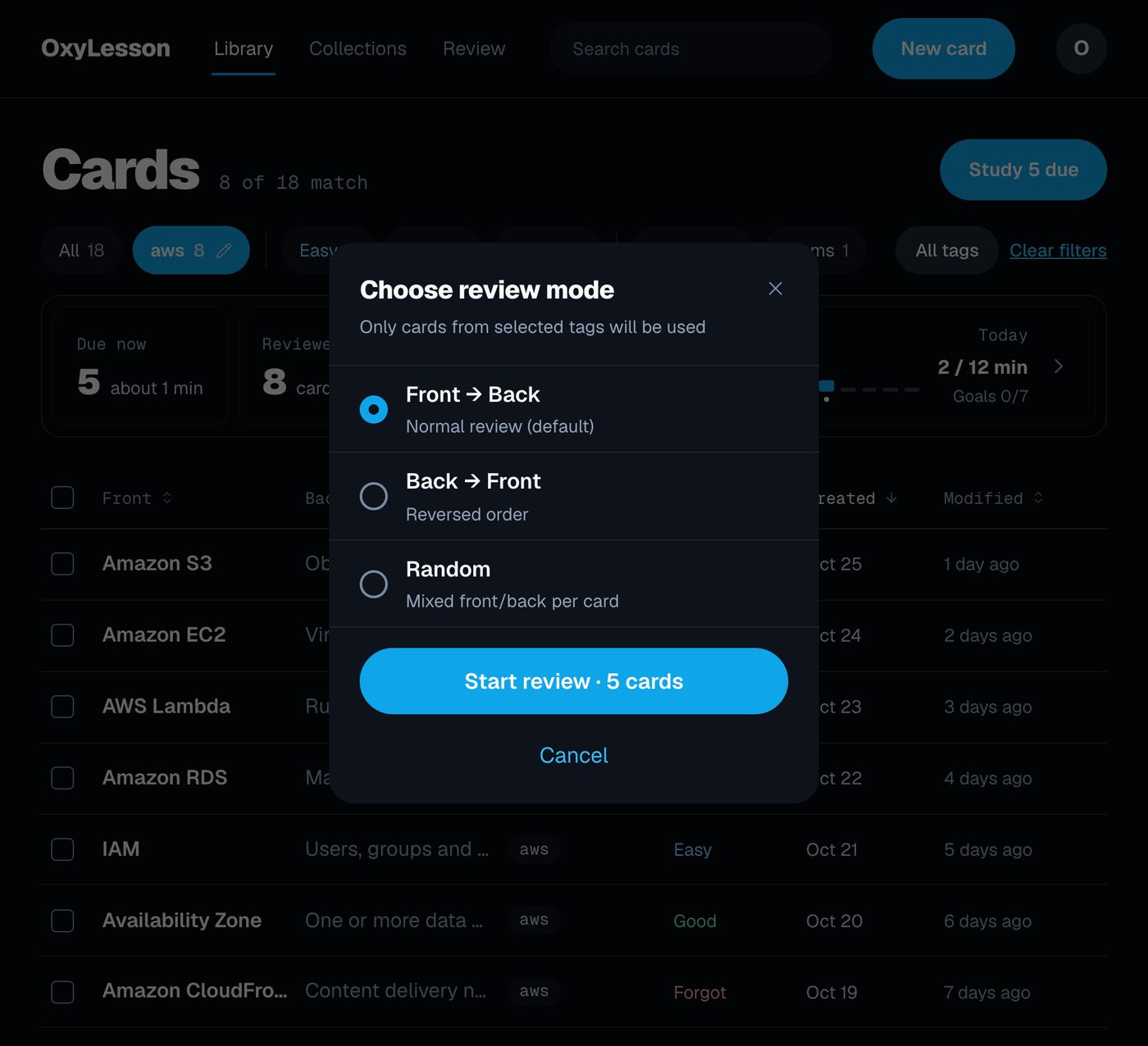
Each day, select the exam tag in the library and press Study. The Choose review mode
dialog then says Only cards from selected tags will be used
, and its Start review
button shows how many cards are due.
Keep an eye on Due now
in the stats strip at the top of the library. It counts the due cards for the current filter and estimates the time, for example about 9 min
, from your own average time per card. If that estimate keeps growing from week to week, you are adding cards faster than you can review them, so slow down while the exam is still weeks away. Is 15 minutes a day enough to learn a language? shows the daily goal and the weekly goal bars that track your minutes.
When a filtered session ends, Session done
shows a Review all due
button with a count if cards with other tags are waiting. Review them too when you have the time, since every skipped day adds to the next one.
The final week
Keep doing the daily reviews. A card that is not due yet is one the scheduler expects you to remember until its due date, and that includes exam day when the due date falls later.
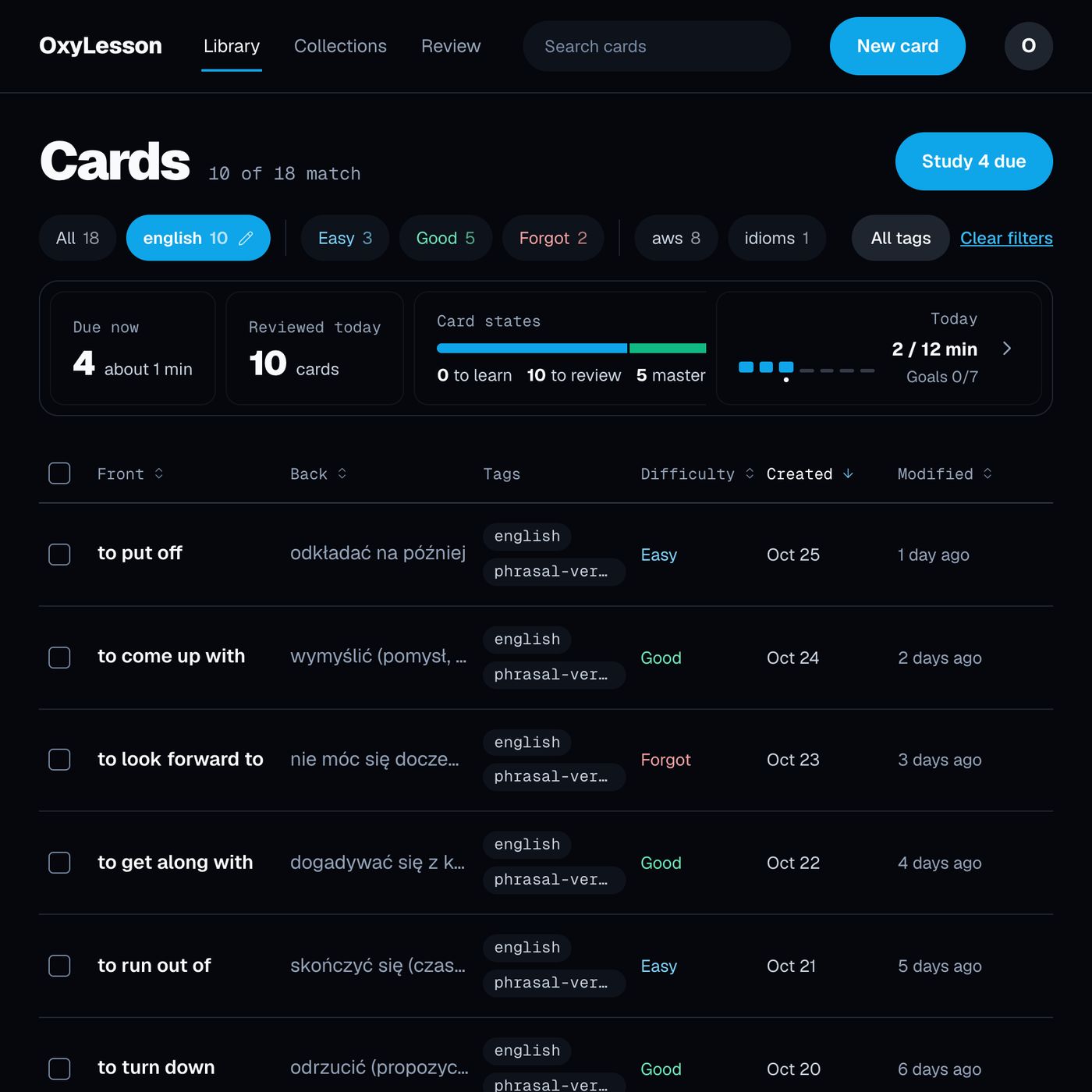
For the cards that keep failing, filter the library by the exam tag and the Forgot
chip, which groups the cards the scheduler rates hardest. The table lists the Front and Back of each card, so you can go through them.
Reading a list is weaker practice than recalling the answers, as Do flashcards really help in language learning? explains. Cover the Back column and try to answer each front before you look. When one of these cards comes due in a review, Help me understand
and Help me remember
on the answer side add a short explanation or a memory hook, and Save as note
keeps it on the card.
If you start only days before the exam, add the cards you need at once and review them on the days they come due. Each card will get fewer spaced reviews than in the studies above. For the next exam, How to learn effectively using OxyLesson shows what the first week looks like when you start early.
Sources:
- Anki Manual. Deck options, FSRS section,
Desired retention
. https://docs.ankiweb.net/deck-options.html - Cepeda, N. J., Vul, E., Rohrer, D., Wixted, J. T., & Pashler, H. (2008). Spacing effects in learning: A temporal ridgeline of optimal retention. Psychological Science, 19(11), 1095-1102. https://doi.org/10.1111/j.1467-9280.2008.02209.x
- Rawson, K. A., & Dunlosky, J. (2011). Optimizing schedules of retrieval practice for durable and efficient learning: How much is enough? Journal of Experimental Psychology: General, 140(3), 283-302. https://doi.org/10.1037/a0023956
- Rawson, K. A., Dunlosky, J., & Sciartelli, S. M. (2013). The power of successive relearning: Improving performance on course exams and long-term retention. Educational Psychology Review, 25(4), 523-548. https://doi.org/10.1007/s10648-013-9240-4
Cover photo by Ralf1403 on Pixabay.