Is 15 minutes a day enough to learn a language?
Fifteen minutes a day keeps your flashcard reviews up to date and adds up to about 91 hours a yea...
By Kamil
7 mins read

Fifteen minutes a day keeps your flashcard reviews up to date and adds up to about 91 hours a year. That is too little to reach fluency on its own, which takes hundreds of hours.
Short daily sessions are a good fit for vocabulary reviews. Listening and speaking seem to gain more from longer blocks of time. A plan that works with a small daily budget uses the daily minutes for reviews and adds a longer session once or twice a week.
What 91 hours a year buys
Fifteen minutes on each of 365 days is 5,475 minutes, or about 91 hours. For comparison, the U.S. Department of State publishes how long its Foreign Service Institute expects students to take to reach a score of 3 in speaking and listening on the Interagency Language Roundtable scale (U.S. Department of State). Languages close to English, such as Spanish, French and Dutch, take 24 to 30 weeks, which is 552 to 690 class hours. German and Indonesian take about 828 class hours. Polish, Russian, Turkish and many others take about 1,012. Arabic, Mandarin, Cantonese, Japanese and Korean take 2,200. A typical week there is 23 hours in class and 17 hours of self-study.
At 15 minutes a day, the 690 class hours for Spanish come to about seven and a half years. With the self-study added, a 30-week course is 1,200 hours, which comes to about thirteen years. The page also warns that the real time depends on the learner's ability, earlier language learning and time in class. The students are full-time adults with teachers, and the figures assume English as the first language, so read them as a rough scale for your own plans.
Why short daily sessions suit flashcards
Cepeda and colleagues pooled 839 tests of spaced study from 317 experiments, all of them verbal recall tasks. The longer you need to remember something, the larger the gap between study sessions that gave the best result (Cepeda et al., 2006). A scheduler applies this to each card. OxyLesson uses FSRS, which moves a card you remember further into the future and brings a card you forget back soon. You do not configure it.
A scheduler only works if you review the cards on the days they come due, and a short session every day does that. For more on why testing yourself with cards works, see Do flashcards really help in language learning?
Why longer blocks still matter
The spacing results come from recall tasks with verbal material, and they do not carry over to whole courses without a test. Serrano and Muñoz compared adult students in three English programs with the same 110 hours. One spread them over seven months at four hours a week, one over three to four months at eight to ten hours a week, and one over five weeks at 25 hours a week. Concentrating the hours in a shorter period worked better for the students' learning than spreading them over many months (Serrano & Muñoz, 2007).
The study measured class hours, so it says nothing about flashcards, but it suggests that listening, speaking and reading gain from time in one piece. Keep the 15 minutes for reviews, and book one or two longer blocks a week for a film, a conversation or a chapter. New words from those blocks can become cards. Breaking the advanced English barrier shows how to turn a film's subtitles into cards.
Setting the goal in OxyLesson
The first step of onboarding is Set your daily goal
, where you pick how many minutes a day you want to study. You can change it later on the Account page, in the Study section, under Daily learning goal
. The Time zone
field there sets when your day starts for the daily goal, the streak and the week.
The goal counts review time only. For each card, the app counts the time the review page is visible, with a cap per card, and pauses while you are in another tab or app. Writing cards or reading notes in the card form does not count, so a 15-minute goal is 15 minutes of answering cards.
Before you start, look at Due now
in the library. Next to the number of due cards it shows an estimate such as about 9 min
, based on your own average time per card. If that estimate grows past your goal day after day, you are adding new cards faster than your daily minutes can review them. Add fewer for a week, as How to learn effectively using OxyLesson explains.
What the screens show
When a grade takes you past your goal, a small Daily goal achieved
notice appears with the minutes and cards for the day. It ends with Goal 2 starts now
and your goal length, so you can keep going and complete the goal a second time. The second one reads Goal 2 achieved
.
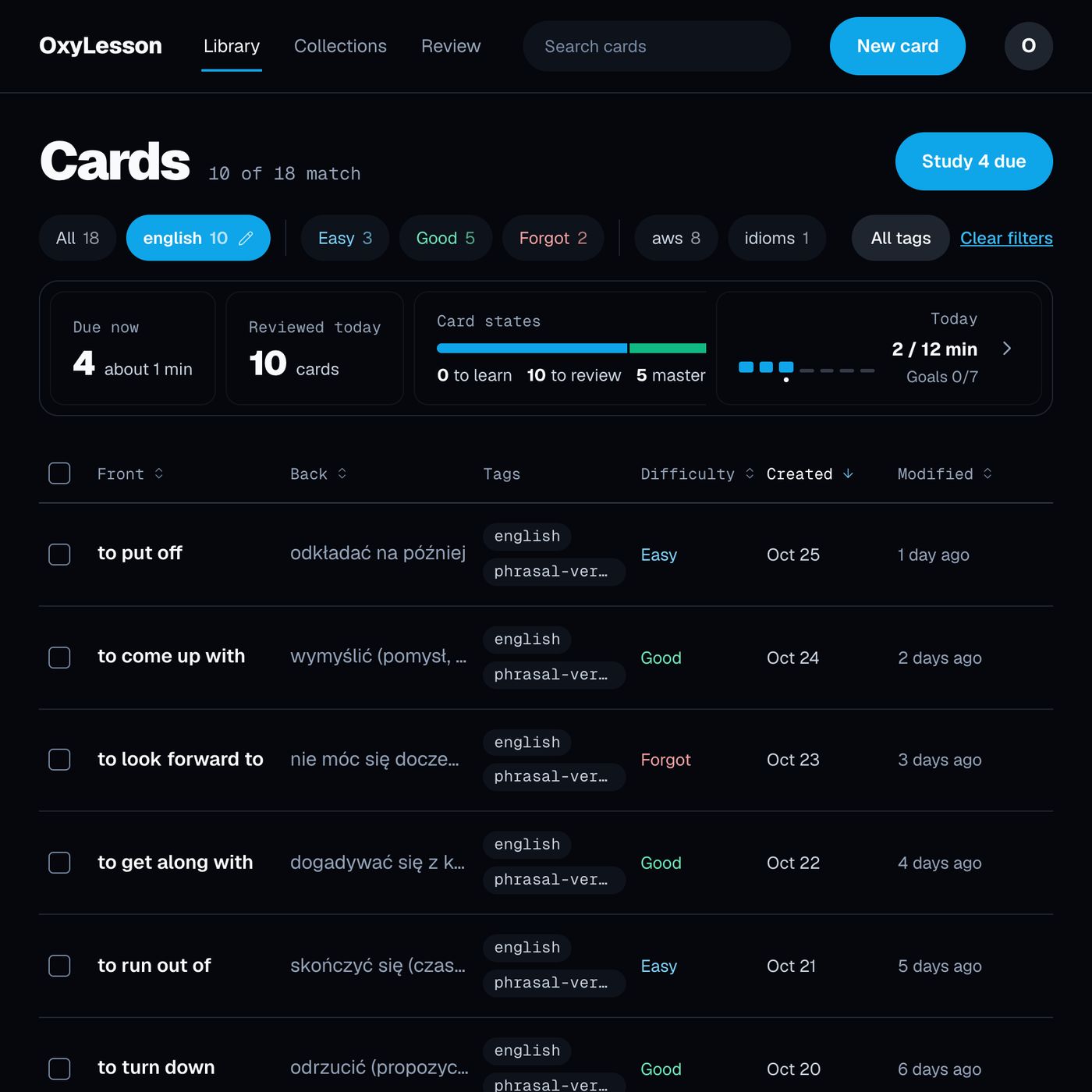
On a computer, the stats strip at the top of the library ends with the week from Monday to Sunday. Each bar fills toward today's goal and turns green when the goal is met, a 2×
mark sits above a day with two goals met, and a dot marks today. Next to the bars you see Today
with minutes against the goal and Goals
met out of 7. Clicking the strip opens Statistics
, where the This week
chart shows the minutes for each day and Goals met
for the week. On a phone, the summary bar under the search opens the same dialog.
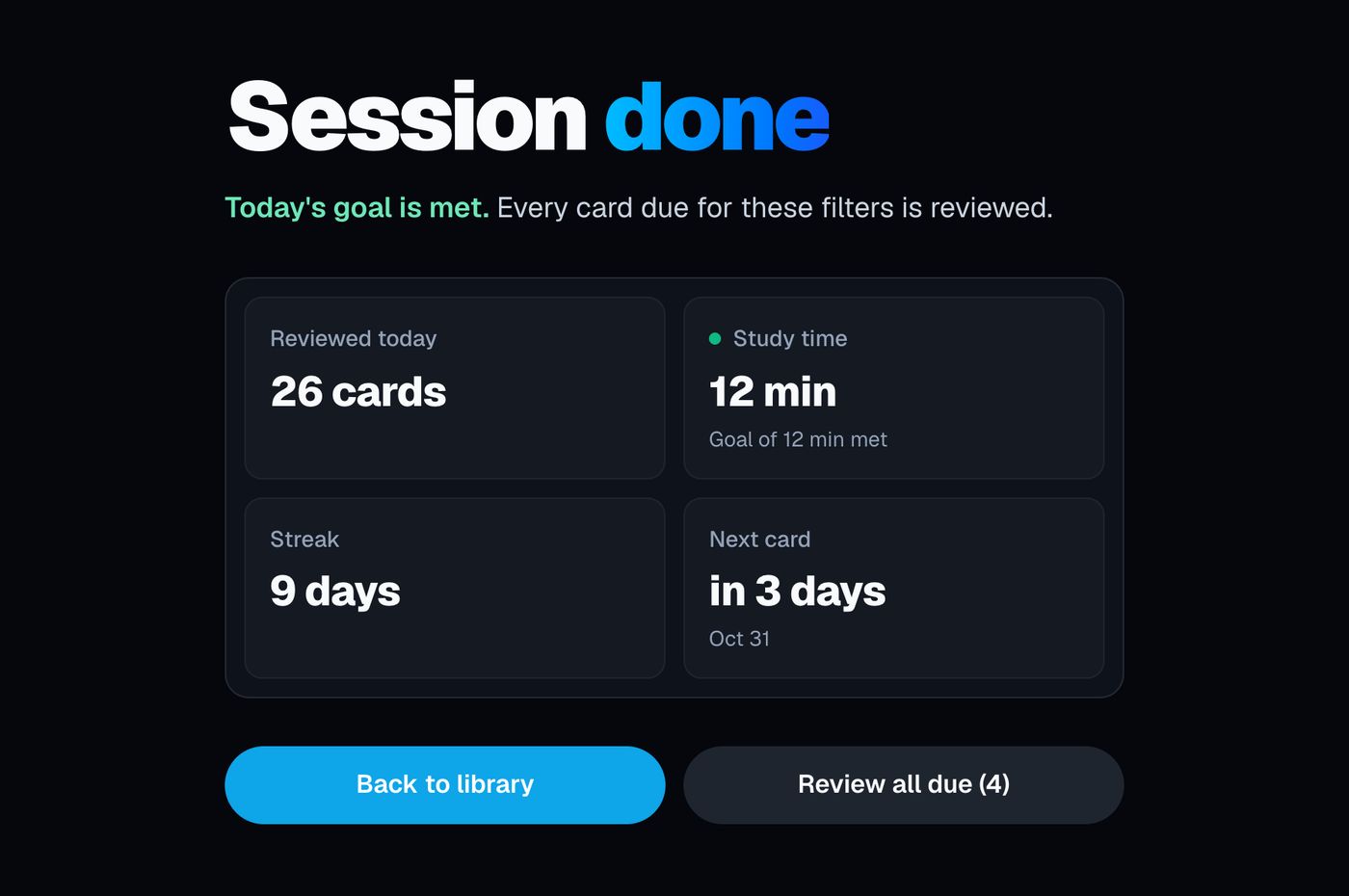
When you finish every due card, Session done
shows four numbers: Reviewed today
, Study time
against your goal, Streak
and Next card
.
Missed days and the streak
The streak counts days in a row with at least one review. A day without any review starts it again from zero, and Statistics
still shows your longest streak.
Lally and colleagues followed 96 volunteers who chose one eating, drinking or activity behaviour to repeat daily in the same situation, for example after breakfast, for 12 weeks. Reaching 95% of their own plateau of automaticity took between 18 and 254 days, and missing one chance to do the behaviour did not materially affect the process (Lally et al., 2010). A single figure such as the often repeated 21 days hides that spread.
For daily reviews, that means tying them to one fixed moment, such as the bus ride or the coffee after lunch, since the volunteers repeated their behaviour in the same situation. On a bad day, a few cards keep the streak, and the goal can wait for tomorrow. If you miss a day, the app resets a counter. Your cards keep their schedules, and the ones that came due are waiting in Due now
.
Sources:
- Cepeda, N. J., Pashler, H., Vul, E., Wixted, J. T., & Rohrer, D. (2006). Distributed practice in verbal recall tasks: A review and quantitative synthesis. Psychological Bulletin, 132(3), 354-380. https://doi.org/10.1037/0033-2909.132.3.354
- Lally, P., van Jaarsveld, C. H. M., Potts, H. W. W., & Wardle, J. (2010). How are habits formed: Modelling habit formation in the real world. European Journal of Social Psychology, 40(6), 998-1009. https://doi.org/10.1002/ejsp.674
- Serrano, R., & Muñoz, C. (2007). Same hours, different time distribution: Any difference in EFL? System, 35(3), 305-321. https://doi.org/10.1016/j.system.2007.02.001
- U.S. Department of State. Foreign Language Training, National Foreign Affairs Training Center. https://www.state.gov/national-foreign-affairs-training-center/foreign-language-training
Cover photo by Nile on Pixabay.