How to create effective flashcards: rules for cards you will remember
An effective flashcard asks for one fact you understand, in words short enough to answer in a few...
By Kamil
Updated
5 mins read

An effective flashcard asks for one fact you understand, in words short enough to answer in a few seconds. Most cards that keep coming back as Forgot
break that rule: they ask for a list, a paragraph, or something you memorized without understanding it.
The rules below come from Piotr Wozniak's Twenty rules of formulating knowledge
, written in 1999 by the creator of the SuperMemo algorithm (Wozniak, 1999). Each one is shown with the OxyLesson card type that fits it.
Understand first, then write the card
Wozniak's first two rules are Do not learn if you do not understand
and Learn before you memorize
. A card cannot give you understanding; it can only keep what you already understood. Read the chapter, work through the example, then write cards for the facts you want to keep. If a card's answer means nothing to you, rewrite it or delete it.
One fact per card
Rule 4 is the minimum information principle: formulate the material as simply as possible. Wozniak adds that simplicity does not have to mean skipping the difficult part; you split it into smaller cards instead.
A card like this is hard to grade:
Front: What is the TCP three-way handshake?
Back: The client sends SYN, the server answers SYN-ACK, the client sends ACK, and the connection is open.
You remember two of the three steps, and neither Good
nor Forgot
is the honest grade. Split it into three cards (What does the client send first?
, What does the server answer?
, What does the client send to finish?
) and each one has a clear right answer.
Use cloze for sentences and definitions
Rule 5 says cloze deletion is easy and effective: you take a sentence and hide part of it. In OxyLesson, choose the Cloze type and wrap the hidden part in double braces:
The mitochondrion produces {{c1::ATP}} through {{c2::cellular respiration}}.
Each number becomes its own card, so this one sentence gives two cards, each with one blank. During the review the hidden word is shown highlighted once you reveal the answer:
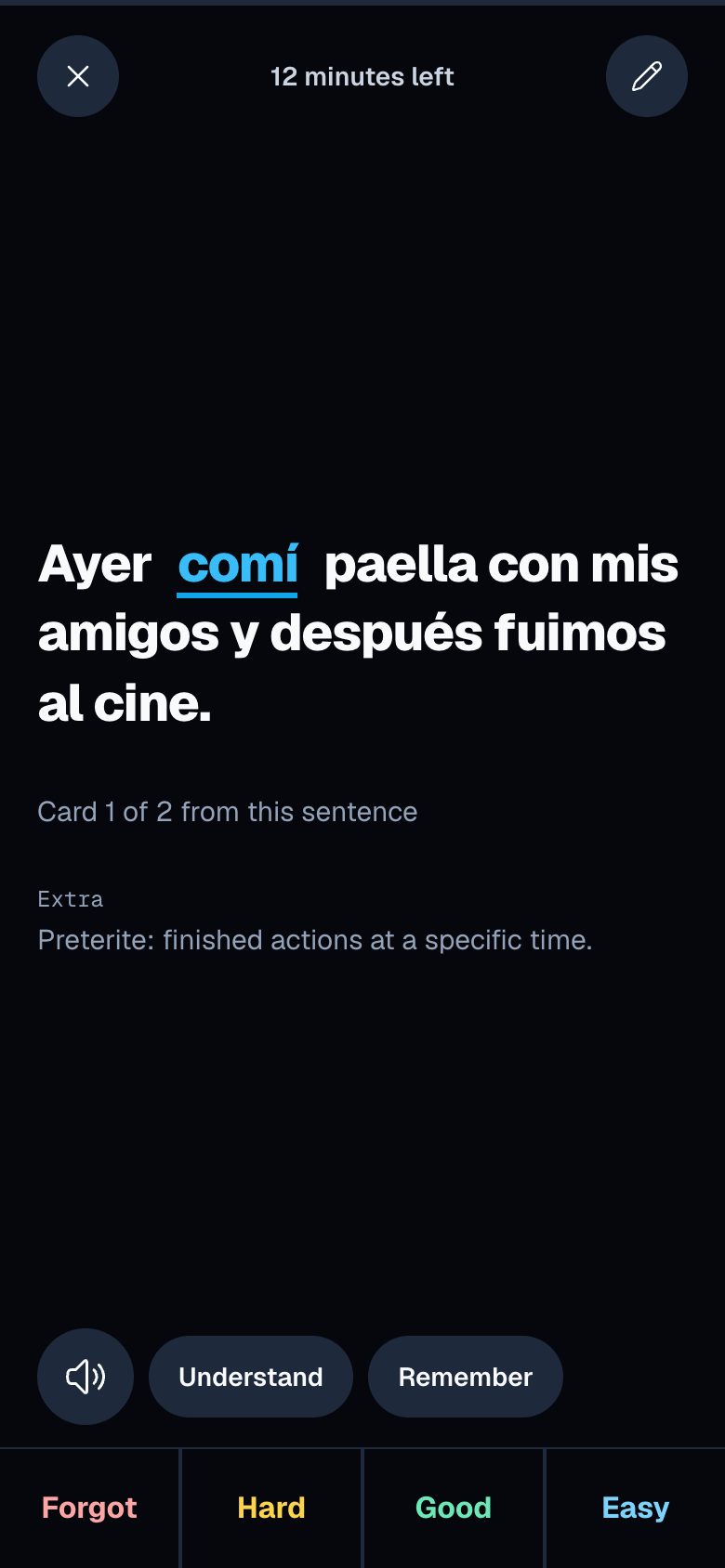
Add a hint after a second pair of colons, as in {{c1::ATP::a molecule}}, when the blank alone is ambiguous. If you are not sure what to hide, Suggest blanks with AI
proposes words, and you accept or skip each one.
Cloze cards are also the fix for vocabulary out of context. Instead of deposit
on the front and a translation on the back, as in OxyLesson's Car Rental collection, make one card from a sentence you might actually say at the counter: I'd like my {{c1::deposit}} back, please.
Avoid lists and sets
Rules 9 and 10 are Avoid sets
and Avoid enumerations
. A card that asks for the seven layers of the OSI model
fails as soon as you forget one layer, and you cannot tell which one. Turn the list into one cloze note with a number per item:
OSI layers from the bottom: {{c1::Physical}}, {{c2::Data link}}, {{c3::Network}}, {{c4::Transport}}, {{c5::Session}}, {{c6::Presentation}}, {{c7::Application}}.
You get seven cards. Each one shows the whole list with one gap, so you learn the order as well as the names.
Use pictures for things you can see
Rule 6 is Use imagery
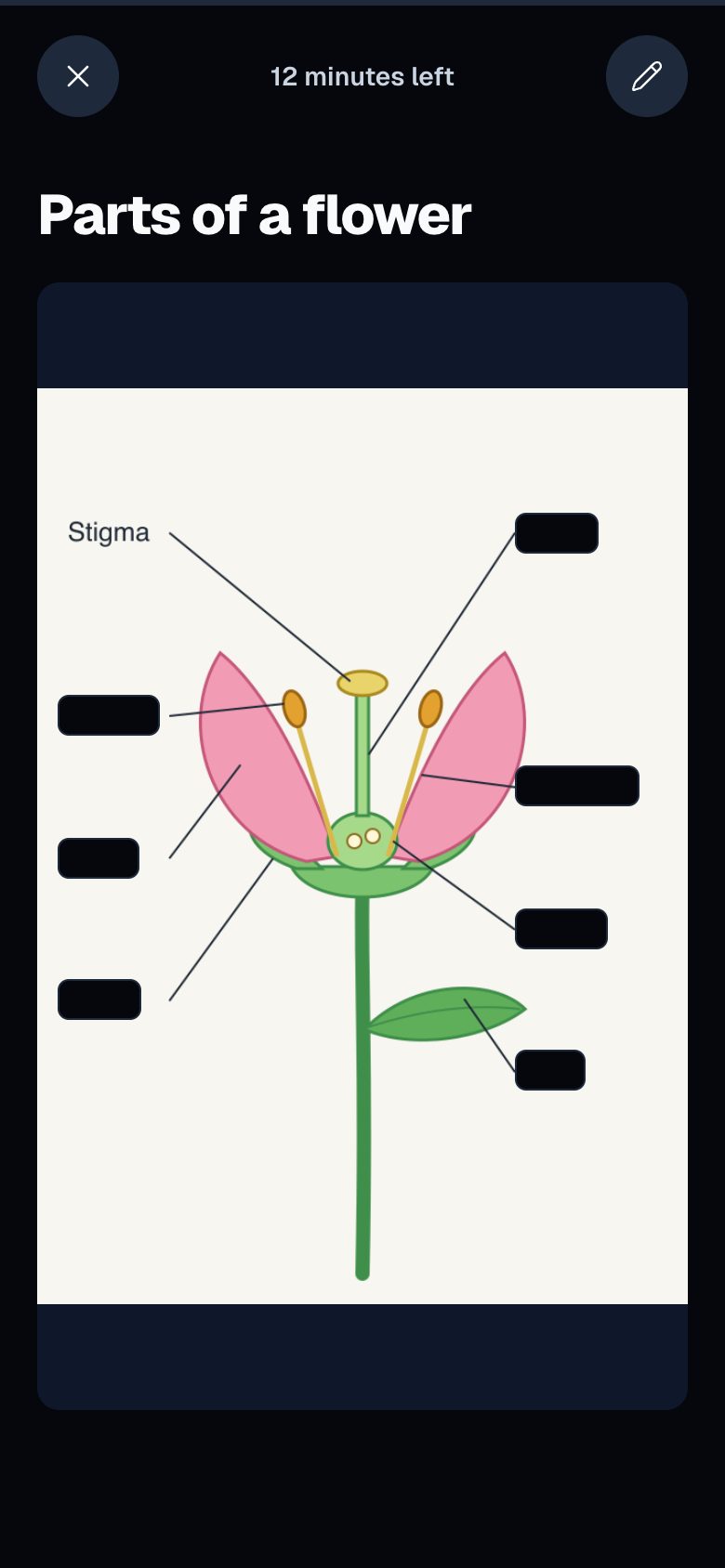
. For anatomy, maps, diagrams and the parts of a machine, a picture asks the question better than words. OxyLesson's image occlusion lets you upload an image and draw masks over the labels you want to learn. During the review the labels stay covered, and you name them before you reveal the answer:
For concrete nouns in a foreign language, Search library
in the card form finds a photo, which saves you writing a translation for words like wheelbarrow.
Mark the word that matters
In a long front side, it is not always clear what the card asks about. Select the word the card is about and press the Highlight button, or Cmd/Ctrl+U. The word is underlined during reviews, so you know where to look.
Organize with tags, not giant decks
OxyLesson has no separate decks; every card lives in one library and carries tags. Tag by topic and by source, for example aws-iam and practice-exam-2, and you can start a review for one tag or a mix of them. A card can carry several tags, so the same card shows up when you study the topic and when you revise the source.
Check your cards after a week
The library's difficulty chips (New, Easy, Good, Forgot) show where cards stand. Filter by Forgot
once a week and read those cards. Most of them break one of the rules above: two facts on one card, a list, a word with no context.
Source: Wozniak, P. (1999, updated). Effective learning: Twenty rules of formulating knowledge. SuperMemo. https://www.supermemo.com/en/blog/twenty-rules-of-formulating-knowledge