How do you practise Cambridge word formation and key word transformations with flashcards?
Write each form of a word family into its own cloze sentence, with the base word as the hint. For...
By Kamil
7 mins read

Write each form of a word family into its own cloze sentence, with the base word as the hint. For key word transformations, put both sentences on the card and give the key word as the hint.
Both card types make you produce the missing words from a prompt, which is what the two exam tasks ask for. This magazine is not affiliated with Cambridge English, and every example sentence below was written for this post.
What the two tasks ask
On Cambridge English's B2 First exam format page, the word formation part is a text with gaps, and each line ends with a prompt
word that you change to make the missing word. The page says the part tests word-building: the different words you can make from one base word. Its own list of examples includes a negative form with un-, so the answer is not always a plain noun or adjective.
The key word transformation part gives you a sentence, a key word and a second sentence with a gap. You use the key word to complete the second sentence so that it means the same as the first. The C1 Advanced format page describes the same task and sets the answer at three to six words. The B2 First page gives no word limit, so check the official handbook for your exam before you practise.
Why the word family needs its own practice
Knowing stimulate does not mean you can produce stimulant. Schmitt and Zimmerman (2002) asked 106 graduate and undergraduate students who were not native speakers of English to produce the noun, verb, adjective and adverb forms of 16 prompt words. Few students knew all four forms of a word, and few knew none. Most knew two or three. Noun and verb forms grew with overall knowledge of the word, but adjective and adverb forms were harder. The authors concluded that derived forms may need direct teaching.
Sasao and Webb (2017) built a test of English affix knowledge with three parts: form (recognising the affix), meaning (what it adds) and use (what word class it makes). Word formation tests the third part most. To fill a gap, you need the suffix that turns create into the noun or the adverb the sentence needs.
Bauer and Nation (1993) arranged English affixes into a graded set of seven levels. They used frequency, regularity, productivity and predictability as the criteria. For an exam learner, that means some forms follow a regular pattern and others change the spelling of the base word, like pronounce and pronunciation. Give those irregular forms a card of their own.
A word family as cloze cards
In OxyLesson, open the card form and switch to Cloze. Type a sentence, select the derived word and press Blank selected text
(Cmd+Shift+B on a Mac, Ctrl+Shift+B elsewhere). Click the blank to open its popover, and type the base word in capitals in Hint
. These are example cards for one family:
Her {{c1::creativity::CREATE}} impressed the judges.
The {{c1::creators::CREATE}} of the show answered questions after the screening.
The second album sounded tired and {{c1::uncreative::CREATE}}.
She solved the problem {{c1::creatively::CREATE}}, with tape and a coat hanger.
On the question side, OxyLesson shows an empty box where the word was, with CREATE in small letters under it. That is close to the exam layout, where each gap comes with a prompt word you must change. On the answer side, the word appears in place and is underlined.
Put the whole family in Extra on the back
, for example create (v), creation, creator, creativity (n), creative, uncreative (adj), creatively (adv). It shows on the answer side, so you only read it after you try the gap.
Keep one form per sentence. If one sentence held creators and creativity as blanks 1 and 2, the card for blank 1 would show creativity in the text, and that gives away the stem and part of the answer.
To write the rest of the family quickly, turn on Freeze
next to Extra on the back
and next to Tags, then use Save and add next
. The next card keeps the family list and the tags, and you type only the new sentence.
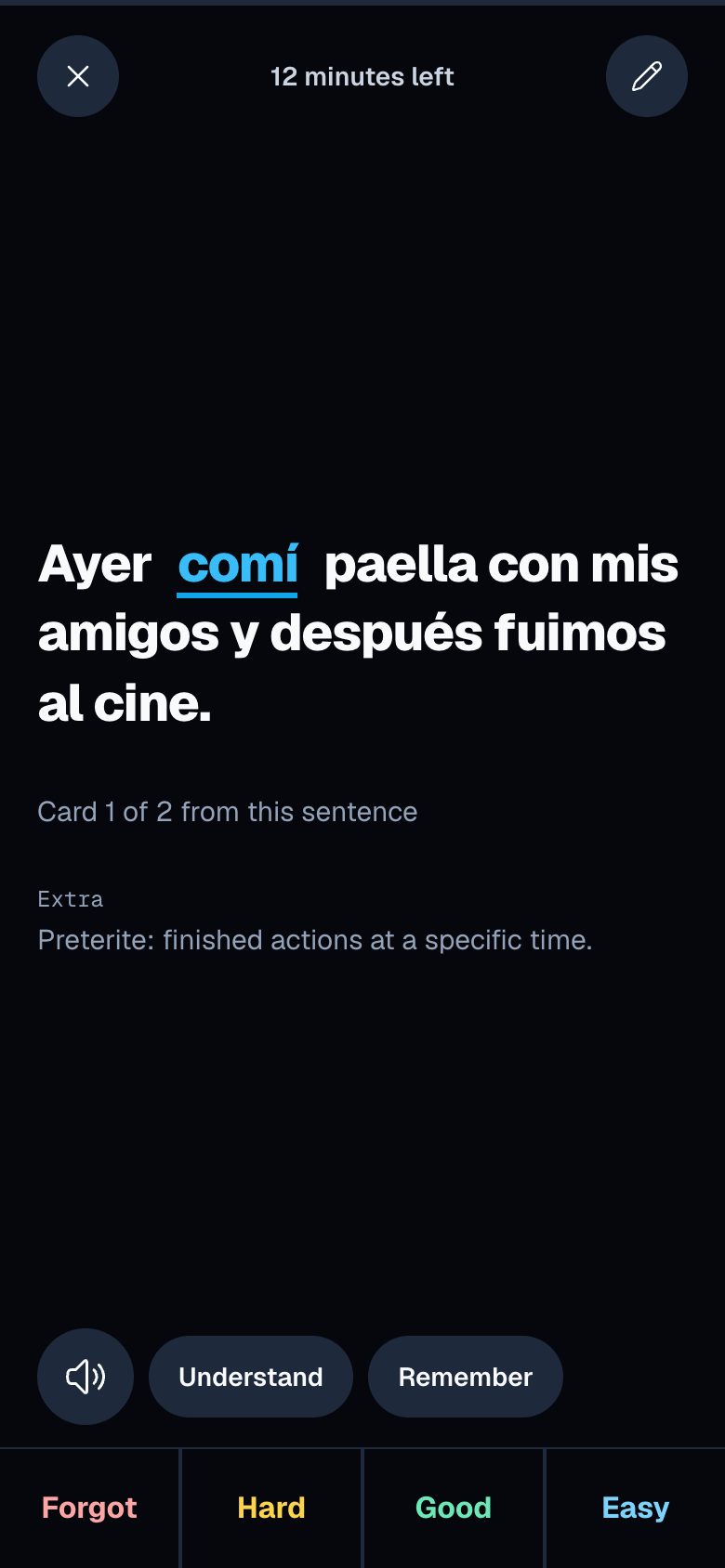
Suggest blanks with AI
can help when you paste a sentence from a reading text. It proposes single words worth hiding, each with a short reason, and you choose Make blank
or Skip
for each one. It does not add a hint to the blank, so you type the base word in Hint
yourself.
A key word transformation as a cloze card
A cloze text can run over two lines, so the first sentence can sit above the gap. The hint carries the key word. An example card:
Getting up early is still hard for me.
I {{c1::am not used to getting::USED}} up early.
The question shows the first sentence and the second one with a box and USED under it. On the answer side you see both sentences complete. Count the words in your answer against the limit for your level. Change the subject or the tense of the first sentence and you have a second card that tests the same structure, for example {{c1::wasn't used to getting::USED}} for a past situation.
Some transformations can be answered in more than one correct way, and a flashcard shows only the answer you wrote. If your version is different, check whether it keeps the meaning and still uses the key word. If you are unsure, ask a teacher.
How to grade
Press Forgot
when you wrote the wrong form, even if it was the right word family: creative in a gap that needs creativity is a wrong answer. Press Hard
for the right form that took effort, and Good
when it came at once. Treat a misspelled answer as Forgot
too.
Each blank number is its own card with its own schedule, and FSRS brings each one back on its own timetable. If you keep missing the adverb but know the noun, only the adverb card comes back often. Cloze cards always show the gap first, also in Back → Front
and Random
mode.
Practise one task at a time
Tag the cards by task, for example b2-word-formation and b2-transformation. In the Library, click a tag chip, then click Study. The dialog says Only cards from selected tags will be used
. The difficulty chips next to the tags filter the list too: Forgot
shows the forms you missed last time.
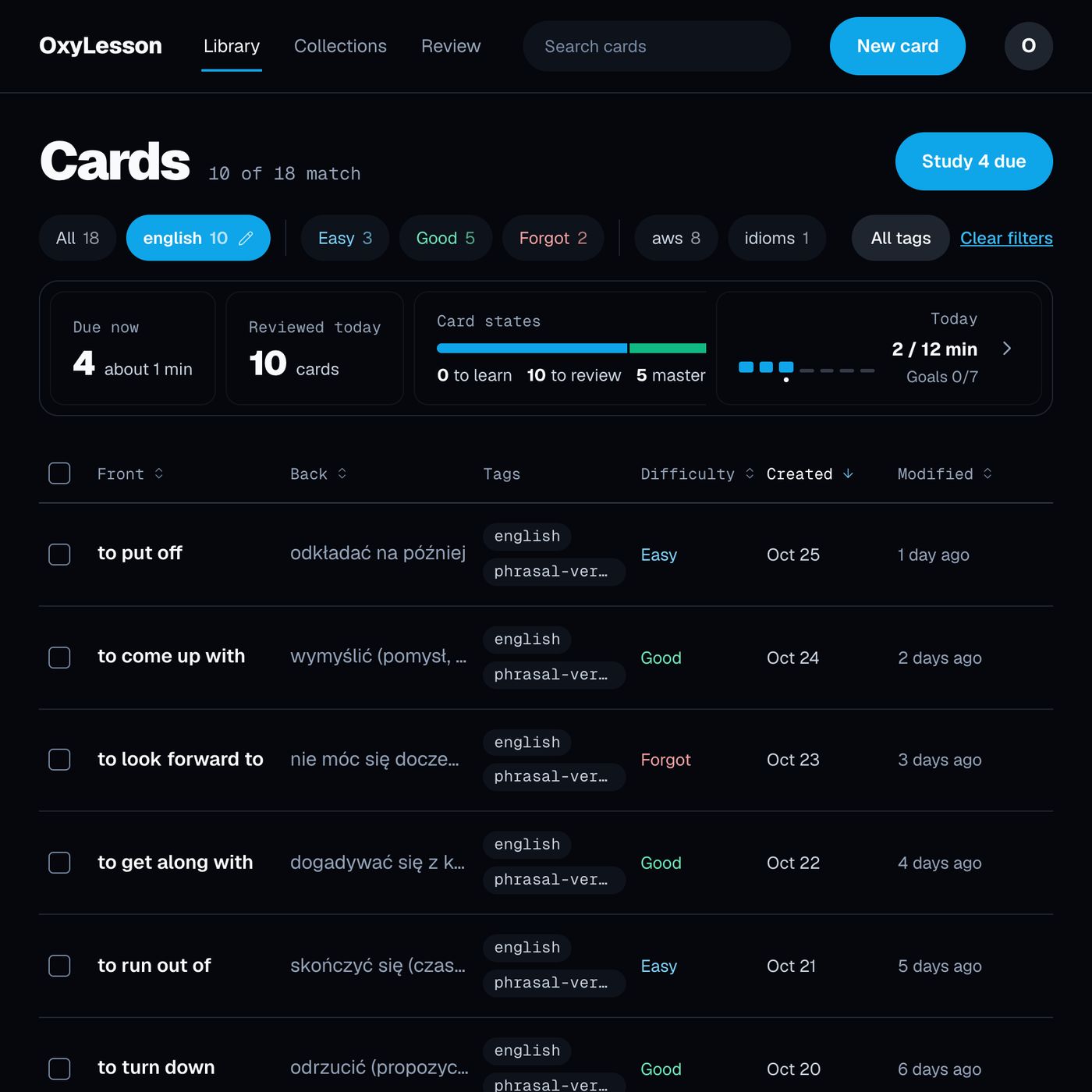
A review shows only cards that are due. OxyLesson has no study-ahead mode and no exam-date setting, so start adding families and transformations several weeks before the exam and review daily.
For more on putting one grammar form per card, see can you learn grammar with flashcards. Key word transformations also test collocation, which learn words or phrases covers. For the basics of cloze cards, see how to create effective flashcards.
Sources:
- Bauer, L., & Nation, P. (1993). Word families. International Journal of Lexicography, 6(4), 253-279. https://doi.org/10.1093/ijl/6.4.253
- Cambridge English. B2 First for Schools and B2 First exam format. https://www.cambridgeenglish.org/exams-and-tests/qualifications/first/format/
- Cambridge English. C1 Advanced exam format. https://www.cambridgeenglish.org/exams-and-tests/qualifications/advanced/format/
- Sasao, Y., & Webb, S. (2017). The Word Part Levels Test. Language Teaching Research, 21(1), 12-30. https://doi.org/10.1177/1362168815586083
- Schmitt, N., & Zimmerman, C. B. (2002). Derivative word forms: What do learners know? TESOL Quarterly, 36(2), 145-171. https://doi.org/10.2307/3588328
Cover photo by alexxxis on Pixabay.