Can you forget a language you learned, and how do you get it back?
Yes, an unused language fades, but much of it stays stored, and relearning it is faster than lear...
By Kamil
8 mins read
Yes, an unused language fades, but much of it stays stored, and relearning it is faster than learning it was. Start again with a small daily batch and let your recall set the order.
Studies of school languages, childhood languages and word lists learned in a lab agree that a lot survives. They disagree about a language you used only as a small child, and that question is still open.
What happens to a language you stop using
The largest study of a school language is Harry Bahrick's. He tested 733 people who had learned Spanish at school up to 50 years earlier, and most of them had used it so little since that their practice made no measurable difference. Their knowledge dropped quickly for the first three to six years. Then it stayed stable for up to 30 years before a final decline. Bahrick called that stable stage permastore
: large parts of what people had learned were still there after decades without use. How much they kept depended mainly on how well they had learned Spanish in the first place (Bahrick, 1984).
Why relearning goes faster
In 1885 Hermann Ebbinghaus measured memory with a method that still matters for anyone coming back to a language. He learned lists of nonsense syllables, waited, and timed how long it took to learn the same list again. The time he saved was his measure of what remained. After 31 days he still saved about a fifth of the original work (Ebbinghaus, 1885).
Kees de Bot and Saskia Stoessel used the same savings idea on a real language. They studied two German speakers who had learned Dutch as children and had not used it for about 30 years. Some Dutch vocabulary was still there, including words with no German look-alike. The authors also point out how hard it is to tell real memory apart from good guessing strategies, and with two people the study is a case report that shows what is possible (de Bot & Stoessel, 2000).
How you space the relearning matters too. Bahrick and three co-authors followed four people who learned and relearned 300 foreign words over nine years. Longer gaps between sessions made relearning a little slower at first and gave better retention later. Thirteen sessions 56 days apart kept about as much as 26 sessions 14 days apart (Bahrick et al., 1993).
Childhood languages: the evidence is mixed
People adopted abroad as small children are the hardest test case, because they stopped hearing their first language almost completely.
Pallier and colleagues tested adults born in Korea and adopted by French families in childhood. They spoke French fluently and reported no memory of Korean. On tests of Korean they did no better than native French speakers who had never learned it. Brain scans while they listened to Korean showed no response that set Korean apart from other unfamiliar languages (Pallier et al., 2003).
Choi, Broersma and Cutler asked whether a forgotten birth language makes relearning easier. They gave 29 Dutch adults adopted from Korea, and 29 matched Dutch controls, short intensive training on Korean consonant contrasts that Dutch does not have. The adoptees learned the contrasts faster. Those adopted at 3 to 5 months did as well as those adopted at 17 months or older (Choi et al., 2017a). In a second study, the adoptees' pronunciation of a Korean contrast also improved more than the controls' after the same kind of training (Choi et al., 2017b).
The two teams measured different things. Pallier's team tested what adoptees could do without practice, and Choi's team tested how fast they relearned. One possible reading is that a trace too weak to show on a test can still speed up relearning, which is what savings measures. Neither study tested that directly. The groups were small, and both studies are about sounds learned in infancy. For the school French you dropped at eighteen, Bahrick's data is the closer guide.
Getting it back in OxyLesson
Start with the material you already have. On the Import cards
page, Upload file
takes .csv, .txt and .apkg files. From an old Anki deck, each note becomes a card with its text and its Anki tags, cloze notes stay cloze cards, and the file name becomes one more tag. Images and audio are not imported. A word list from school can be pasted one card per line in the format front;back;notes;tag1,tag2. Here are three example lines written for this article:
la biblioteca;the library;;school-spanish
el ayuntamiento;the town hall;;school-spanish
quedar con alguien;to arrange to meet someone;;school-spanish
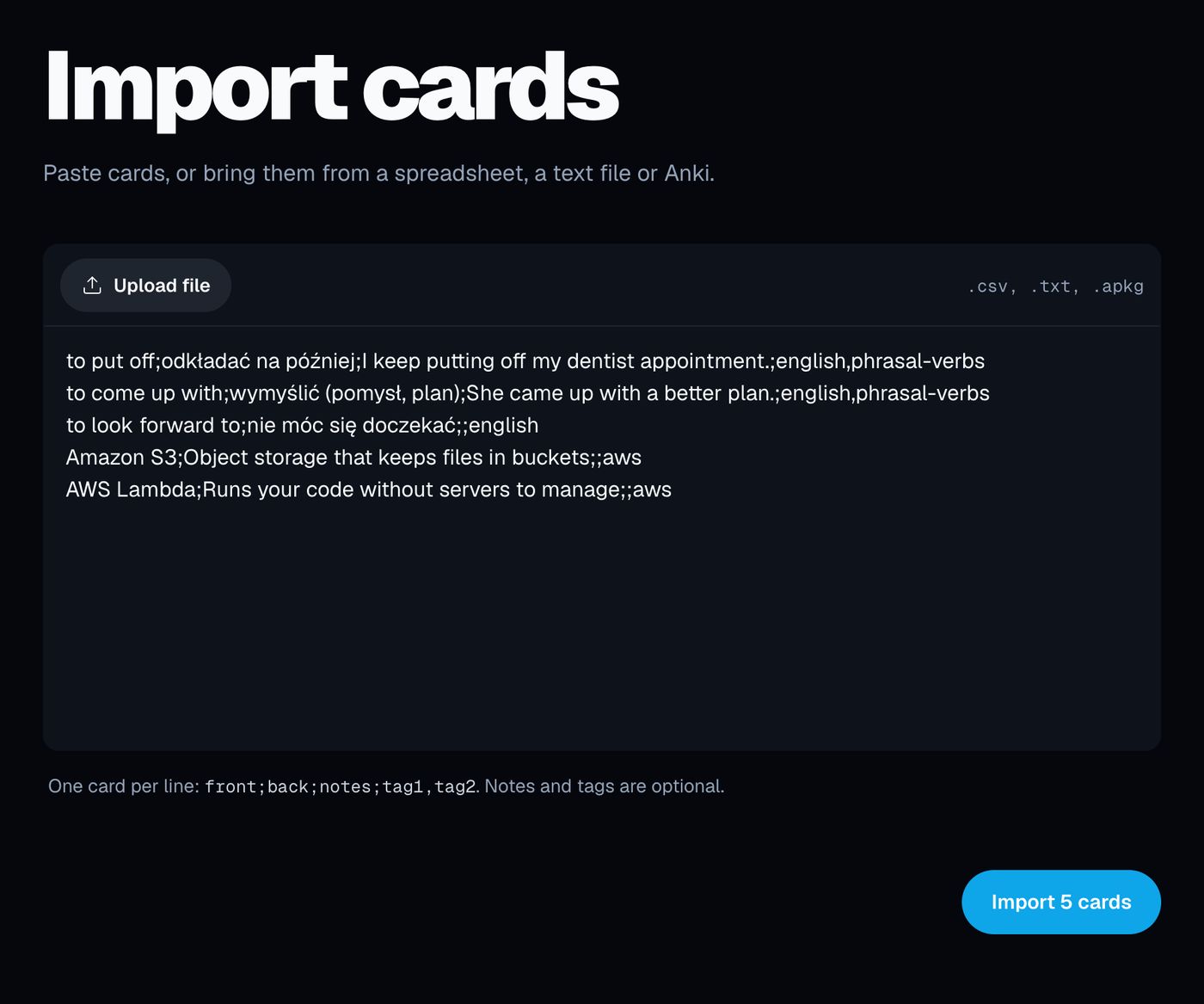
The import reads only the text and tags of your Anki notes. The review history stays in Anki, so every card starts as New and is due right away. That helps a comeback, because your old intervals describe someone who used the language every week, and the scheduler can now learn what you know today. After the import, the library opens filtered by the imported tags.
OxyLesson has no daily cap on new cards, so an import of 2,000 old cards puts all 2,000 in front of you. Make the batch small yourself. Press Study
, work through as many cards as fit your day, and stop. The cards you did not reach stay New and wait. The Today
panel above the card list shows your minutes against your daily goal, which is a simple way to set the size.
The next day, review what came back before you add more. In the library, select the Easy, Good and Forgot chips; a card matching any selected chip is included, so every card you have already seen is in and the New ones are out. Press Study
. When Session done
appears, select the New chip instead and add another handful.
Grade what your memory does now. Press Easy
when a word comes back at once, Good
when it comes after a moment, Hard
when you get it slowly or only in part, and Forgot
when it is gone. FSRS, the scheduler OxyLesson uses, sends an Easy card further out than a Good one, and there is nothing to configure. If Bahrick's permastore applies to you, many old words will come back at once. Honest Easy
grades move them out of the way, so your time goes to what was lost.
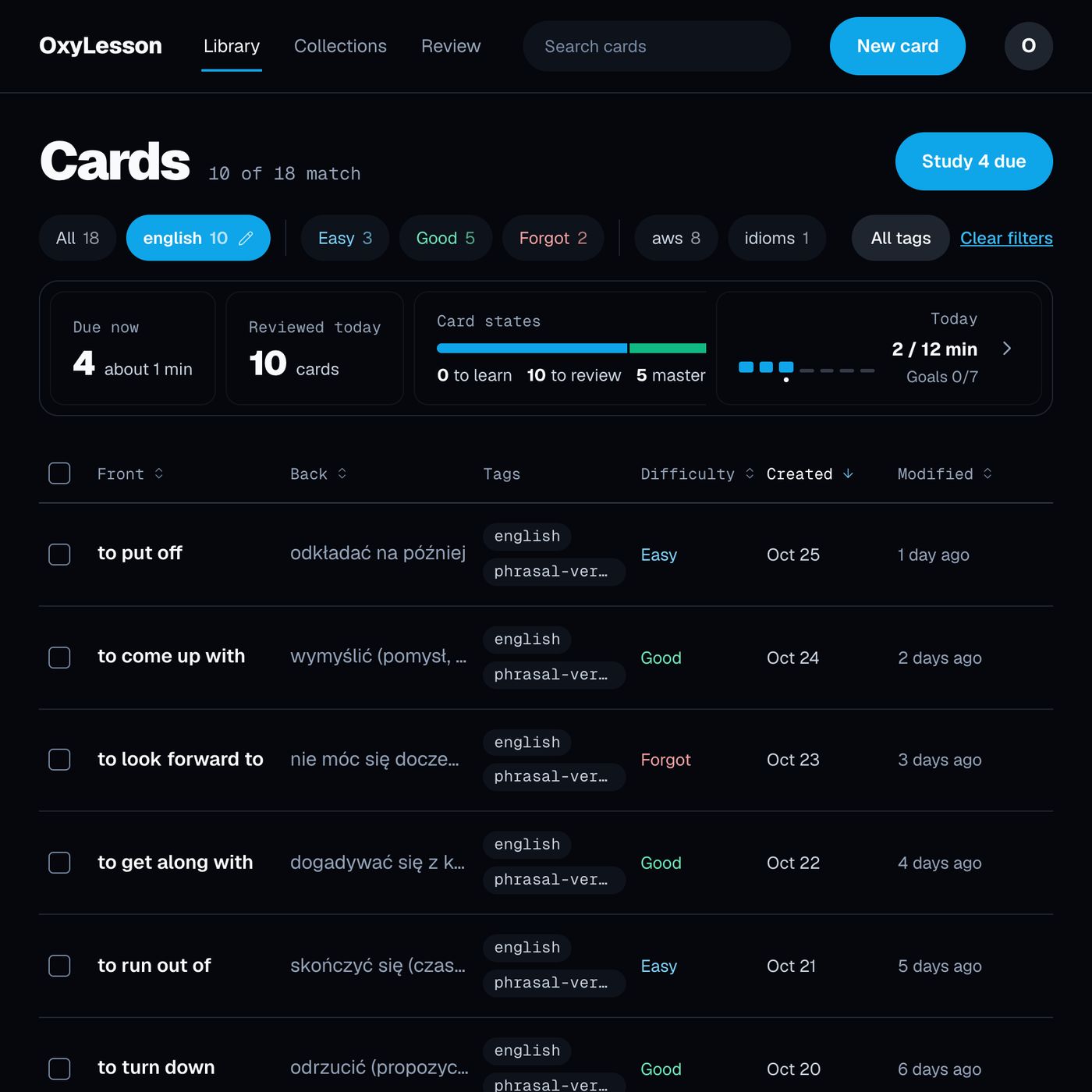
The difficulty chips group cards by the difficulty the scheduler has worked out for each one, so the words you keep missing gather under Forgot. Select your old deck's tag and the Forgot chip to drill only those. For a word that will not stick, Help me remember
on the review answer asks the AI for one association that links the front to the back, and Save as note
keeps it in the card's note after you edit it. Do memory tricks work for vocabulary? covers when that kind of trick helps.
Plan for months of review. In the 1993 study, widely spaced sessions gave the best retention, and FSRS spreads the intervals out as your grades improve. For a whole study week in the app, see how to learn effectively using OxyLesson, and for the research on flashcards in general, do flashcards really help in language learning?
Sources:
- Bahrick, H. P. (1984). Semantic memory content in permastore: Fifty years of memory for Spanish learned in school. Journal of Experimental Psychology: General, 113(1), 1-29. https://doi.org/10.1037/0096-3445.113.1.1
- Bahrick, H. P., Bahrick, L. E., Bahrick, A. S., & Bahrick, P. E. (1993). Maintenance of foreign language vocabulary and the spacing effect. Psychological Science, 4(5), 316-321. https://doi.org/10.1111/j.1467-9280.1993.tb00571.x
- Choi, J., Broersma, M., & Cutler, A. (2017a). Early phonology revealed by international adoptees' birth language retention. Proceedings of the National Academy of Sciences, 114(28), 7307-7312. https://doi.org/10.1073/pnas.1706405114
- Choi, J., Cutler, A., & Broersma, M. (2017b). Early development of abstract language knowledge: Evidence from perception-production transfer of birth-language memory. Royal Society Open Science, 4(1), 160660. https://doi.org/10.1098/rsos.160660
- de Bot, K., & Stoessel, S. (2000). In search of yesterday's words: Reactivating a long-forgotten language. Applied Linguistics, 21(3), 333-353. https://doi.org/10.1093/applin/21.3.333
- Ebbinghaus, H. (1913). Memory: A contribution to experimental psychology (H. A. Ruger & C. E. Bussenius, Trans.). Teachers College, Columbia University. (Original work published 1885.) No DOI; full text at https://psychclassics.yorku.ca/Ebbinghaus/index.htm
- Pallier, C., Dehaene, S., Poline, J. B., LeBihan, D., Argenti, A. M., Dupoux, E., & Mehler, J. (2003). Brain imaging of language plasticity in adopted adults: Can a second language replace the first? Cerebral Cortex, 13(2), 155-161. https://doi.org/10.1093/cercor/13.2.155
Cover photo by cocoparisienne on Pixabay.