Should you review one exam domain at a time or mix them?
Learn each exam domain on its own while you build its cards, then mix all the domains in your rev...
By Kamil
8 mins read

Learn each exam domain on its own while you build its cards, then mix all the domains in your reviews. Mixing makes you tell similar ideas apart, and scenario questions test exactly that.
Blocked and mixed study
Blocked study means you finish one kind of material before you start the next: all the threat cards, then all the architecture cards. Mixed study, which researchers call interleaving, shuffles them so that cards from different domains follow each other in one session.
Most of this research uses paintings, picture categories or maths problems, and none of the studies below used flashcards for a certification exam. I mark where I apply their findings to exam cards.
What the studies found
Kornell and Bjork showed people paintings by several artists, either grouped by artist or mixed with the other artists' work. Mixed study made people better at naming the artist of new paintings they had never seen. Most participants still rated grouped study as more effective, even after their own test results had shown the opposite. The authors suggest that grouping gave them a sense of fluent learning (Kornell & Bjork, 2008).
Rohrer and Taylor taught students several kinds of maths problems. One group practised them in blocks by type, the other with the types mixed. On a test one week later, the mixed group did much better (Rohrer & Taylor, 2007).
Brunmair and Richter pooled 59 studies and found a moderate overall benefit of interleaving (Hedges' g = 0.42). It was largest for paintings and other visual material (g = 0.67), small for maths (g = 0.34), and reversed for words: there, blocked study did better (g = -0.39). Interleaving helped more when the categories were similar to each other and when the items within one category varied more. The authors advise caution with expository texts and words (Brunmair & Richter, 2019).
Carvalho and Goldstone found the same pattern with category structure. Mixing helped when the categories looked alike, and grouping helped when they were very different. They explain this by attention: mixing draws attention to the differences between categories, and grouping draws attention to what the items in one category share (Carvalho & Goldstone, 2014).
What this means for exam cards
This part is my reading of the studies. A certification exam has domains that overlap. A question can describe an incident and ask which control fits, so you have to tell apart concepts that sound alike and may sit in different domains of the exam objectives. That is the situation where mixing helped most in the research: categories that look alike and have to be told apart.
Plain terms and definitions are closer to the word materials, where mixing did not help. So build and first learn each domain's cards together, and start mixing once the cards in a domain come back mostly as Good
or Easy
. The same caution about look-alike words appears in How do you learn phrasal verbs so they stick?.
One tag per domain
OxyLesson has no decks. Every card carries tags, and a review can run on any tag. Take CompTIA Security+ as an example. CompTIA's Security+ V7 page (exam SY0-701) lists five domains: general security concepts; threats, vulnerabilities, and mitigations; security architecture; security operations; and security program management and oversight. The Security+ page also lists a newer V8 version (exam SY0-801), so check there which version you will sit and use the domain names from its exam objectives.
Give every card two tags: one for the exam and one for its domain, for example secplus and sec-threats. In the card form, press Freeze
next to Tags
, and the next new card starts with the same tags. For cards you already have, select them in the library and use Set tags
.
The tags dialog says Tags · a card needs every selected tag
, so two domain tags together find only the cards that carry both, which is usually none. Pick one domain tag for a single domain, and secplus alone for all of them.
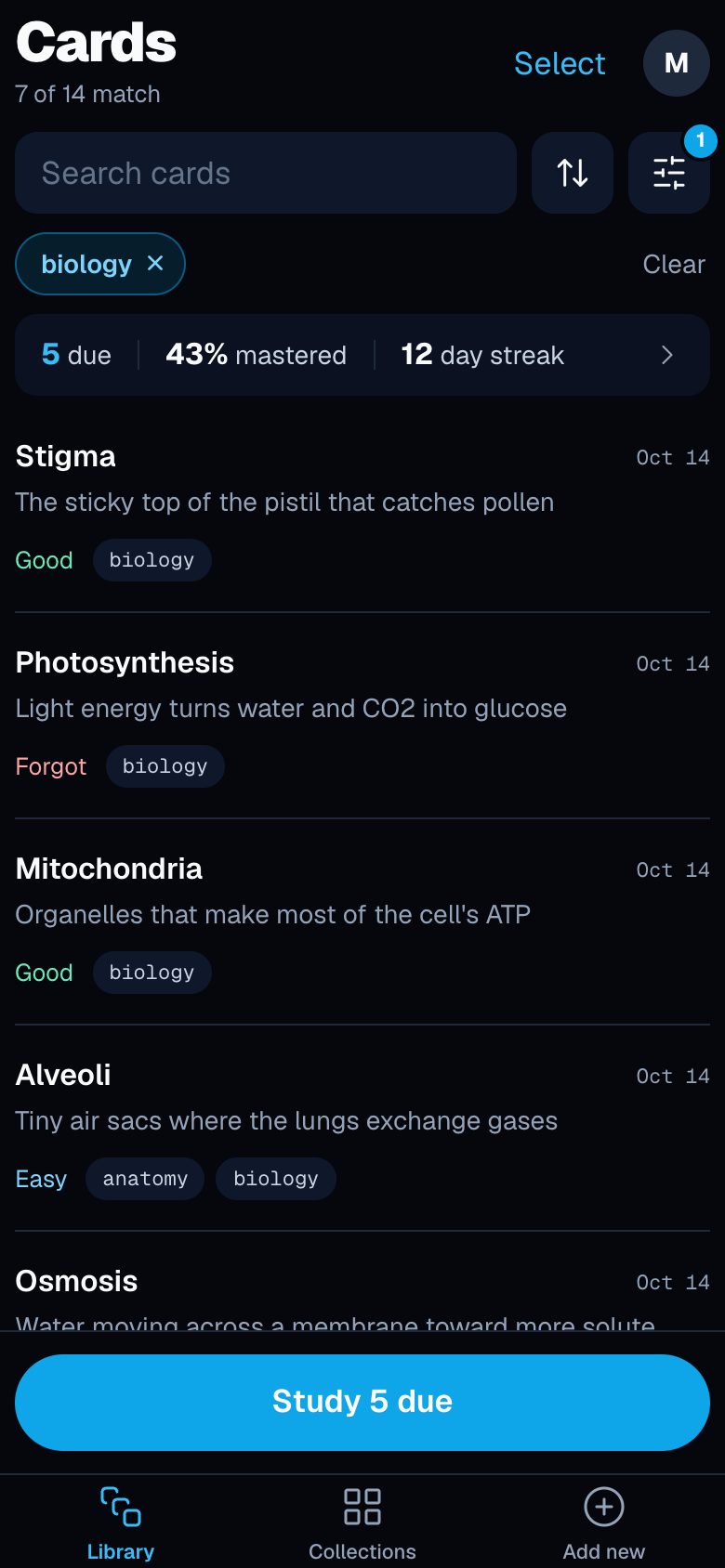
While you learn: one domain at a time
Select the domain tag in the library and press Study
. The dialog says Only cards from selected tags will be used
, so the session shows only that domain's due cards.
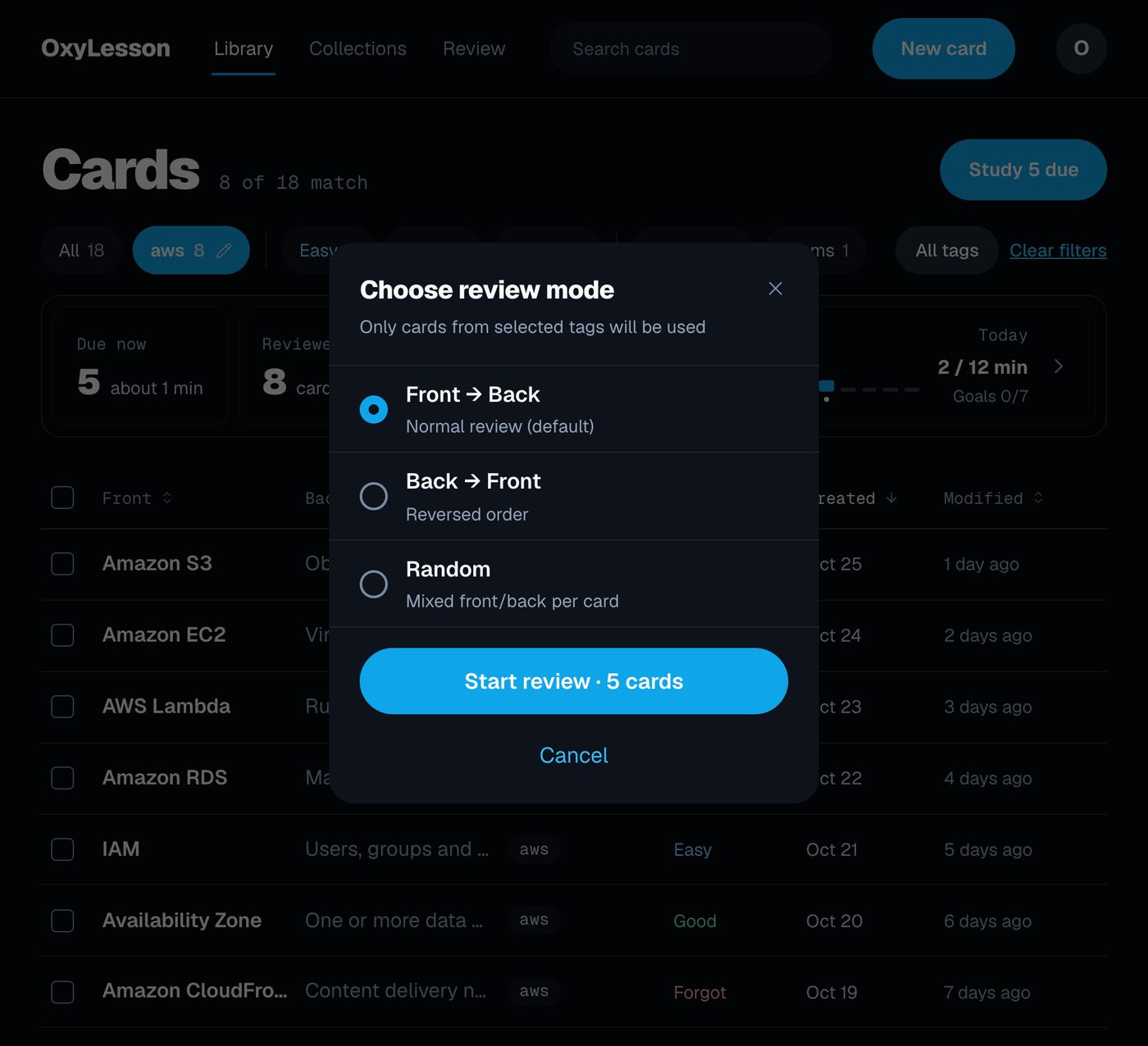
The three modes in that dialog, Front → Back
, Back → Front
and Random
, decide which side of a card you see first. Random
picks the side per card. It does not shuffle domains.
Once you know them: mix the domains
Select only secplus and start a review. Every due Security+ card comes up, whatever its domain.
The Session done
screen at the end of a filtered review has a shortcut. When cards outside your filter are due, it shows Review all due (n)
, which starts a review of every due card in your library. That is the widest mix, and it also includes cards that have nothing to do with the exam, such as a language you are learning. The Review
link in the top menu does the same.
The same two-phase plan for one specific exam, with the cards to write for it, is in How to study for the AWS Cloud Practitioner exam with flashcards.
What the app decides for you
A review shows only cards that are due. Cards come in order of their due date, oldest first. A new card counts as due from the moment you create it, so new cards come in the order you created them. If you wrote all the threat cards on Monday and all the architecture cards on Tuesday, a first secplus session of brand-new cards still runs one domain after the other.
That changes after the first grades. FSRS gives each card its own next date from your grades on that card, so after a few days the domains are spread across your sessions and mixed without any effort from you. The filter you started the review from has no effect on that schedule: a card graded Good
in a domain session gets the same next date as in a mixed one.
There is no study-ahead mode and no exam-date setting, so mixing only changes which due cards you see together and adds no reviews. How to fit new cards and reviews into the weeks before a test is covered in How should you plan flashcard reviews before an exam date?
Cards that make mixing pay off
Mixing helps when it puts look-alikes next to each other, so write cards that ask you to choose between them. Here are three examples I wrote for this article:
| Type | Front or text | Back or extra |
|---|---|---|
| Basic | Which control type discourages an attack before it starts, such as a warning sign? | Deterrent. Notes: a preventive control stops the action, such as a locked door. |
| Basic | Encryption protects which part of the CIA triad? | Confidentiality. Notes: hashing checks integrity. |
| Cloze | {{c1::Phishing}} sends the same message to many people; {{c2::spear phishing}} targets one person or group. |
Each blank becomes its own card. |
The note on each Basic card names the near-miss answer, so a wrong guess in a mixed session shows you what you confused it with. Base cards on the official exam objectives and your study materials, never on copied exam questions.
Sources:
- Brunmair, M., & Richter, T. (2019). Similarity matters: A meta-analysis of interleaved learning and its moderators. Psychological Bulletin, 145(11), 1029-1052. https://doi.org/10.1037/bul0000209
- Carvalho, P. F., & Goldstone, R. L. (2014). Putting category learning in order: Category structure and temporal arrangement affect the benefit of interleaved over blocked study. Memory & Cognition, 42(3), 481-495. https://doi.org/10.3758/s13421-013-0371-0
- Kornell, N., & Bjork, R. A. (2008). Learning concepts and categories: Is spacing the
enemy of induction
? Psychological Science, 19(6), 585-592. https://doi.org/10.1111/j.1467-9280.2008.02127.x - Rohrer, D., & Taylor, K. (2007). The shuffling of mathematics problems improves learning. Instructional Science, 35(6), 481-498. https://doi.org/10.1007/s11251-007-9015-8
- CompTIA. Security+ certification page and Security+ V7 page. https://www.comptia.org/en-us/certifications/security/ and https://www.comptia.org/en-us/certifications/security/v7/
Cover photo by stux on Pixabay.