Should flashcards go from your language to the target language, or the other way?
Study both ways, but give more time to the harder one. Your language to the target language train...
By Kamil
8 mins read

Study both ways, but give more time to the harder one. Your language to the target language trains speaking; the other way trains understanding, and each direction mostly improves its own skill.
A card that shows a foreign word and asks what it means trains recognition, the skill you use to read and listen. A card that shows your own language and asks for the foreign word trains production, which you need to speak. Production is harder, and in the studies below it also carried over to some recognition. If speaking is your goal, write production cards with a real situation on the front.
What the studies found
Researchers usually call the two directions receptive learning (the foreign word is the cue, you recall the meaning) and productive learning (your language is the cue, you recall the foreign word).
Griffin and Harley ran an experiment with school students aged 11 to 13 who were learning French from word lists. They found that learning in the order first language, then second language was the more versatile choice when the learners needed both to produce and to understand the French words (Griffin & Harley, 1996).
Webb had English learners in Japan study word pairs in one direction or the other, then tested each word in ten different ways. Productive learning gave larger gains in several aspects of knowing a word, including how the word is spelled and how it is used in a sentence. Receptive learning gave a larger gain in recognizing what a word means. His conclusion was that if you use only one direction, productive learning of word pairs might be more effective (Webb, 2009).
Whole phrases behave the same way. Steinel, Hulstijn and Steinel had 129 Dutch university students learn 20 English idioms in one direction and tested them both ways, right after learning and three weeks later. Productive learners had a sizable advantage on the production test, and receptive learners did better on recognition. Receptive learning was particularly weak for idioms that are hard to picture (Steinel et al., 2007).
In these studies, practice in one direction mostly paid off on tests in the same direction, and productive practice also carried over to some recognition. So choose by what you need to do with the words: recognition cards are enough for reading a textbook, and a conversation needs the cards that make you say the phrase.
Put a situation on the front
A production card with one word on each side (a word in your language on the front, to mind
on the back) teaches you a translation. It does not tell you when to use the phrase, and in a conversation nobody hands you the word in your language first. You start from a situation, so write the situation on the front.
Two example cards follow. Write the front in your own language; here it is in English so every reader can follow.
| Front | Back | Notes |
|---|---|---|
| Someone offers you more coffee, and you don't want any. | No, I'm good, thanks. | A polite no to an offer. I'm goodis also a casual answer to How are you? |
| Ask whether it's OK to close the window. | Do you mind if I close the window? | Mindhere means be bothered. No, go aheadmeans yes. Actually, I'd rather you didn'tmeans no. |
Both meanings in the notes come from the Cambridge Dictionary. Its entry for good
lists I'm good
as the reply when you have everything you need, with the example More coffee?
No, I'm good, thanks.
, and also as an informal reply to a greeting (Cambridge Dictionary, good
). Its entry for mind
defines the verb in questions as to be annoyed or worried by something
and glosses Do you mind if I
as may I
(Cambridge Dictionary, mind
). So no
means yes, because you are saying you are not bothered.
A learner who replies yes
to mean go ahead
is saying the opposite, and the card alone would not warn them. That is what the notes are for. In OxyLesson the card form has a Notes
field under the two sides (Optional context for yourself
), and the note shows under the answer in every review.
Choosing the direction when you study
In OxyLesson you choose the direction each time you press Study
, in the Choose review mode
dialog, so the same card can be studied both ways:
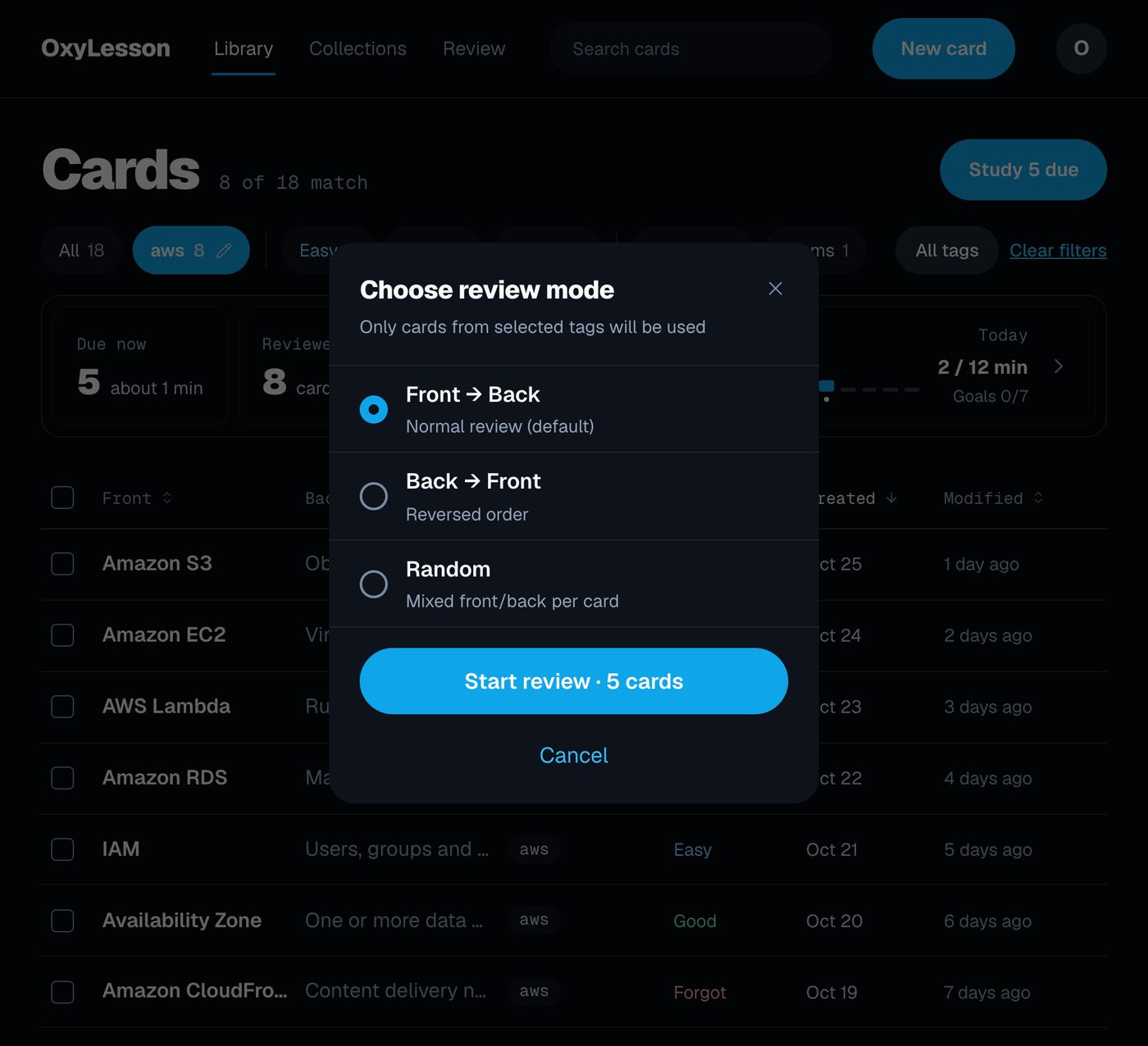
Front → Back
is the normal review and the default.Back → Front
shows the back first, for every card in the session.Random
mixes both, choosing a side per card.
With the situation cards above, Front → Back
is production practice, and Back → Front
turns the same cards into recognition practice: you see Do you mind if I close the window?
and recall when you would say it. If you filter the library by a tag first, for example a speaking
tag you give your production cards, the dialog says Only cards from selected tags will be used
, so you can drill one group in one direction.
Audio follows the direction you choose. The speaker next to the question reads the side shown, so in Back → Front
it reads the back. The Q key plays the question and the A key the answer, and A plays nothing before you reveal the answer, so it never gives the answer away. For production cards, say the phrase out loud before you reveal it, then press A and compare.
A card has one schedule, whichever direction you study it in. A grade you give in Back → Front
moves the same card as a grade in Front → Back
. If you recognize a phrase easily but still cannot produce it, and you mostly review it in the easy direction, it will come back less often than your speaking needs. When both directions matter for a phrase, make two cards, one with the sides swapped, so each direction gets its own schedule.
Cloze cards always ask for the word
A cloze card hides a word inside a sentence: you type Do you {{c1::mind}} if I close the window? and the review shows the sentence with a blank. You can add a hint, {{c1::mind::be bothered}}, which shows under the blank. OxyLesson never flips a cloze card: in Back → Front
and Random
it still shows the blank first, since the full sentence shown first would leave nothing to recall.
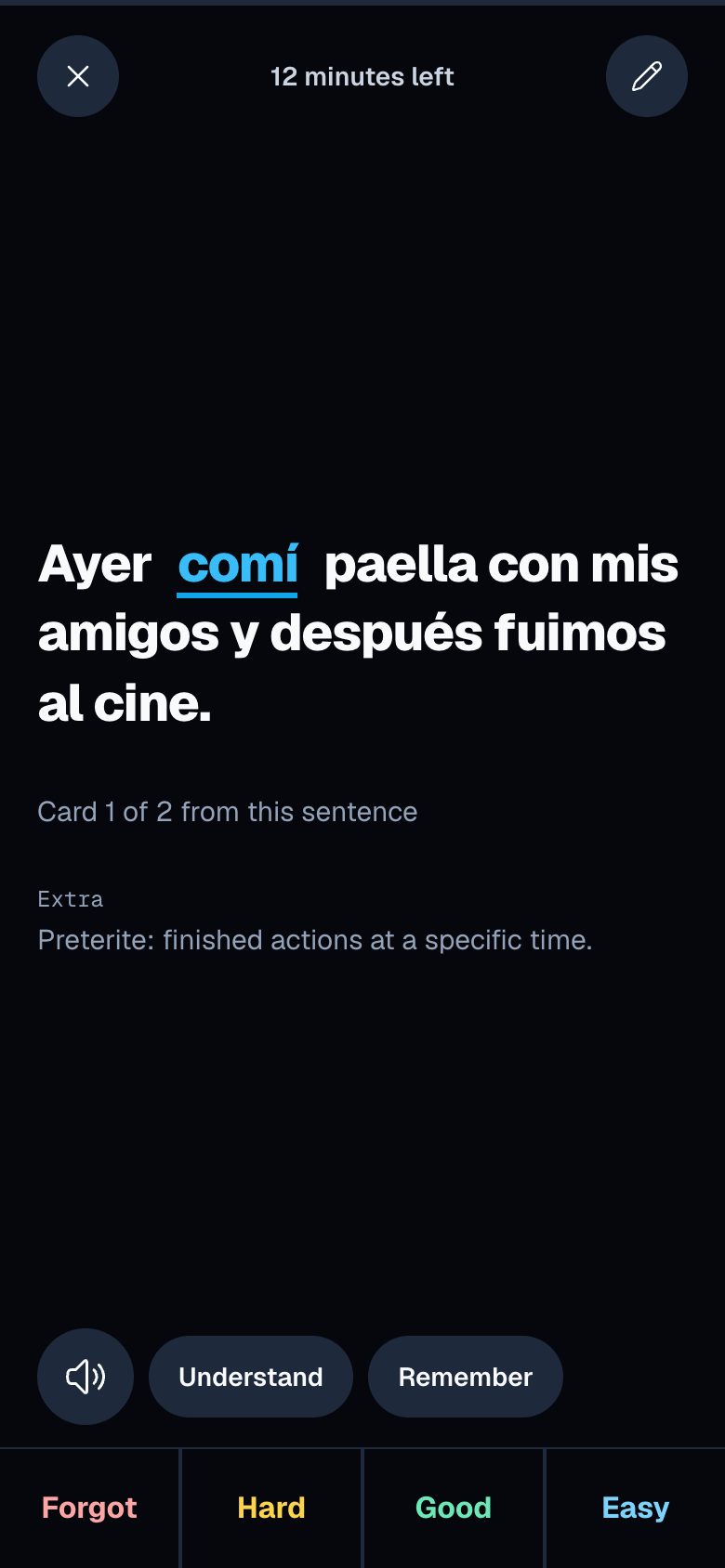
So a cloze card is always a production card, with the context built in: you read a sentence in the target language and produce the missing word yourself. Cloze cards work well for the part of a phrase you keep getting wrong, such as the verb after Do you mind if I
.
A simple routine
Write new phrases as situation cards with the target language on the back. Review them Front → Back
most days. Once a week, run the same tag in Back → Front
to check that you also recognize them when you hear or read them. For the phrases that matter most, add a second card in the other direction or a cloze card.
Grade production cards honestly. If you got the phrase only after a long pause, press Hard
. If you got the meaning right but the words wrong, press Forgot
, because in a conversation you would have needed the words.
For more on writing the cards themselves, see how to make effective flashcard decks, and for a whole study week, how to learn effectively using OxyLesson.
Sources:
- Cambridge Dictionary.
good
(adjective, senses HEALTHY and SATISFACTION:I'm good
). Cambridge University Press. https://dictionary.cambridge.org/dictionary/english/good - Cambridge Dictionary.
mind
(verb, sense BE ANNOYED). Cambridge University Press. https://dictionary.cambridge.org/dictionary/english/mind - Griffin, G., & Harley, T. A. (1996). List learning of second language vocabulary. Applied Psycholinguistics, 17(4), 443-460. https://doi.org/10.1017/S0142716400008195
- Steinel, M. P., Hulstijn, J. H., & Steinel, W. (2007). Second language idiom learning in a paired-associate paradigm: Effects of direction of learning, direction of testing, idiom imageability, and idiom transparency. Studies in Second Language Acquisition, 29(3), 449-484. https://doi.org/10.1017/S0272263107070271
- Webb, S. (2009). The effects of receptive and productive learning of word pairs on vocabulary knowledge. RELC Journal, 40(3), 360-376. https://doi.org/10.1177/0033688209343854
Cover photo by geralt on Pixabay.