How do you memorize legal and financial definitions word for word?
Split the definition into short parts, hide each element you could get wrong in a cloze blank, an...
By Kamil
8 mins read

Split the definition into short parts, hide each element you could get wrong in a cloze blank, and recall it before you look. Then check your answer against the official text, one element at a time.
The check matters because single words change the meaning of a legal definition. Identified or identifiable
covers more people than identified
alone, and if you recall only one of the two, you have learned a different rule.
Why a half-right answer feels right
John Dunlosky, Katherine Rawson and their colleagues studied how students grade their own recall of key-term definitions. In a 2009 study with middle school students, learners studied definitions, tried to recall each one, and then scored their answer as fully correct, partially correct or incorrect. Many of their answers were entirely wrong, yet they gave full or partial credit to 73% of those wrong answers when they judged them with nothing to compare against. When the correct definition was shown next to their answer, that dropped to 44%. A second experiment broke each definition into idea units, and students first ticked off which units were in their answer. That reduced overconfidence further.
A 2011 study with college students found the same pattern. Students judged recalled definitions as entirely or partially correct even when they were wrong. Checking each idea unit reduced this, and so did listing the idea units themselves before judging. They were overconfident even when they graded other students' answers. The authors conclude that the trouble lies in judging how good a recalled answer is.
For your cards, that means comparing with the full text every time and keeping each card small enough to test one or two idea units.
Recall, then look at the answer
Producing the words yourself also helps you remember them. McDaniel and colleagues (2007) gave students in a college course weekly quizzes with feedback. Short-answer quizzes helped more than multiple-choice quizzes, even though the course's unit tests and final exam were multiple choice. Kang, McDermott and Roediger (2007) found that this depends on feedback. Without feedback, a short-answer test did not beat a multiple-choice one. With corrective feedback, the short-answer test gave the best final scores. A definition card therefore needs both parts: you recall the missing words before the reveal, and the reveal shows you the exact text.
Start from the official text
Copy the definition from the official source, never from a summary or a prep book. For EU law that is EUR-Lex. Its legal notice says that, unless otherwise specified, you can reuse the legal documents published there. The same notice names the International Accounting Standards as documents with special conditions of use, so for accounting standards and other copyrighted glossaries, write cards in your own words.
A consolidated version on EUR-Lex is a documentation tool with no legal effect; the authentic text is the one in the Official Journal. Acts also change: the EUR-Lex page for the GDPR lists amendment proposals from the Commission, so check the act's page before your exam to see whether your wording is still current. For what an exam covers, use its official outline, such as the IAPP CIPP/E Body of Knowledge.
This article is about memorizing text and is not legal advice.
A worked example: GDPR Article 4(1)
Article 4(1) of the GDPR defines personal data in one long sentence. It is too long for one card side in OxyLesson, and it holds more idea units than one card should test anyway. Split it where its clauses break: who the data is about, how a person can be identified, and which factors count.
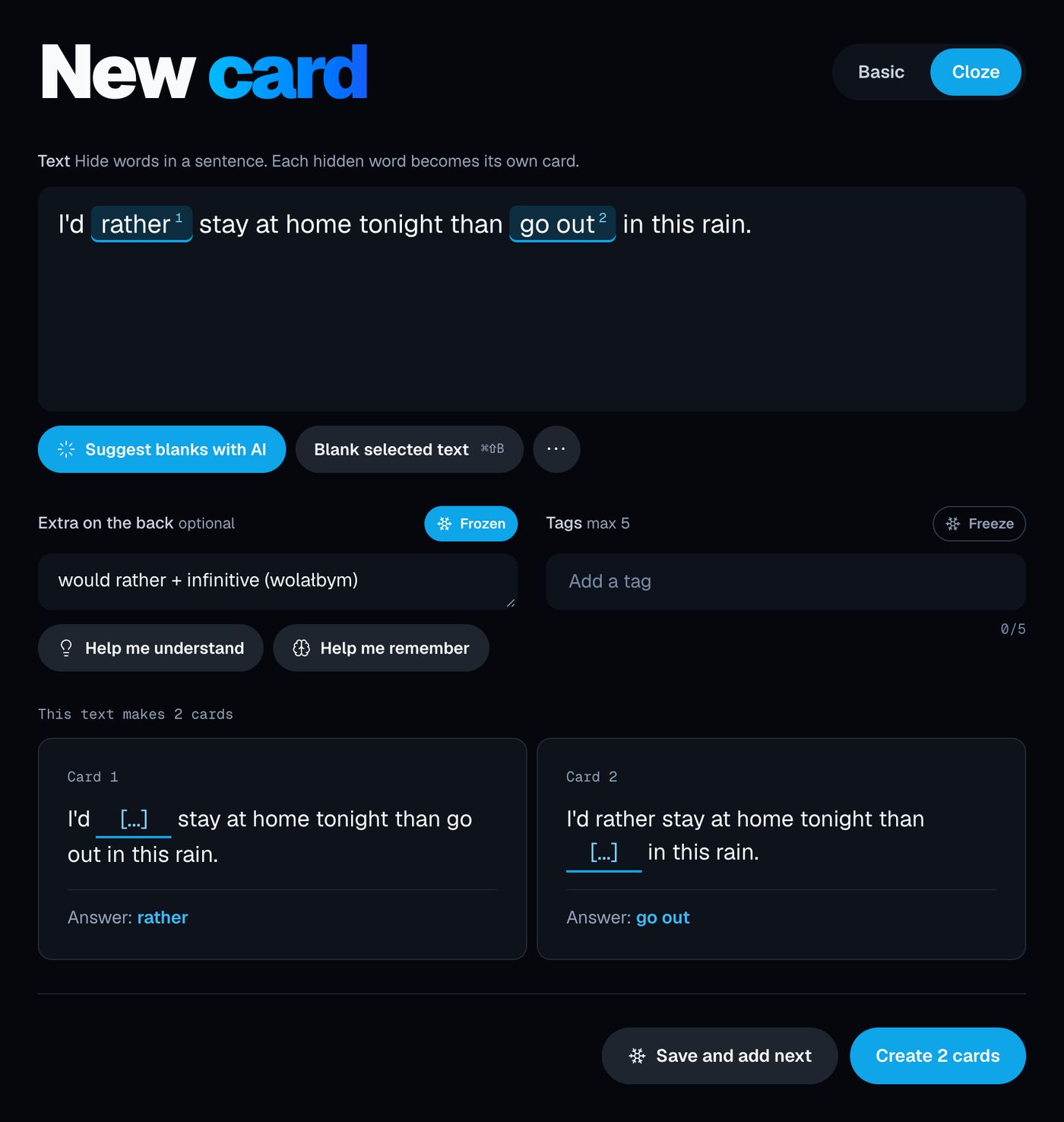
In OxyLesson, open New card and switch to Cloze. Type or paste the first part, select a word and press Blank selected text
(Cmd+Shift+B on a Mac, Ctrl+Shift+B elsewhere). Each blank number becomes its own card with its own schedule. These are example notes:
‘personal data’ means any information relating to an {{c1::identified}} or {{c1::identifiable}} {{c2::natural person}} (‘{{c3::data subject}}’);
Both words of the pair share the number 1, so card 1 hides them together and you must produce both. Card 2 asks for natural person
, and card 3 for the term in brackets.
an identifiable natural person is one who can be identified, {{c1::directly or indirectly::two adverbs}}, in particular by reference to an identifier such as {{c2::a name}}, {{c3::an identification number}}, {{c4::location data}}, {{c5::an online identifier}}
The text after the second pair of colons is a hint. On the question it shows in place of the empty box, so card 1 tells you that you are looking for two adverbs. Use a hint when a blank could be filled in several ways. The rest of the sentence, the list of identity factors, goes in a third note with one blank per factor. A list is hard to recall as a whole, which is why the guide to effective flashcards gives each item its own number.
Suggest blanks with AI
proposes single words worth hiding, each with a reason, and you keep or skip each one. For legal text you decide which words carry the rule, and phrases such as directly or indirectly
you select yourself.
Put the full article in Extra and freeze it
Paste the whole of Article 4(1) into Extra on the back
, starting with the article number, for example GDPR Art. 4(1):. Extra shows on the answer of every card from the note, so each review ends with the complete official sentence and its source.
Turn on Freeze
next to Extra on the back
and next to Tags, then save with Save and add next
. The next note keeps the same Extra and tags, so you only type the next part of the definition. A tag such as gdpr-art4 lets you filter the library and your reviews to these cards.
How to review and grade
When a card comes up, say or write the missing words before you reveal. OxyLesson does not check typed answers, so the comparison is yours. On the answer, the hidden words are shown highlighted in the full sentence, with Extra below.

Compare your answer with the highlighted words, then read the full text in Extra, the way students in the idea-unit studies checked each unit. If any element was missing or different, press Forgot
, even if you had the meaning right. Hard
is for the exact words that took effort. A word-for-word card has no partial credit, and a generous grade sends a wrong version back to you later than it should.
FSRS schedules every card, and there is nothing to configure. A review shows only cards that are due, and there is no study-ahead mode or exam-date setting. Start well before your exam so that the hard parts come back several times.
The same method for a financial definition
Definitions in EU financial law work the same way. Article 4(1)(1) of MiFID II (Directive 2014/65/EU) defines an investment firm in one sentence, and the consolidated version on EUR-Lex keeps the same wording. An example first note:
‘investment firm’ means any {{c1::legal person}} whose regular occupation or business is the provision of one or more {{c2::investment services}} to {{c3::third parties}}
A second note covers the rest of the sentence, from and/or the performance of one or more investment activities
. Paste the full point into Extra, and keep the conditions that follow it in the article for separate notes.
When the wording changes
If an amendment changes a definition, edit the note. OxyLesson keeps the review history of every card whose blank number is still in the text, so a new word inside an old blank changes the card without resetting it. If your edit removes a blank number, a dialog lists the cards that will be deleted before you save. Update Extra in the same edit, so the source you check against is the current one.
Sources:
- Dunlosky, J., Hartwig, M. K., Rawson, K. A., & Lipko, A. R. (2011). Improving college students' evaluation of text learning using idea-unit standards. Quarterly Journal of Experimental Psychology, 64(3), 467-484. https://doi.org/10.1080/17470218.2010.502239
- Kang, S. H. K., McDermott, K. B., & Roediger, H. L. (2007). Test format and corrective feedback modify the effect of testing on long-term retention. European Journal of Cognitive Psychology, 19(4-5), 528-558. https://doi.org/10.1080/09541440601056620
- Lipko, A. R., Dunlosky, J., Hartwig, M. K., Rawson, K. A., Swan, K., & Cook, D. (2009). Using standards to improve middle school students' accuracy at evaluating the quality of their recall. Journal of Experimental Psychology: Applied, 15(4), 307-318. https://doi.org/10.1037/a0017599
- McDaniel, M. A., Anderson, J. L., Derbish, M. H., & Morrisette, N. (2007). Testing the testing effect in the classroom. European Journal of Cognitive Psychology, 19(4-5), 494-513. https://doi.org/10.1080/09541440701326154
- Regulation (EU) 2016/679 (General Data Protection Regulation), Article 4. Official Journal of the European Union, L 119, 4.5.2016. https://eur-lex.europa.eu/eli/reg/2016/679/oj
- Directive 2014/65/EU (MiFID II), Article 4. Official Journal of the European Union, L 173, 12.6.2014. https://eur-lex.europa.eu/eli/dir/2014/65/oj
- EUR-Lex legal notice. https://eur-lex.europa.eu/content/legal-notice/legal-notice.html
Cover photo by succo on Pixabay.