How to study for the AWS Cloud Practitioner exam with flashcards
Turn the official exam guide into cards, tag each card with its exam domain, and write most cards...
By Kamil
8 mins read
Turn the official exam guide into cards, tag each card with its exam domain, and write most cards about telling similar services apart. Study one domain at a time, then mix all four.
Much of this exam is vocabulary: service names, what each service does, and who is responsible for what. Flashcards handle that well, so most of the work is choosing what goes on the cards.
Start from the exam guide
AWS publishes an exam guide for AWS Certified Cloud Practitioner (CLF-C02). On 3 November 2026 it listed four content domains:
- Cloud Concepts
- Security and Compliance
- Cloud Technology and Services
- Billing, Pricing, and Support
Each domain has its own page of task statements. Read the weighting and scoring on the AWS page itself, because AWS revises the guide and the exam code, and check that the code matches the exam you book.
Work through one task statement at a time and write a few cards for it in your own words. Leave real exam questions out of your cards. The AWS Certification Program Agreement calls exam content AWS confidential information. It forbids sharing the content of any exam and using leaked material, which it calls Unauthorized Content Disclosures
.
Tag every card with its domain
Give each card two tags: aws and one for its domain, for example clf-concepts, clf-security, clf-tech and clf-billing. In the card form, turn on Freeze
next to Tags and use Save and add next
, and the next card keeps the same tags. To tag cards you already have, select them in the library and use Set tags
.
If you prefer to write cards in a spreadsheet or a text file, the import page takes one card per line in the format front;back;notes;tag1,tag2.
In the library, a card has to carry every tag you select to show up. Click clf-security and the card list, the due count and the next review cover that domain only. Click aws on its own and you get all four domains.
Write cards that tell look-alike services apart
Several AWS services sound alike in a one-line description, as the three storage services below show. A card that only asks What is Amazon EBS?
lets you recite a definition. A card that describes a need and asks which service fits makes you pick one service and rule out the others.
Put the near miss in the notes. In a review, the notes show under the answer, labeled Note
, so you read why the other service is wrong right after you answer. These example cards were written for this article and checked against the AWS documentation for each service. You can paste them into the import page:
Which AWS service gives you block storage volumes that you attach to an EC2 instance and use like a local disk?;Amazon EBS;Not EFS: EFS is shared file storage. Not S3: S3 stores objects in buckets.;aws,clf-tech
Which AWS service gives you elastic file storage that many compute instances can share?;Amazon EFS;Not EBS: an EBS volume attaches to an EC2 instance like a disk.;aws,clf-tech
Which AWS service stores data as objects inside buckets?;Amazon S3;Not EBS or EFS: those are block and file storage.;aws,clf-tech
These are Basic cards, so Back → Front
also works on them: it shows the service name and asks what the service is for.
Use cloze cards for the shared responsibility model
The AWS Shared Responsibility Model page divides security into two parts. AWS protects the infrastructure that runs all of the services offered in the AWS Cloud
, including the physical security of its facilities. The customer's part will be determined by the AWS Cloud services that a customer selects
. On Amazon EC2 that includes updates and security patches for the guest operating system and the security group firewall.
A cloze card fits this well, because a full sentence holds the context that changes the answer. In the card form, switch to Cloze, type the sentence, select the word to hide and press Blank selected text
(Cmd+Shift+B on a Mac, Ctrl+Shift+B elsewhere). A hint after a second pair of colons tells you which choice to make. These are example cards:
On Amazon EC2, the {{c1::customer::AWS or customer}} applies security patches to the guest operating system.
On Amazon EC2, the {{c1::customer::AWS or customer}} configures the security group firewall.
{{c1::AWS::AWS or customer}} is responsible for the physical security of the facilities where its services run.
In Extra on the back
, add that the split depends on the service you use, as the AWS page says. The hidden word alone does not tell you that.
Draft the first cards with an AI agent
OxyLesson runs an MCP connector at https://oxylesson.com/mcp, so Claude, ChatGPT or a coding agent can create cards in your library. The account page section AI agents (MCP)
shows how to connect, and the post on AI flashcards walks through it.
Once it is connected, paste one task statement from the guide into the chat and ask for comparison cards in the format above, with the tags aws and the domain tag. The agent saves them with the create_cards tool. The tool skips a card whose front and back match one you already have. Read every draft against the AWS documentation before you study it, because a language model can mix up similar services just as easily as a person can.
Later, ask the agent to run get_statistics for each domain tag. For each tag it returns how many cards are new, learning, in review and mastered, plus how many are due now. These are the same numbers the library stats panel shows for that tag, so you can see which domain is behind.
Review one domain, then all of them
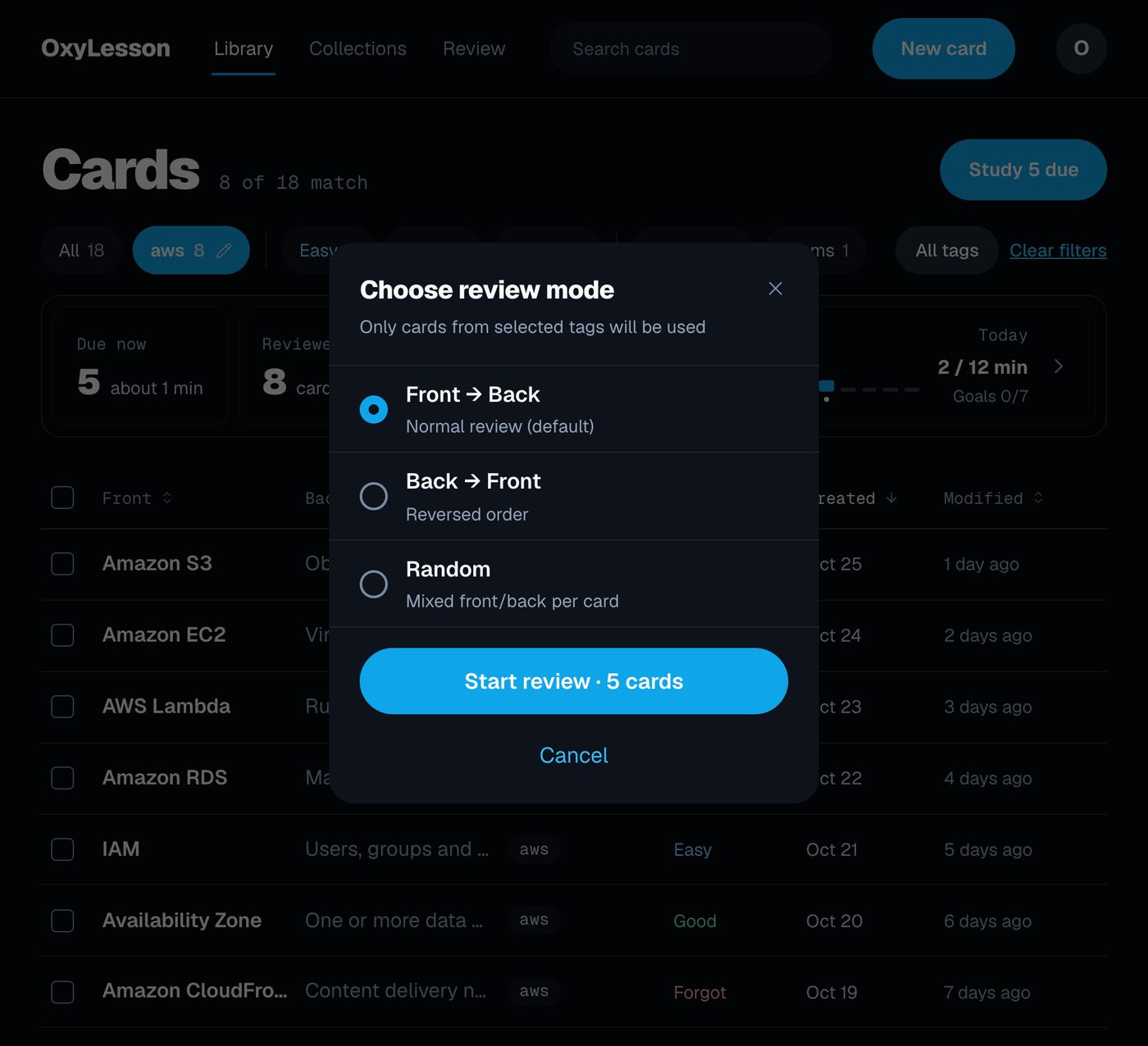
While you are building a domain, review it on its own. Click its tag in the library, then Study N due
. The Choose review mode
dialog confirms that only cards from selected tags will be used.
When every domain has cards, filter by aws only, so cards from all four domains come up in the same session. Kornell and Bjork (2008) had people study paintings by several artists, either one artist at a time or mixed together. The mixed group was better at naming the artist of paintings they had not seen before. Participants still rated the one-at-a-time order as more effective, even after their own test results showed the opposite.
Brunmair and Richter (2019) pooled 59 studies and found a moderate overall benefit of mixing (Hedges' g = 0.42), stronger when the categories were similar to each other. For learning words, though, blocked study did better (g = -0.39), and the results for expository texts were unclear. So mixing makes the most sense for the cards that make you choose between similar services. For plain definitions, the research does not favor it.
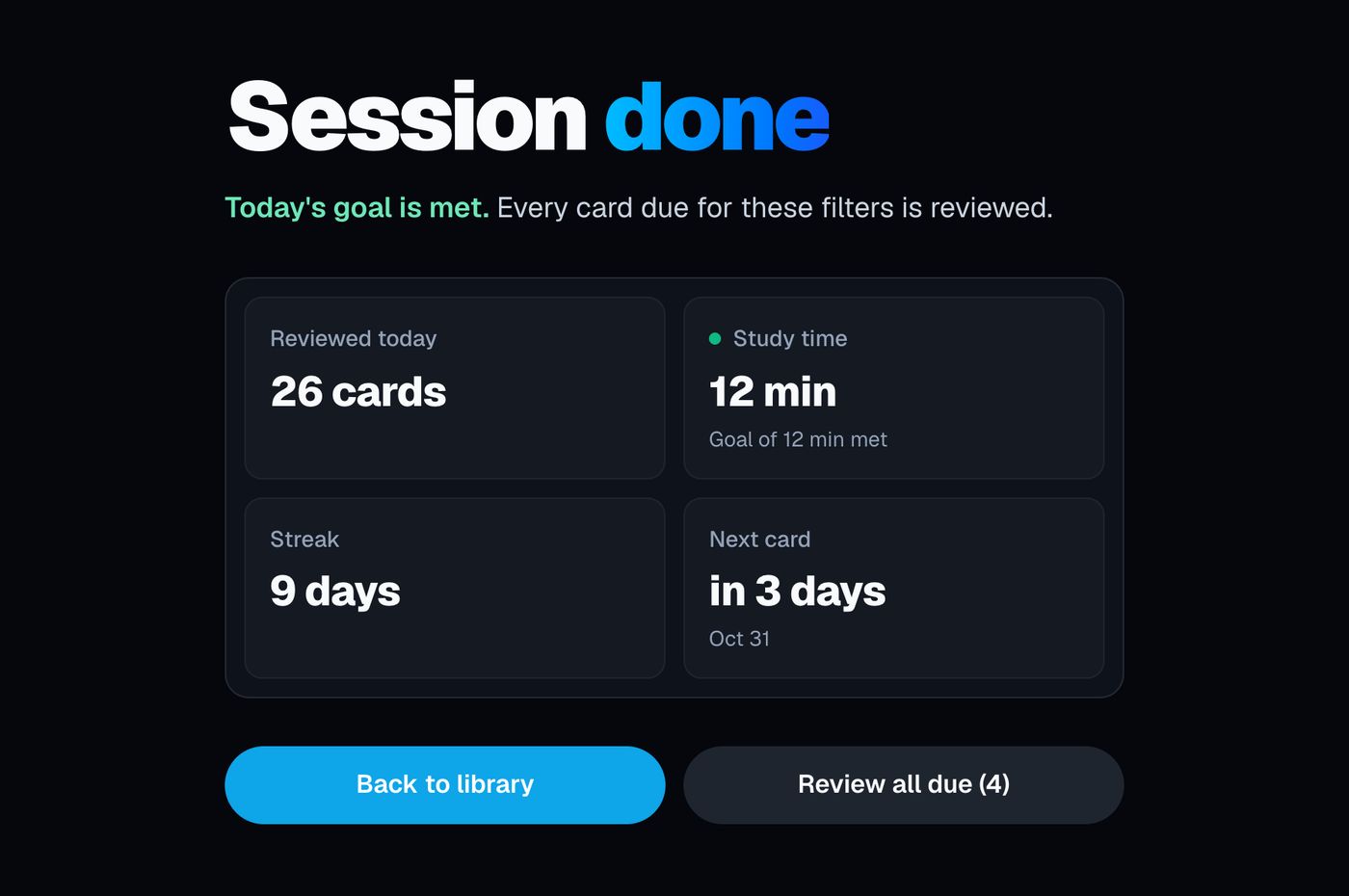
At the end of a filtered session, the Session done
screen offers Back to library
and, when other cards are due, Review all due (n)
. That second button starts a review of every due card in your library, AWS or not.
Start early and grade honestly
OxyLesson schedules each card with FSRS, and there is nothing to configure. A review shows only the cards that are due. There is no study-ahead mode and no exam date setting, so a deck started a few days before the exam cannot spread its reviews out. Start building cards when you start the course.
Testing yourself also beats rereading your notes. In Roediger and Karpicke (2006), students who took recall tests on a passage remembered much more of it after two days and after one week than students who reread it, even though rereading made them more confident. After five minutes, rereading was ahead.
Grade what you produced. If the card described EBS and you answered EFS, press Forgot
, even if you know both services. Press Hard
for a right answer that took effort. For the basics of card writing, see how to create effective flashcards. For a short overview of OxyLesson for this exam, see the AWS Cloud Practitioner page.
Sources:
- Amazon Web Services. AWS Certified Cloud Practitioner (CLF-C02) exam guide. https://docs.aws.amazon.com/aws-certification/latest/cloud-practitioner-02/cloud-practitioner-02.html (checked 2026-11-03)
- Amazon Web Services. Shared Responsibility Model. https://aws.amazon.com/compliance/shared-responsibility-model/ (checked 2026-11-03)
- Amazon Web Services. AWS Certification Program Agreement. https://aws.amazon.com/certification/certification-agreement/ (checked 2026-11-03)
- Brunmair, M., & Richter, T. (2019). Similarity matters: A meta-analysis of interleaved learning and its moderators. Psychological Bulletin, 145(11), 1029-1052. https://doi.org/10.1037/bul0000209
- Kornell, N., & Bjork, R. A. (2008). Learning concepts and categories: Is spacing the
enemy of induction
? Psychological Science, 19(6), 585-592. https://doi.org/10.1111/j.1467-9280.2008.02127.x - Roediger, H. L., & Karpicke, J. D. (2006). Test-enhanced learning: Taking memory tests improves long-term retention. Psychological Science, 17(3), 249-255. https://doi.org/10.1111/j.1467-9280.2006.01693.x