How do you learn phrasal verbs so they stick?
Start with the most frequent phrasal verbs, learn one meaning of each in a sentence you would say...
By Kamil
7 mins read
Start with the most frequent phrasal verbs, learn one meaning of each in a sentence you would say, and quiz yourself on the particle. Keep look-alikes like give up and give in out of the same batch.
That goes against the common habit of learning phrasal verbs with *give*
as one list.
Start with the short list
English has thousands of phrasal verbs, but a small group does most of the work. Gardner and Davies (2007) counted phrasal verbs in the 100-million-word British National Corpus. Just 25 phrasal verbs made up nearly a third of all occurrences, and 100 made up more than half.
Those 100 verbs carry far more than 100 meanings: the same study counted potentially 559 meaning senses. Garnier and Schmitt (2015) report that phrasal verbs have 5.6 meaning senses on average, many of them rare. Their PHaVE List gives the 150 most frequent phrasal verbs with the key senses that cover more than 75% of their uses in the Corpus of Contemporary American English, and the share of each sense.
In practice that means one card per meaning. Pick up in pick up the kids
and pick up in pick up some Spanish
are two different things to remember. Learn the most common sense first and give the second sense its own card later.
Should you learn give up, give in and give away together?
The case against learning similar words side by side comes from studies of semantic clustering
. Tinkham (1997) compared sets of similar words (his example is eye, nose, ear, mouth, chin) with thematic sets (frog, green, hop, pond, slippery, croak). The similar sets hindered learning and the thematic sets helped.
Nakata and Suzuki (2019) tested this with 133 Japanese university students who learned 48 English words. Half came in sets from one category (mammals, organs, geographical features, plants). On the posttests, related and unrelated words scored about the same. The difference showed in the errors. When each set was studied in one block, learners mixed up members of the same set much more often: 6.32% of answers a week later for related words against 0.47% for unrelated ones. A typical slip was giving raccoon when asked for weasel. When items from different sets were mixed through the session, those mix-ups fell to 3.70%. The same paper also lists earlier studies in which related sets did better.
None of these studies used phrasal verbs. They tested nouns from one category, and a group like give up, give in, give away is a different kind of set: same verb, different particles. The error looks familiar, though: you know the answer starts with give and pick the wrong particle. What follows is my inference, and no study has tested it for phrasal verbs. Add one phrasal verb per base verb at a time, and add its look-alike a week or two later, once the first one comes back as Good
or Easy
.
Group by situation instead
Thematic sets were the ones that helped in Tinkham's study, and phrasal verbs fit them well. Moving house gives you pack up, move in, throw away, sort out and settle in: five verbs with five different meanings that belong to one scene.
In OxyLesson, give each card a tag for its situation, such as pv-moving or pv-work. A card can carry several tags, so a second tag like phrasal-verbs still fits.
Make the particle the blank
The particle is the part that changes between look-alikes, so it is worth testing on its own. Yasuda (2010) taught one group of Japanese learners the spatial meaning behind particles, while a control group learned the same phrasal verbs the traditional way. On a test where students filled in the missing particle, the first group did significantly better. You can look for these meanings yourself. In eat up, use up and fill up, the particle says that something is finished.
A cloze card asks exactly that question. Choose Cloze on the New card
page and blank the particle:
I finally gave {{c1::up::stop}} smoking last year.
The text after the second pair of colons is a hint. The review shows it under the empty box, so you know which meaning of give the card wants. Put the meaning or a translation in Extra on the back
. The live preview under the form shows how many cards the text makes.
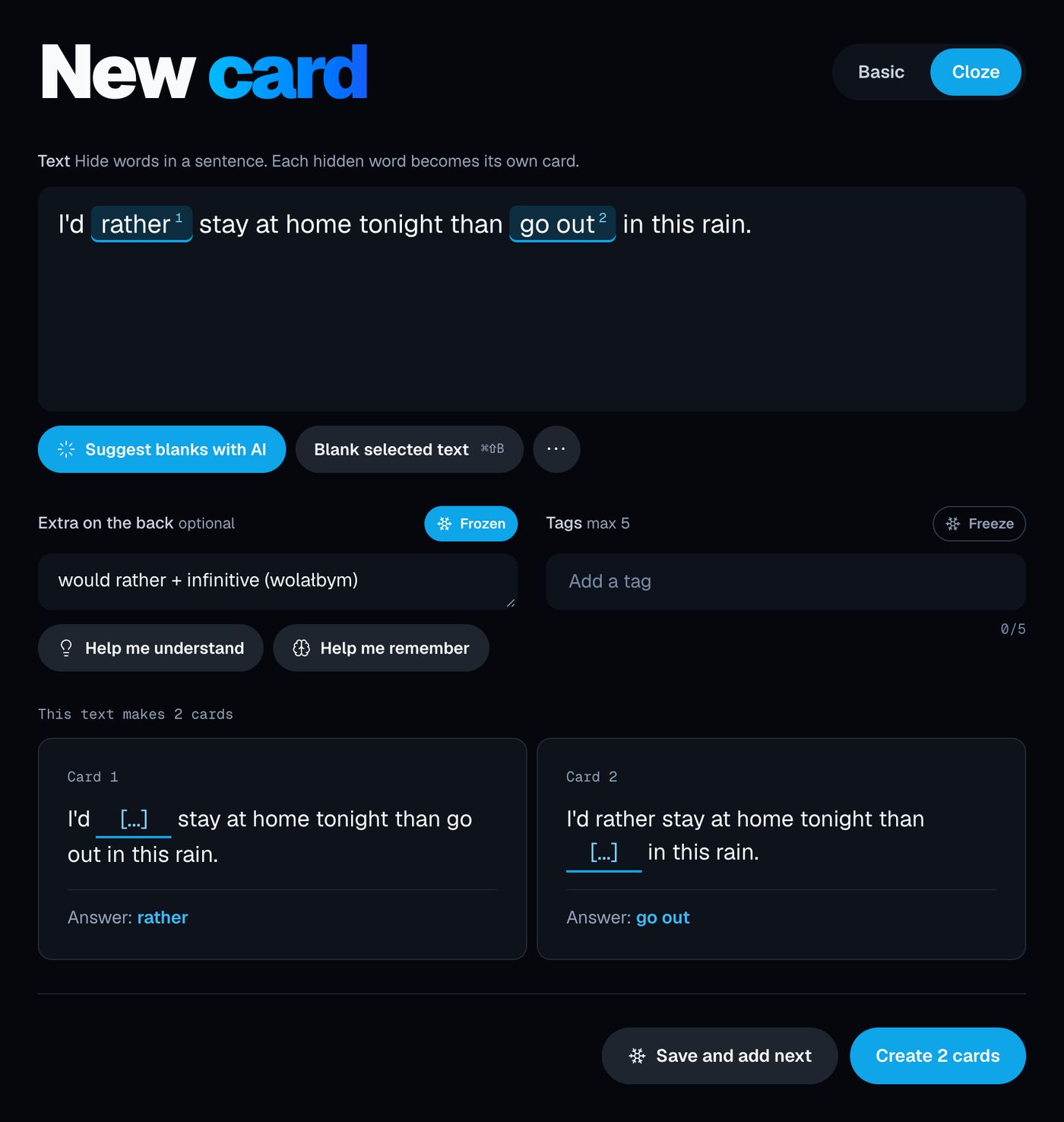
To make the blank, select the word and press Blank selected text
(Cmd+Shift+B on a Mac, Ctrl+Shift+B elsewhere). Suggest blanks with AI
reads your sentence and proposes single words to hide, and you choose Make blank
or Skip
for each one. Its instructions favour nouns, verbs, adjectives and adverbs, so it may offer gave instead of up. Skip it and blank the particle yourself.
For the rules of good cloze cards in general, see how to create effective flashcards. If you want sentences you have actually heard, the subtitle import post shows how to pull them from a film.
Add a meaning card with Highlight
A cloze card tests the form. To test whether you can use the verb, add a Basic card with the whole sentence on the Front and a translation on the Back. Translate
on the Back fills it from the Front in the language you pick. Then select the phrasal verb on the Front and press Highlight, or Cmd/Ctrl+U. The words are underlined in the review, so you know which part of the sentence the card is about.
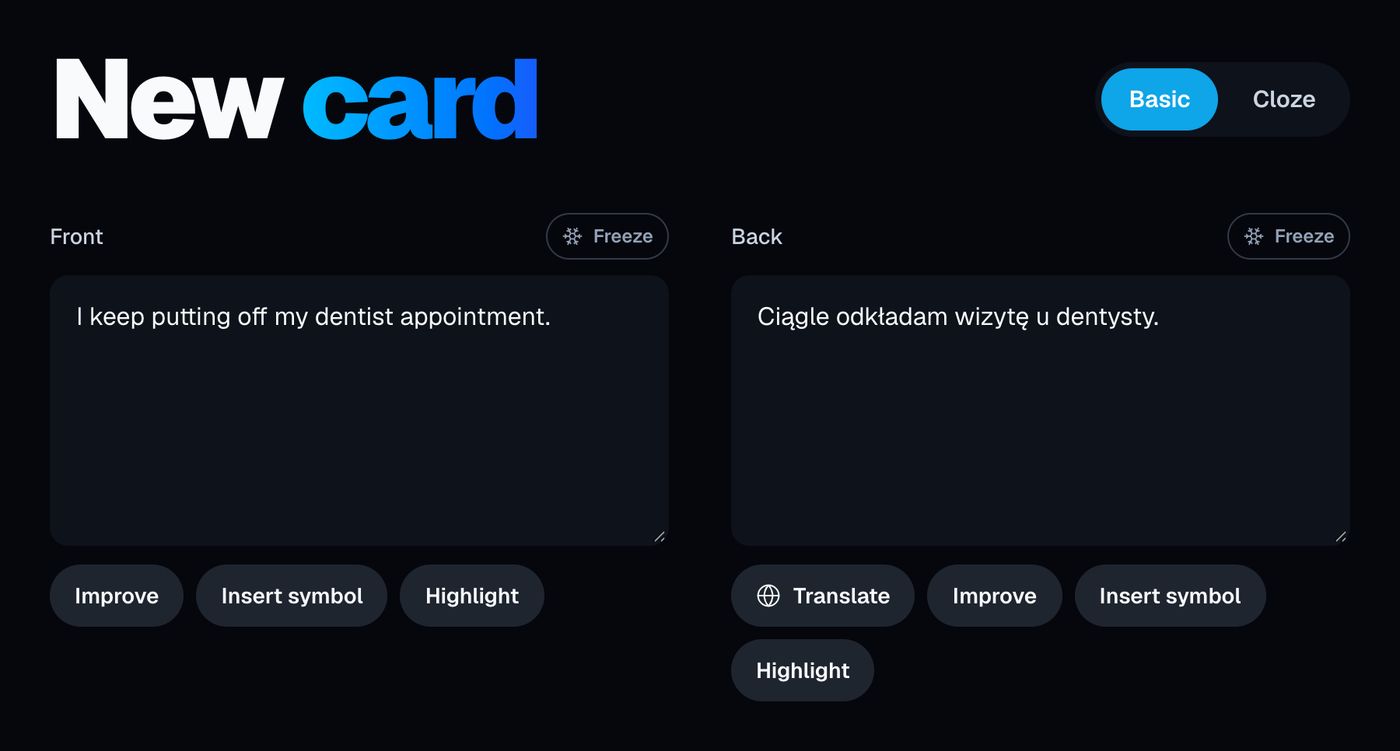
Add the highlight last. Improve
and Translate
replace the whole text, and their result has no highlights.
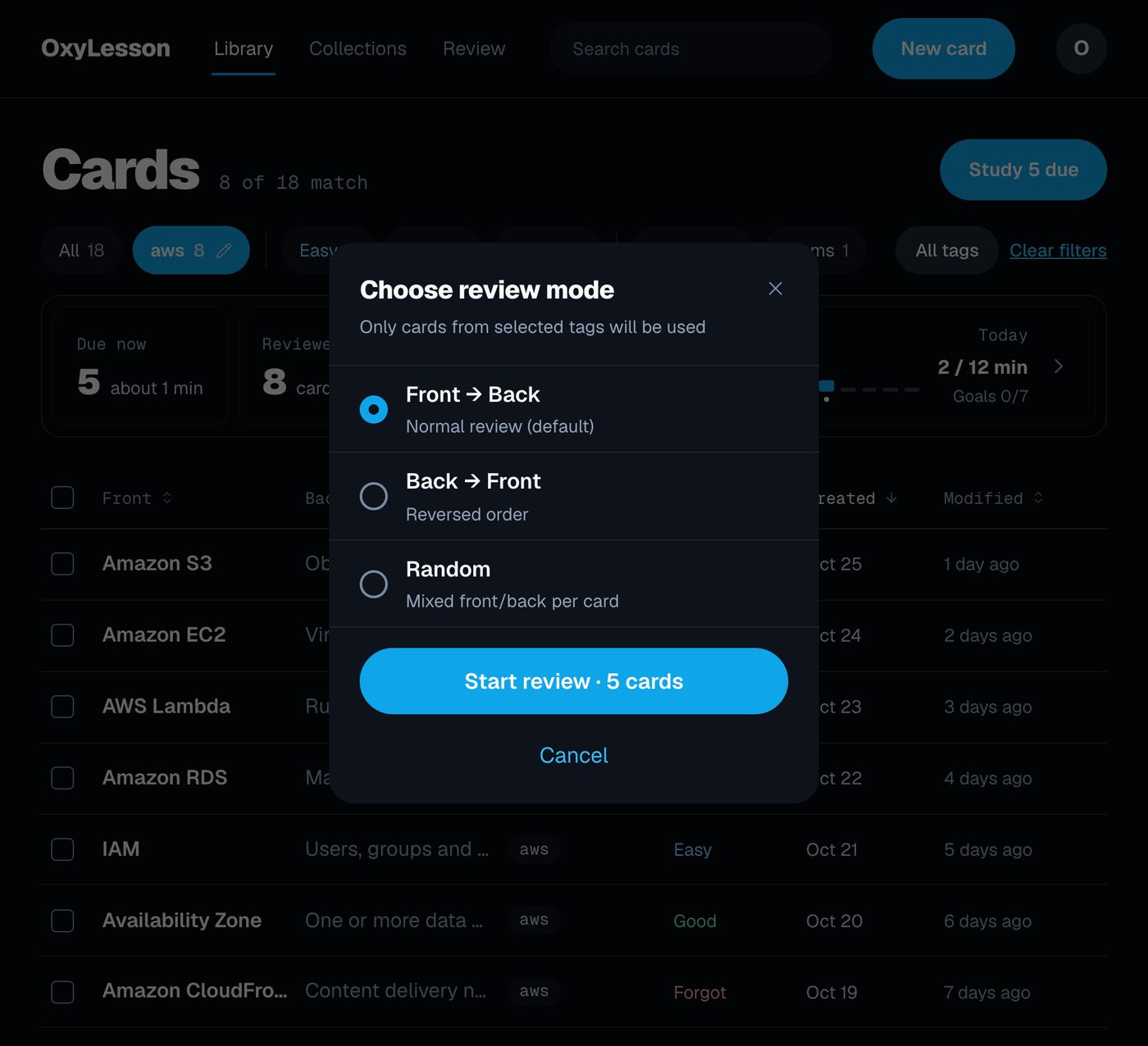
When you start the review, choose Back → Front
to see the translation and say the English sentence. Cloze cards are never flipped in that mode, so your particle cards still show the blank first.
Review by situation, then mix
To practise one scene, open the Library, click the pv-moving tag chip and press Study. The Choose review mode
dialog says Only cards from selected tags will be used
, and the button shows how many cards are due. If you select two tags, a card needs both to be included.
Most days, review everything that is due without a filter. Your phrasal verbs then come up between other cards, which is closer to the spaced condition in Nakata and Suzuki's study, where the sets were mixed. OxyLesson schedules each blank as its own card, so the particle card and the meaning card for one verb come back on their own dates.
Once a week, select a phrasal-verb tag together with the Forgot
difficulty chip. If two verbs with the same base keep landing there, rewrite their sentences so the situations are clearly different.
Sources:
- Gardner, D., & Davies, M. (2007). Pointing out frequent phrasal verbs: A corpus-based analysis. TESOL Quarterly, 41(2), 339-359. https://doi.org/10.1002/j.1545-7249.2007.tb00062.x
- Garnier, M., & Schmitt, N. (2015). The PHaVE List: A pedagogical list of phrasal verbs and their most frequent meaning senses. Language Teaching Research, 19(6), 645-666. https://doi.org/10.1177/1362168814559798
- Nakata, T., & Suzuki, Y. (2019). Effects of massing and spacing on the learning of semantically related and unrelated words. Studies in Second Language Acquisition, 41(2), 287-311. https://doi.org/10.1017/S0272263118000219
- Tinkham, T. (1997). The effects of semantic and thematic clustering on the learning of second language vocabulary. Second Language Research, 13(2), 138-163. https://doi.org/10.1191/026765897672376469
- Yasuda, S. (2010). Learning phrasal verbs through conceptual metaphors: A case of Japanese EFL learners. TESOL Quarterly, 44(2), 250-273. https://doi.org/10.5054/tq.2010.219945
Cover photo by 3473838 on Pixabay.