How do you learn English idioms so you can use them?
Learn common idioms in full sentences and check each meaning and register in a dictionary. Pictur...
By Kamil
8 mins read

Learn common idioms in full sentences and check each meaning and register in a dictionary. Picture the literal scene, and make speaking cards only for the few you will say.
Which idioms are worth learning
Liu (2003) argued that most teaching and reference materials on English idioms are based on intuition. As a result they include seldom-used idioms, and some of them describe an idiom's meaning or use wrongly. He searched three corpora of spoken American English, compiled lists of the most frequent idioms, and compared the results with nine idiom dictionaries. The dictionaries fell short in three areas: which idioms they included, how they explained meaning and use, and how well their examples fit.
Martinez and Schmitt (2012) looked beyond idioms. Their PHRASE List contains the 505 most frequent non-transparent multiword expressions in English. These are phrases whose meaning you cannot work out from the single words. The authors meant the list mainly for receptive use, which means understanding. That is also what a learner needs from most idioms. You should recognise under the weather when someone says it, and you can leave speaking practice for a smaller set.
My own rule, which no study has tested, is to make a card for an idiom once you have met it in something you read or watched. Add a speaking card only if you can picture yourself saying it in a real conversation.
Why guessing from context is not enough
Cooper (1999) asked non-native speakers of English to explain common idioms shown in a written context and to think aloud while they did it. Most of them worked by trial and error, trying one strategy after another. That way you can arrive at a meaning that fits the sentence and is still wrong.
So look the idiom up before you make a card. The Cambridge Dictionary entry gives you three things for the card. The first is the meaning. For the ball is in someone's court, Cambridge says the person has to do something before any progress can be made. The second is the register. Break the ice, call it a day, a piece of cake and under the weather are all marked informal, and many entries also show a level such as B2 or C2. The third is an example sentence you can compare with your own.
Use that label when you speak. Telling a colleague you feel under the weather sounds natural, while a formal email to a client reads better if you say you were ill.
Picture the scene behind the words
Many idioms began as literal descriptions. Boers, Eyckmans and Stengers (2007) point out that the original, literal use motivates
the meaning of many idioms. They ran a series of experiments with students of English in higher education. Learners who knew where an idiom came from understood its figurative meaning better. Working out the meaning from that information also seemed to help recall. Knowing the origin of some idioms also helped learners judge whether those idioms were typical of informal speech.
Steinel, Hulstijn and Steinel (2007) found that idioms which call up a mental image were learned better. Their study also tested which direction to learn in, and that part has its own post.
For some idioms the scene is right there in the words. The ball is in your court comes from tennis: the ball is on your side, so you have to play the next shot. Hit the nail on the head is a hammer striking the exact spot, and Cambridge defines it as describing exactly what is causing a situation or problem. Add a one-line description of the scene to the card.
Check the origin story before you save it
Before you write an origin on a card, look for it in a dictionary that gives word history. For spill the beans, Merriam-Webster's word history places the phrase in the early 20th century. Its first meaning was to spoil; to upset the apple cart
, and it appeared mostly in sports reports. Any story that dates it centuries earlier should give a source. If you can find no word history at all, keep the literal picture, such as the tennis court or the hammer, and leave the story out.
The same check applies to text written by a language model. In OxyLesson, Help me understand
sits under the notes field of the card form. It also appears on the review answer once you reveal it. It asks a model to explain what the card means in at most three short sentences and to give one example sentence that starts with Example:
. The model sees only the text of the two sides and writes in the language of the front. The instructions say nothing about origins, so check any origin the text mentions before you rely on it.
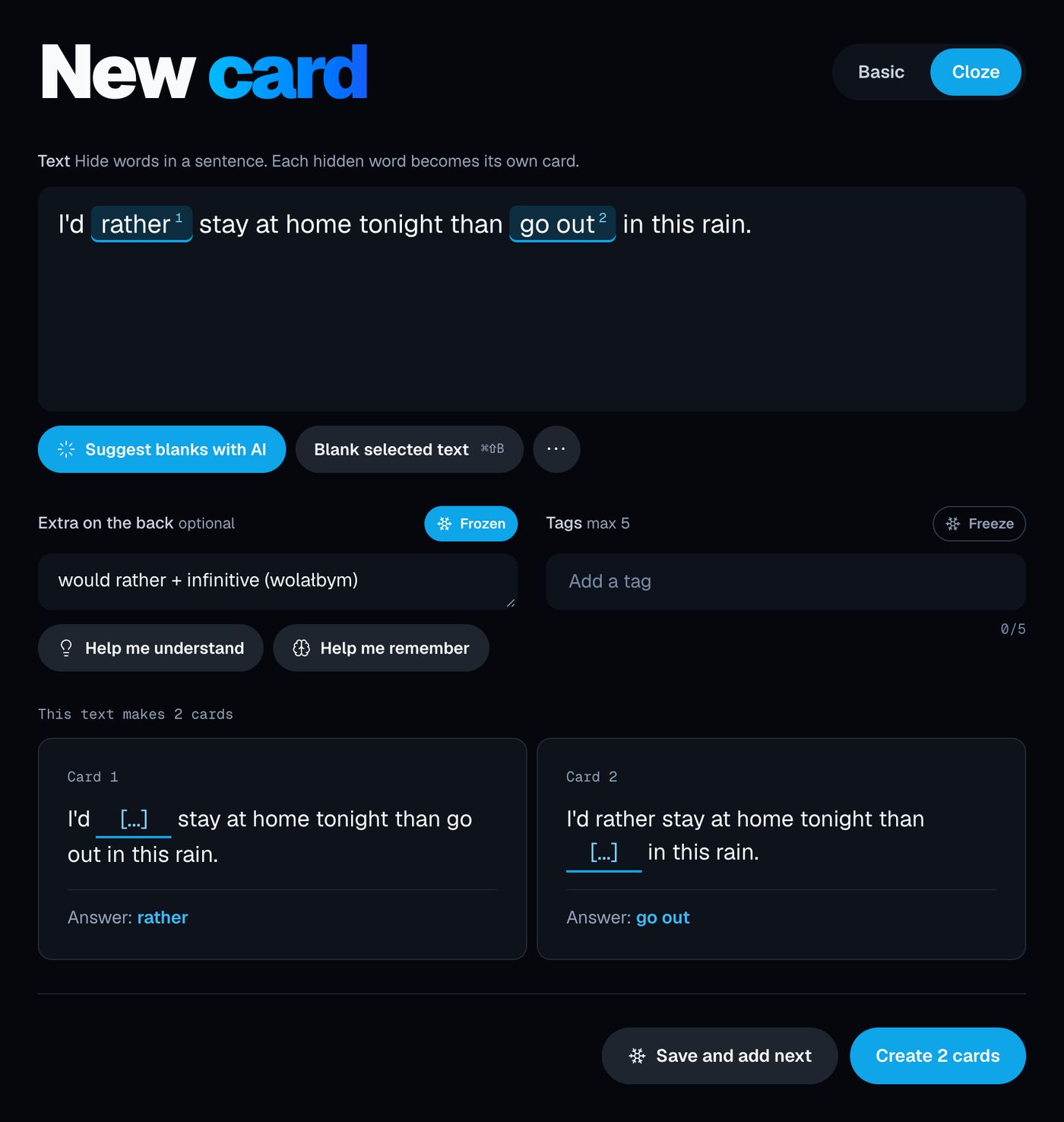
Compare the explanation with the dictionary entry before you keep it. In the card form, the text goes into the notes field. Nothing is saved until you save the card. On the review answer, the text opens in a Study help
sheet with an editable box. Fix it there and press Save as note
, or press Close
to throw it away. The second button, Help me remember
, writes a memory hook, and the memory tricks post explains how to judge one.
A card for understanding
For idioms you only need to recognise, make a Basic card. Put a full sentence with the idiom on the Front. Then select the idiom and press Highlight, or Cmd/Ctrl+U, so the review underlines it. On the Back, write the meaning in your own words. Here is an example I wrote:
Front: I've sent them our offer, so the ball is in their court now.
Back:  They have to act next before anything can happen.
Notes: Tennis. The ball is on their side, so they must play the next shot.
Translate
under the Back can fill it from the Front in a language you pick. Check that the translation keeps the meaning of the idiom and not just its words. If you use Improve
on the Front, add the highlight afterwards, because Improve
replaces the whole text and its result has no highlights.
A card for using the idiom
To say an idiom yourself, the card has to make you produce it. Press New card
, switch the type to Cloze, and blank the whole idiom. Use its meaning as the hint:
We've done enough for today. Let's {{c1::call it a day::stop working}}.
The review shows the hint under the empty box. So the card asks which idiom means stop working
in this sentence. Write informal
in Extra on the back
so the register appears with the answer.
When you already know an idiom and keep getting one word wrong, blank only that word, as in Don't {{c1::spill}} the beans. The collocations post uses hints another way, for the word in your own language that pulls you toward the wrong partner word. Phrasal verbs such as give up have a post of their own.
Basic cards can train production too. Start the review in Back → Front
, read the meaning, and say the English sentence. Cloze cards are never flipped, in that mode or in Random
, so they always show the blank first.
Tag and review
Give every idiom card an idioms tag. In the Library, click the tag chip to filter the table. Add the Forgot difficulty chip to see the idioms you keep missing. If two idioms with close meanings end up there together, give each one a sentence from a clearly different situation.
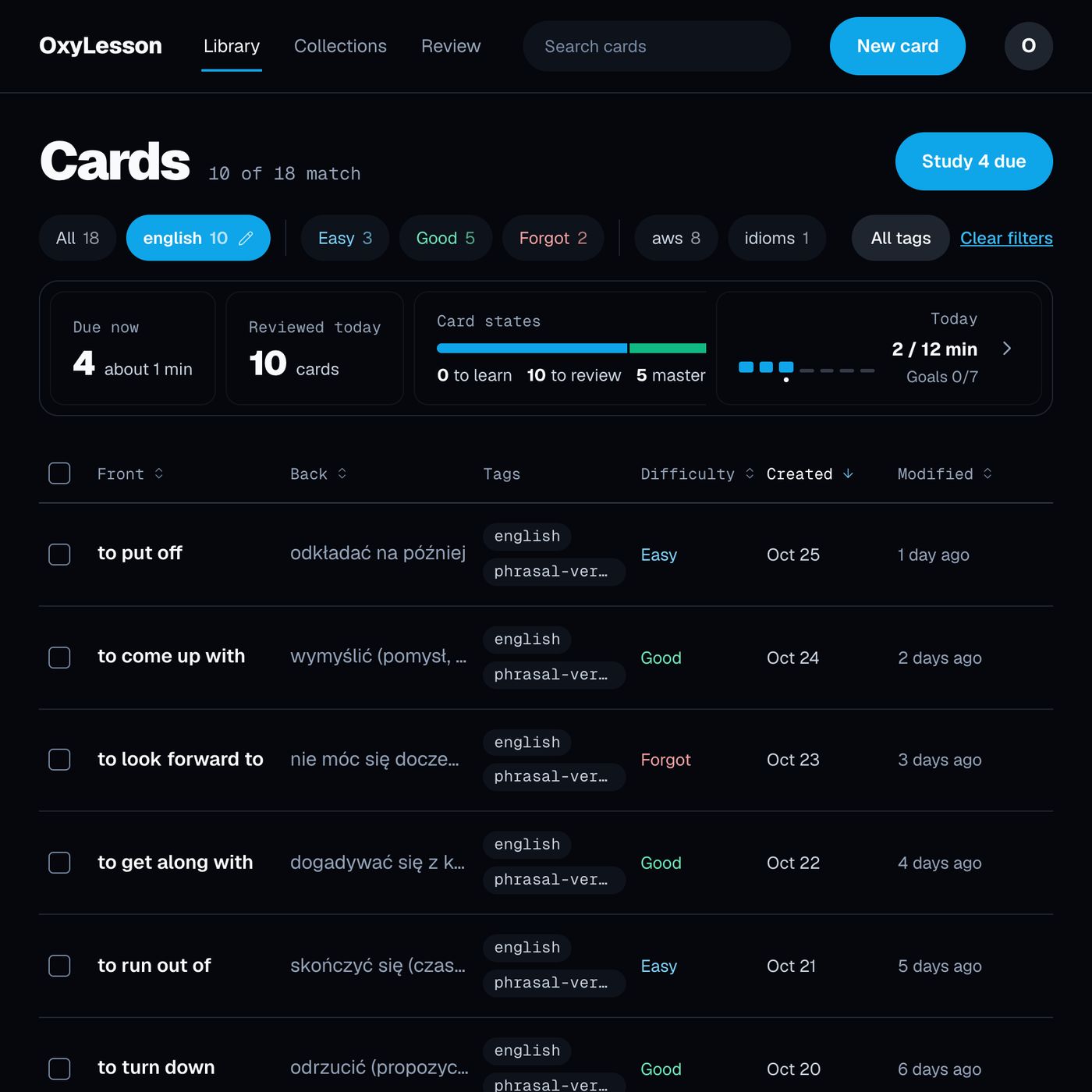
OxyLesson schedules every card with FSRS, and you do not have to set anything up. A review shows only the cards that are due, and you cannot study ahead. If you want an idiom ready for a meeting tomorrow, say the sentence aloud a few times yourself instead of waiting for the card to come back.
Sources:
- Boers, F., Eyckmans, J., & Stengers, H. (2007). Presenting figurative idioms with a touch of etymology: More than mere mnemonics? Language Teaching Research, 11(1), 43-62. https://doi.org/10.1177/1362168806072460
- Cambridge Dictionary. Entries for the ball is in someone's court, break the ice, call it a day, a piece of cake, under the weather and hit the nail on the head. https://dictionary.cambridge.org/
- Cooper, T. C. (1999). Processing of idioms by L2 learners of English. TESOL Quarterly, 33(2), 233-262. https://doi.org/10.2307/3587719
- Liu, D. (2003). The most frequently used spoken American English idioms: A corpus analysis and its implications. TESOL Quarterly, 37(4), 671-700. https://doi.org/10.2307/3588217
- Martinez, R., & Schmitt, N. (2012). A Phrasal Expressions List. Applied Linguistics, 33(3), 299-320. https://doi.org/10.1093/applin/ams010
- Merriam-Webster. Words and phrases with 'bean' in them (entry on spill the beans). https://www.merriam-webster.com/wordplay/words-and-phrases-containing-bean
- Steinel, M. P., Hulstijn, J. H., & Steinel, W. (2007). Second language idiom learning in a paired-associate paradigm: Effects of direction of learning, direction of testing, idiom imageability, and idiom transparency. Studies in Second Language Acquisition, 29(3), 449-484. https://doi.org/10.1017/S0272263107070271
Cover photo by fendermama10 on Pixabay.