Should you learn words or phrases? Collocations on flashcards
Learn phrases. Learn each new word with the word it usually goes with, such as take a photo or ...
By Kamil
7 mins read

Learn phrases. Learn each new word with the word it usually goes with, such as take a photo or heavy rain, and make the card ask you for that partner word.
You can know heavy and rain and still say strong rain
. These fixed pairs are called collocations. A dictionary entry for one word rarely shows them, so they need cards of their own.
What learners get wrong
Nesselhauf (2003) looked at verb and noun pairs like take a break or shake one's head in essays by advanced German-speaking learners of English. Her abstract singles out the learners' first language, whose influence went far beyond
what earlier small studies had predicted. Her teaching advice centres on the places where German and English differ.
Laufer and Waldman (2011) built a corpus of about 300,000 words of essays by Hebrew-speaking learners at three levels and compared it with essays by young native speakers of English. They checked the verbs used with the 220 most frequent nouns. Learners at all three levels produced far fewer collocations than the native writers. The number only went up at the advanced level, and errors, especially ones carried over from Hebrew, were still there at that level.
Boers and colleagues (2006) asked whether these phrases change how a learner sounds. They ran a small experiment with 32 college students majoring in English. Over 22 teaching hours, both groups worked with authentic texts and recordings. The 17 students in the experimental group were shown the fixed word combinations in those materials, and the 15 in the control group were not. In interviews afterwards, two judges who did not know the groups rated the experimental students as more proficient. Two other judges counted the fixed phrases in each interview, and those counts went together with the proficiency ratings. The authors call it a small-scale study, and one class of 32 students is a thin base for a general rule.
Why one meeting is not enough
Durrant and Schmitt (2010) tested the idea that adult learners only store single words. Their lab study found that adults do keep track of which words appear together in their input. The authors put the gap in learners' collocations down to too little input rather than to a different way of learning.
Two studies looked at how many meetings it takes. Webb, Newton and Chang (2013) had Taiwanese university students read and listen to a graded reader that contained 18 target collocations 1, 5, 10 or 15 times. More encounters meant more learning, and the authors say that 15 encounters can bring sizeable gains. Peters (2014) gave learners 12 single words and 12 collocations, repeated once, 3 times or 5 times, and asked them to produce each form. Repetition had a large and lasting effect, and the collocations were harder to learn than the single words.
Flashcards let you plan those meetings instead of waiting for them to turn up in your reading. OxyLesson schedules the repeats with FSRS, and there is nothing to configure.
Hide the partner word on a cloze card
In take a photo or heavy rain you usually know the noun already. The verb or adjective next to it is the word you pick wrong, so that is the word the card should hide. In OxyLesson, press New card
, choose Enter manually
and switch the type to Cloze. Here are four example cards I wrote for a Polish speaker. Swap the hints for your own language:
Could you {{c1::take::zrobić}} a photo of us?
I have {{c1::made::zrobić}} a lot of progress with my English.
The match was cancelled because of {{c1::heavy::silny}} rain.
Please {{c1::pay::zwracać}} attention to the dates.
The text after the second pair of colons is a hint, and the review shows it under the empty box. Here the hint is the word from your own language that pulls you toward make a photo or strong rain, the kind of influence Nesselhauf found. Putting that word on the card is my own idea, and no study I found has tested it. Put the full translation in Extra on the back
.
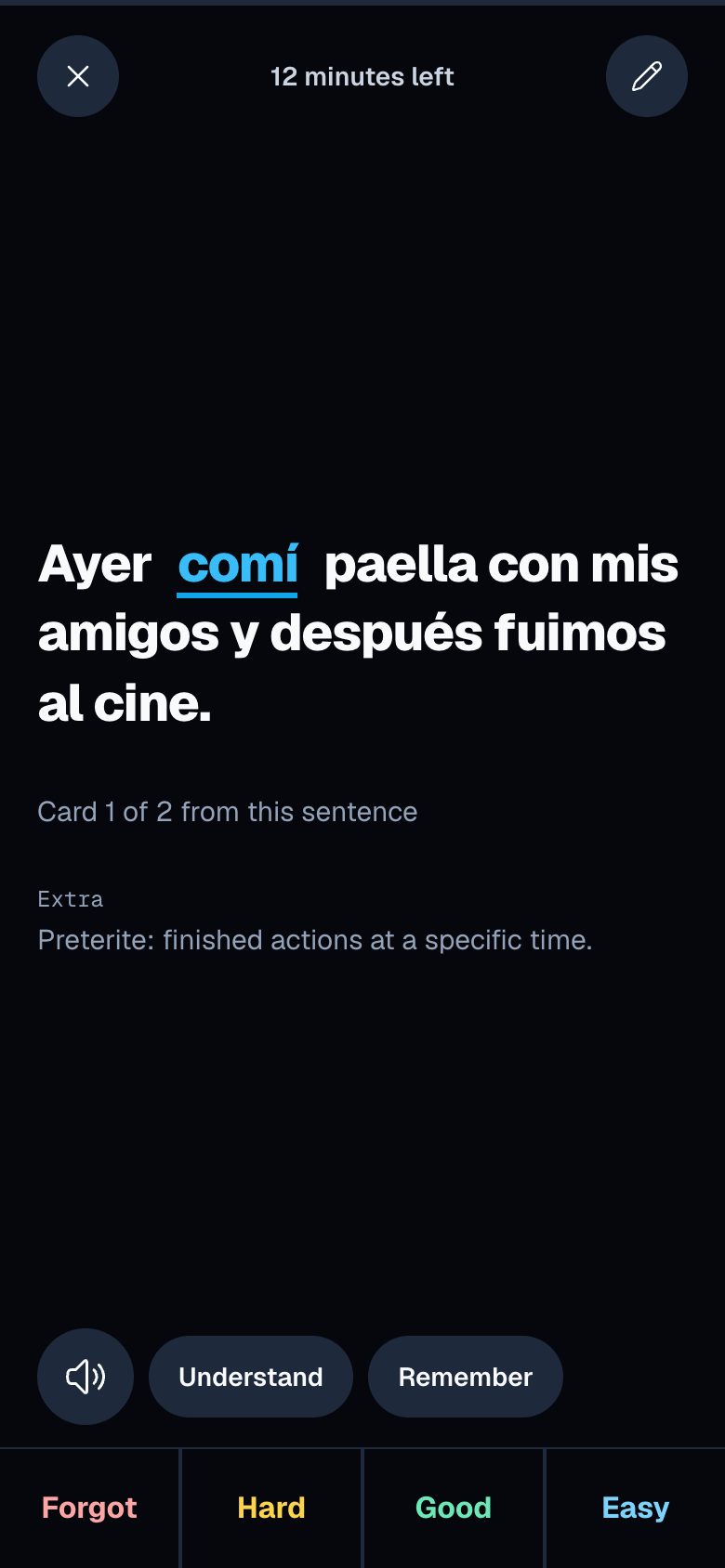
When you answer, the hidden word appears in place inside the sentence, with Extra below it. The speaker on the answer reads the whole sentence. Each time you replay it, the voice slows down a step and keeps its pitch, so you hear the pair inside a sentence.
Use one blank per sentence for collocations. Two numbers in one sentence (c1, c2) make two cards, and each one comes back on its own date. For more on writing cloze cards, see how to create effective flashcards.
Turn single words into phrases with Improve
If you already have cards like decision with a translation on the back, perhaps from an Anki import, fix them in the card form. Improve
works on one side at a time and needs both sides filled. Its instructions tell the model to replace an isolated word or short phrase with one short, everyday sentence that uses it. Press it on the Front first. When you press it on the Back, the instructions ask for a translation of the whole sentence.
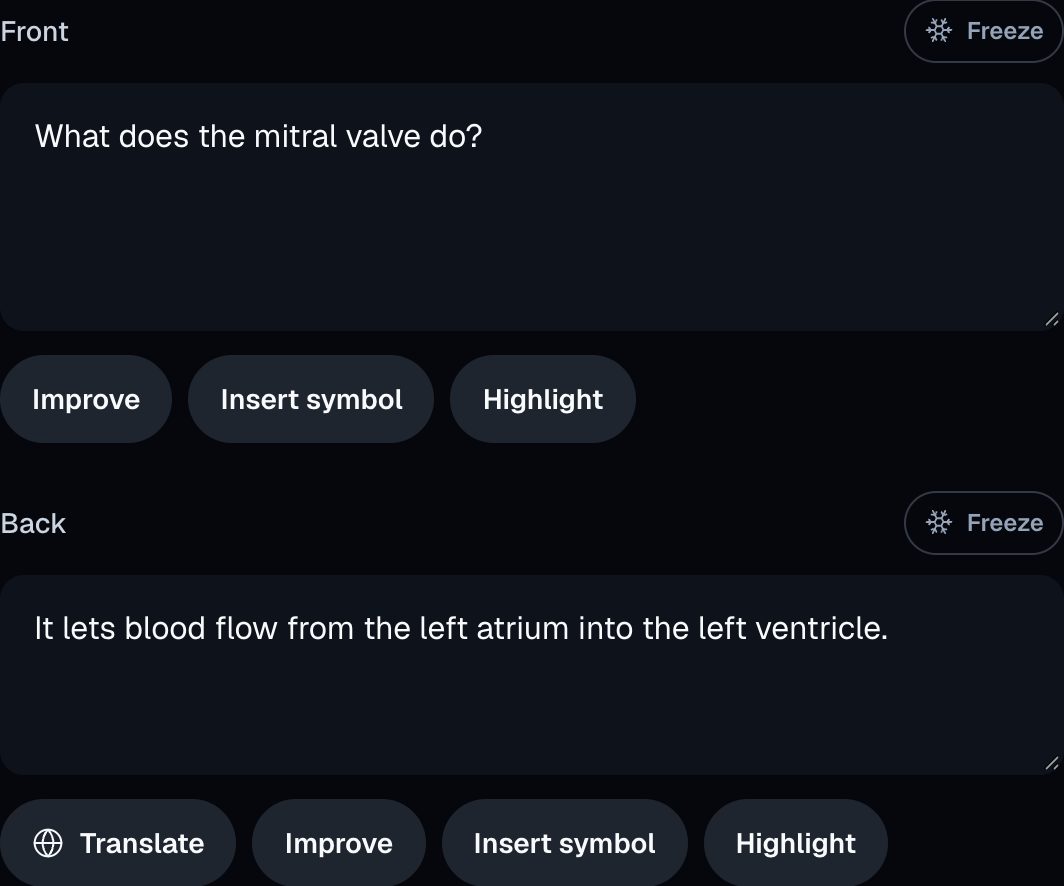
The model picks the partner words, so check the result. Ask yourself whether the verb is the one you would hear from a native speaker, and look the pair up in a collocation dictionary if you are not sure. Then select the pair on the Front and press Highlight, or Cmd/Ctrl+U. The review underlines it, so you can see which words the card tests. Add the highlight last, because Improve and Translate replace the whole text and their result has no highlights.
Bring a list in with one paste
If you collect pairs while reading, add them in one go. Press New card
, choose Import Anki, TXT or CSV
and paste one card per line in the format the page shows: front;back;notes;tag1,tag2. A line whose front holds a cloze blank becomes a cloze note, and its back and notes go into Extra:
Could you {{c1::take::zrobić}} a photo of us?;Czy możesz zrobić nam zdjęcie?;;collocations
The match was cancelled because of {{c1::heavy::silny}} rain.;Mecz odwołano z powodu silnego deszczu.;;collocations,weather
The import button counts the cards before you press it (Import 2 cards
). Keep semicolons out of your sentences, because the import splits columns at them.
Review the pairs you still get wrong
Search cards
looks through the front, the back and the notes. Before you add a new pair, type the noun, for example rain, and you will see every card you already have with it.
Once a week, open the Library, select your collocations tag together with the Forgot difficulty chip, and look at what is there. If the same pair from your own language keeps catching you, write one more sentence with it. Webb and Peters both found that more encounters mean better recall, and a second sentence gives you another one in a new context. Collocations you get wrong when you speak belong in a mistakes log. Phrasal verbs like give up have a post of their own.
Sources:
- Boers, F., Eyckmans, J., Kappel, J., Stengers, H., & Demecheleer, M. (2006). Formulaic sequences and perceived oral proficiency: Putting a Lexical Approach to the test. Language Teaching Research, 10(3), 245-261. https://doi.org/10.1191/1362168806lr195oa
- Durrant, P., & Schmitt, N. (2010). Adult learners' retention of collocations from exposure. Second Language Research, 26(2), 163-188. https://doi.org/10.1177/0267658309349431
- Laufer, B., & Waldman, T. (2011). Verb-noun collocations in second language writing: A corpus analysis of learners' English. Language Learning, 61(2), 647-672. https://doi.org/10.1111/j.1467-9922.2010.00621.x
- Nesselhauf, N. (2003). The use of collocations by advanced learners of English and some implications for teaching. Applied Linguistics, 24(2), 223-242. https://doi.org/10.1093/applin/24.2.223
- Peters, E. (2014). The effects of repetition and time of post-test administration on EFL learners' form recall of single words and collocations. Language Teaching Research, 18(1), 75-94. https://doi.org/10.1177/1362168813505384
- Webb, S., Newton, J., & Chang, A. (2013). Incidental learning of collocation. Language Learning, 63(1), 91-120. https://doi.org/10.1111/j.1467-9922.2012.00729.x
Cover photo by PublicDomainPictures on Pixabay.