Do memory tricks work for vocabulary? Keyword method, memory palace and pictures
Memory tricks help you learn a new word fast, but in experiments the keyword method's lead faded ...
By Kamil
8 mins read

Memory tricks help you learn a new word fast, but in experiments the keyword method's lead faded within days unless the words were reviewed. A memory palace works best for ordered lists.
So use a trick as the first hook for a hard word, let spaced reviews keep the word for months, and check any hook from OxyLesson's Help me remember
before you save it.
The keyword method
The keyword method has two steps. First you find a word in your own language that sounds like part of the new word. Then you picture that keyword together with the meaning. Atkinson and Raugh described it as a chain with two links: a sound link from the foreign word to the keyword, and an image link from the keyword to the translation.
Here is an example of my own. The Spanish pato means duck
. Pato starts like the English pot
, so you picture a duck sitting in a cooking pot. When you meet pato again, pot
brings back the picture, and the picture brings back the duck.
In their experiment with Russian vocabulary, the keyword group scored 72% on the main test and the control group, who studied in their own way, scored 46% (Atkinson & Raugh, 1975).
Why the lead fades
Wang and Thomas compared the keyword method with learning each word in a meaningful sentence. The keyword group did better on a test right after study. Two days later the result reversed, and the sentence group recalled more. This happened with rare English words and with second-language vocabulary. In a third experiment, more practice helped the keyword learners more than the sentence learners. The authors concluded that keyword memories are fragile and need repeated testing (Wang & Thomas, 1995).
A large 2013 review of study techniques rated the keyword mnemonic as low utility. It is hard to use in some contexts, and it seems to help for a limited number of materials and for short retention intervals
(Dunlosky et al., 2013). A hook gets the word into memory, and reviews spread over days keep it there. Our article Do flashcards really help in language learning? covers the evidence for those reviews.
The memory palace
The memory palace, also called the method of loci, puts each item at a point along a route you know well, such as the rooms of your flat. To recall, you walk the route in your mind.
A meta-analysis of 13 randomised trials, mostly run at universities, found that the method helps memory with a medium effect, although most of the studies had a high risk of bias (Twomey & Kroneisen, 2021). A newer review found strong evidence for a large effect on immediate recall of items in order, compared with rehearsal, and rated the quality of that evidence low to very low (Ondřej, 2025).
Dresler and colleagues studied 23 memory athletes. The athletes recalled about 71 of 72 concrete nouns 20 minutes after study, and matched controls recalled about 40. Beginners who practised the method for 30 minutes a day over 40 days improved more than both control groups, and the gain could still be measured four months later (Dresler et al., 2017).
All of these tests asked people to recall a list. Vocabulary is a different task: thousands of separate pairs, each a word and its meaning, asked in any order. A palace with thousands of stops is hard to build and harder to walk. Use it for a fixed list you must give in order, such as the points of a talk. For the 10 times faster
claims you see online, none of these studies reports a gain of that size.
Pictures on cards
Carpenter and Olson taught Swahili words with pictures or with English translations. Under ordinary study conditions, the words were not learned better from pictures. Learners were more confident that they would remember a word from a picture, and that confidence did not match their recall. When retrieval practice or a warning removed the overconfidence, the pictures did help (Carpenter & Olson, 2012).
In OxyLesson, Search library
next to Front image (optional)
and Back image (optional)
finds a photo for the card. The image follows the review direction. In Front → Back
the back image appears with the answer. In Back → Front
it becomes part of the question. In both cases, press Forgot
when you could not say the word, even if the photo felt familiar.
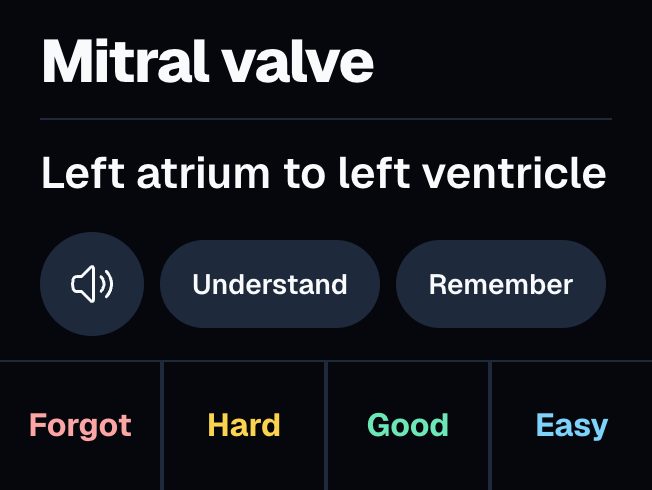
What Help me remember
does
Help me remember
asks a language model for one vivid association or mnemonic that links the front of the card to the back, in a few short sentences. It writes in the language of the card's front and in plain text. It sees only the text of the two sides.
You find it in two places. In the card form it sits under Notes, next to Help me understand
, and adds the hook to the Notes field. Nothing is saved until you save the card, so you can edit the text first. During a review it appears only after you reveal the answer. There it opens a Study help
sheet with the text in an editable box, Close
and Save as note
. Save as note
adds the text to the card's note (to Extra on a cloze card), and Close
discards it. Image occlusion cards do not have the buttons.
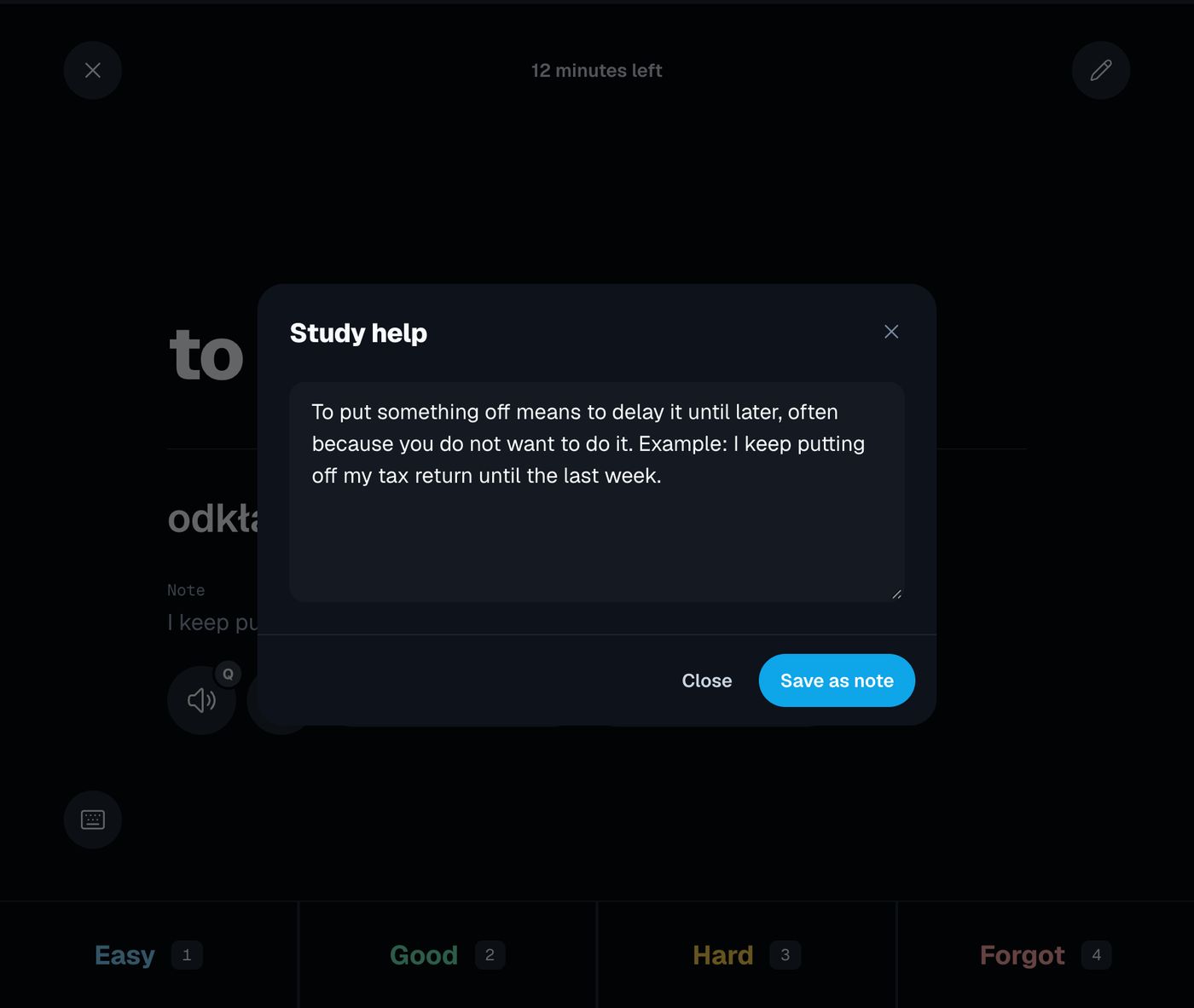
The note shows on the answer side only. So the hook never gives you the answer early: you try to recall first, and then you see the hook. That order matches the Wang and Thomas result, where keyword memories needed repeated testing.
How to judge a hook before you save it
Treat a generated hook as a draft. Check it against these points and edit it in the sheet or in Notes:
- The sound link is real. The model works from the spelling, so play the card's audio and check that the keyword sounds like part of the word.
- You can see the picture at once. A duck in a pot is one image. A hook that needs a story of four steps is hard to replay in the second before you answer.
- It points to the right meaning. A keyword that suggests a similar word with another meaning will mislead you.
- It is short. One or two sentences are easier to read in the second after you reveal the answer.
- It fits you. Change the keyword to a word or place that means something to you.
If a hook fails these checks, close the sheet and save nothing. For abstract words like aunque (although
), a picture is hard to find, and a sentence like the ones in the Wang and Thomas study is easier to write. Help me understand
gives a short explanation with an example sentence, and a cloze card can hide the word in that sentence.
When to drop the hook
When a card comes back after long gaps and you know the word before you think of the picture, the hook has done its job. You can leave it in the note or remove it: press E
or the pencil during the review to edit the card. If you keep pressing Forgot
on a card with a hook, write a better hook, or replace it with a sentence.
Sources:
- Atkinson, R. C., & Raugh, M. R. (1975). An application of the mnemonic keyword method to the acquisition of a Russian vocabulary. Journal of Experimental Psychology: Human Learning and Memory, 1(2), 126-133. https://doi.org/10.1037/0278-7393.1.2.126
- Carpenter, S. K., & Olson, K. M. (2012). Are pictures good for learning new vocabulary in a foreign language? Only if you think they are not. Journal of Experimental Psychology: Learning, Memory, and Cognition, 38(1), 92-101. https://doi.org/10.1037/a0024828
- Dresler, M., Shirer, W. R., Konrad, B. N., Müller, N. C. J., Wagner, I. C., Fernández, G., Czisch, M., & Greicius, M. D. (2017). Mnemonic training reshapes brain networks to support superior memory. Neuron, 93(5), 1227-1235. https://doi.org/10.1016/j.neuron.2017.02.003
- Dunlosky, J., Rawson, K. A., Marsh, E. J., Nathan, M. J., & Willingham, D. T. (2013). Improving students' learning with effective learning techniques. Psychological Science in the Public Interest, 14(1), 4-58. https://doi.org/10.1177/1529100612453266
- Ondřej, J. (2025). The method of loci in the context of psychological research: A systematic review and meta-analysis. British Journal of Psychology. https://doi.org/10.1111/bjop.12799
- Twomey, C. D., & Kroneisen, M. (2021). The effectiveness of the loci method as a mnemonic device: Meta-analysis. Quarterly Journal of Experimental Psychology, 74(8), 1317-1326. https://doi.org/10.1177/1747021821993457
- Wang, A. Y., & Thomas, M. H. (1995). Effects of keyword on long-term retention: Help or hindrance? Journal of Educational Psychology, 87(3), 468-475. https://doi.org/10.1037/0022-0663.87.3.468
Cover photo by geralt on Pixabay.