Can you learn grammar with flashcards?
Yes, if each card makes you produce one grammar form inside a full sentence. Research on taught g...
By Kamil
7 mins read

Yes, if each card makes you produce one grammar form inside a full sentence. Research on taught grammar shows clear gains, and spaced practice helps grammar stay with you.
A card that asks for a rule (When do we use the present perfect continuous?
) trains you to recite the rule. To use the form when you speak, hide it in a real sentence and keep the rule in the card's notes, where you read it after you answer.
The case against studying grammar
The best-known argument against grammar study comes from Stephen Krashen. In Principles and Practice in Second Language Acquisition (1982), he separates two processes. Acquisition is subconscious: you pick up a language by understanding messages, and you end up with a feel for what sounds right. Learning is conscious knowledge of rules, the kind you can explain.
Krashen does not call grammar useless. He gives conscious rules one job: Learning has only one function, and that is as a Monitor, or editor.
You can use a rule to check what you say or write, but only when you have time, are paying attention to form, and actually know the rule. In normal conversation those conditions rarely hold. His harder claim is that learned rules do not turn into acquired ones, even with practice. On that view, fluency comes from comprehensible input, and grammar study adds little to it.
What the meta-analyses found
Norris and Ortega (2000) pooled experimental and quasi-experimental studies of second language instruction published between 1980 and 1998, 49 unique samples in all. They found that focused instruction produced large gains on the targeted forms, that explicit instruction, which draws the learner's attention to the rule, worked better than implicit instruction, and that the effects were durable.
They also listed limits. The kind of test a study used probably affected how large the effect looked, and they wrote that the field had not yet defined and replicated its core terms well enough to generalize with confidence. Krashen would expect the test to matter, since a test that gives you time to think is where his Monitor can work.
Spada and Tomita (2010) took up a narrower question. They pooled 41 studies of English grammar features, sorted each feature as simple or complex by how many criteria you apply to reach the correct form, and compared explicit and implicit instruction. Explicit instruction had larger effects for both simple and complex features, and it improved both controlled knowledge and spontaneous use of the forms. The analysis covers English only, and the simple and complex labels depend on one way of counting rules.
For the popular claim that science proved grammar study is useless
, these two meta-analyses found the opposite. They say nothing against Krashen's view that you need a lot of reading and listening.
What the studies do not say
None of these meta-analyses tested flashcards; they pooled studies of instruction. A flashcard brings a form back until you can produce it without stopping to think.
There is direct evidence for spacing that practice. Bird (2010) taught learners distinctions in the English tense and aspect system on short and long practice intervals. On the long-term tests, the spaced group scored higher, which matches what spacing does for other kinds of learning. OxyLesson schedules every card with FSRS, which brings a card back before you are likely to forget it, and there is nothing to configure.
One form per card, inside a sentence
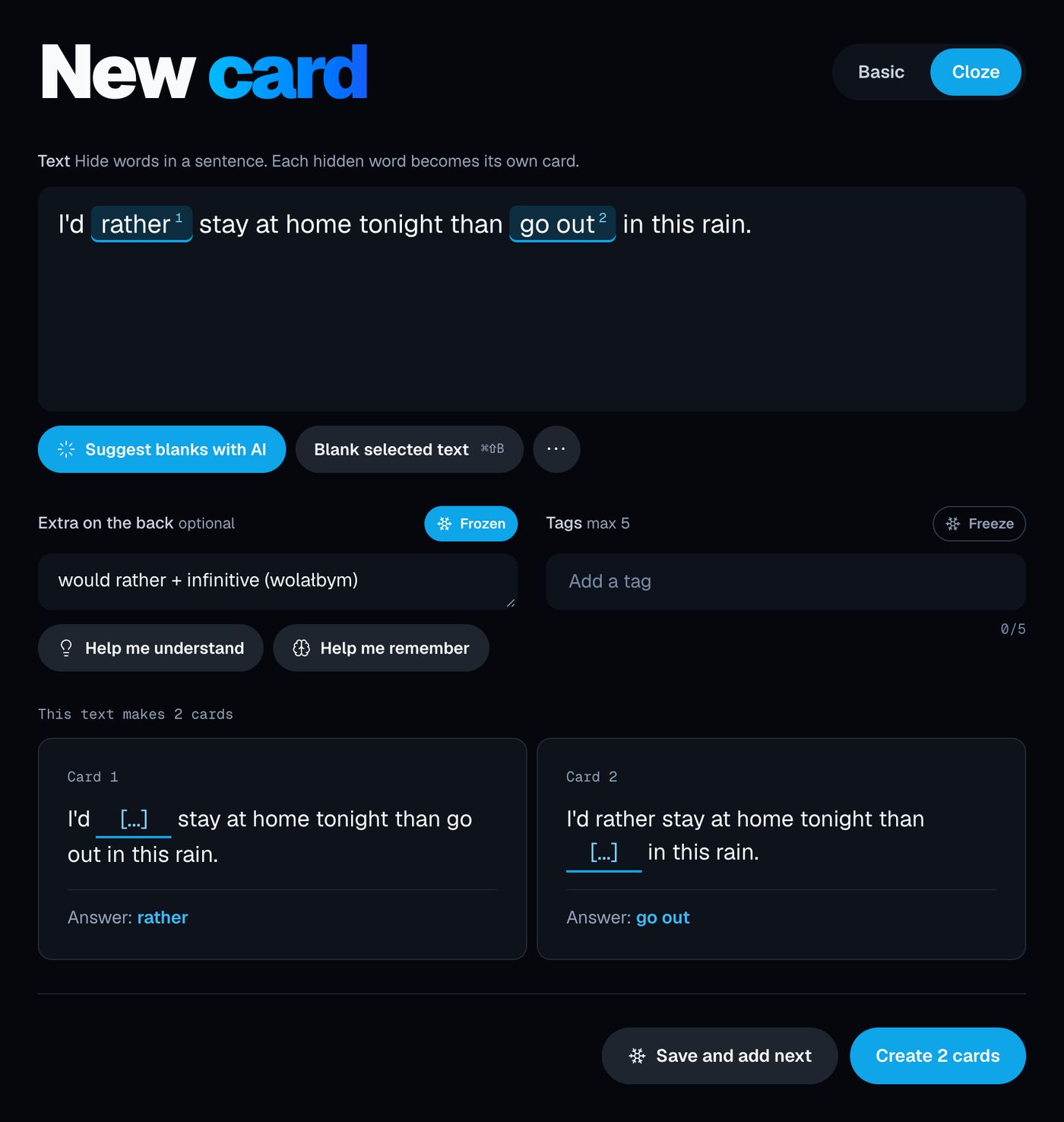
In the card form, switch to Cloze and type a sentence you would really say. Select the part that carries the grammar and press Blank selected text
(Cmd+Shift+B on a Mac, Ctrl+Shift+B elsewhere). Each blank number becomes its own card with its own schedule. The rule goes in Extra on the back
, which shows on the answer.
A hint after a second pair of colons turns a blank into a classic gap-fill. In this example card, the front shows [wait] where the verb was, and you have to build the full form:
I {{c1::have been waiting::wait}} for twenty minutes.
Suggest blanks with AI
proposes single words worth hiding, each with a short reason, and you keep or skip each one. Because it suggests single words, it fits grammar that sits in one word, such as a preposition or a quantifier. A form of several words, like the one above, you select yourself.
Put the explanation in the notes
Under Extra on the back
are two buttons, Help me understand
and Help me remember
. Help me understand
asks a language model for a short explanation of what the card means plus one example sentence, and adds it to the field. You can edit it before you save, so you can cut it down to the one point you keep getting wrong.
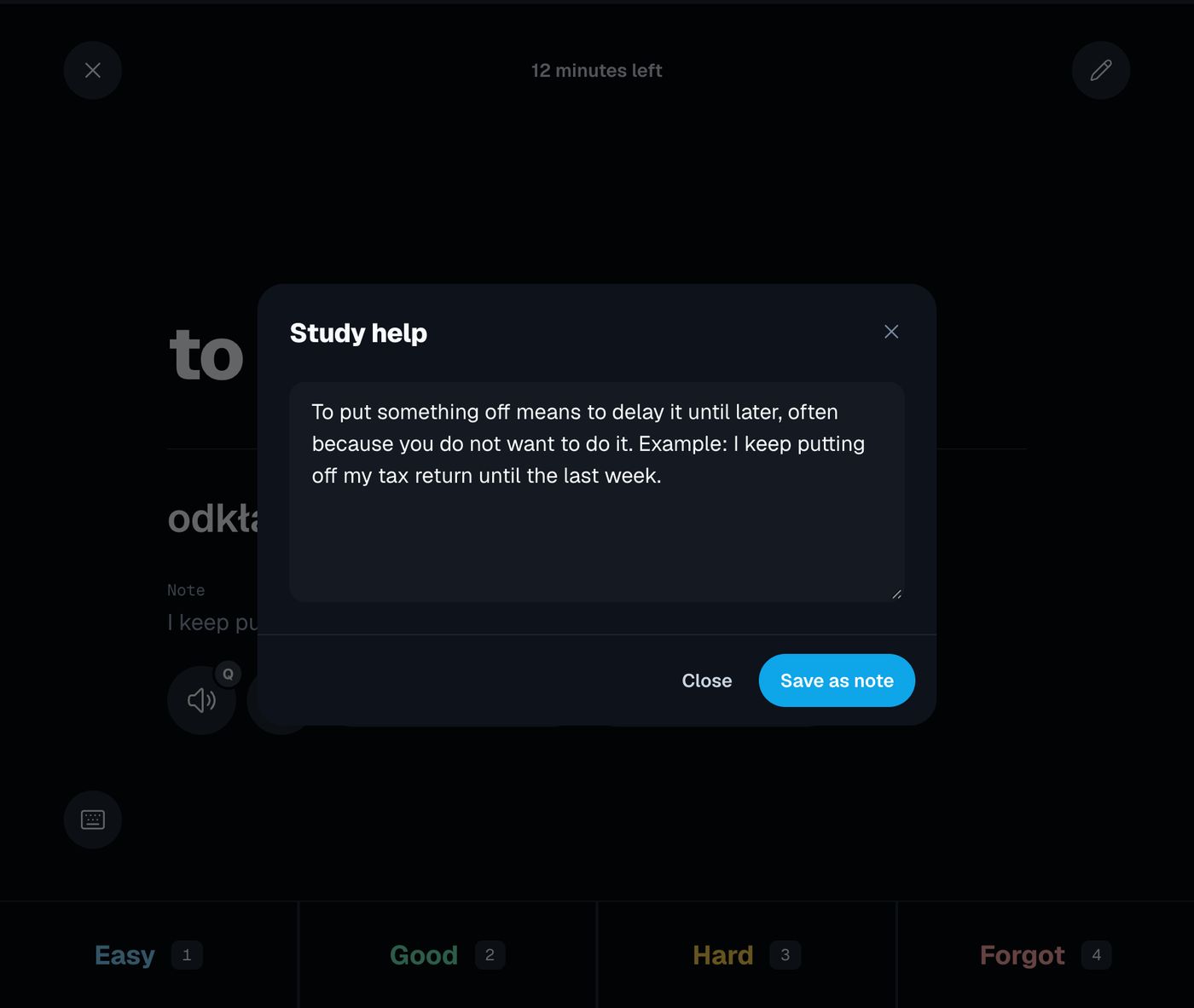
The same buttons appear on the review answer. If a card keeps catching you, open Help me understand
right there. The text opens in a Study help
sheet you can edit, and Save as note
adds it to the card's Extra, so every card from that sentence shows it from then on. Because the explanation sits on the answer side, you always try to produce the form before you read it.
Change one word per card
Once a sentence works, make variants that change one thing: the subject, a question, a negative. Turn on Freeze
next to Extra on the back
and Tags, then use Save and add next
. The next form keeps your explanation and tags, so you only type the new sentence. These are example cards:
She {{c1::'d rather}} walk than take the bus.
{{c1::Would}} you rather stay in or go out?
I'd rather {{c1::not}} talk about it now.
Each sentence is its own note with its own schedule. If you only ever get the question form wrong, only that card comes back often.
Start from a collection, then add sentences
OxyLesson's free Quantifiers collection under Ready-made decks
has eight word cards: some, any, no, all, every, many, much and a lot. Import them with Import selected
. A word with its translation tells you what any means, but not when to use it. Write cloze sentences for the pairs you mix up:
There's {{c1::some}} milk in the fridge.
Is there {{c1::any}} milk left?
How to grade a grammar card
If you produced the wrong form, press Forgot
, even if you knew the meaning. Hard
is for the right form that took effort. Cloze cards always show the blank first, also in Back → Front
and Random
mode. Tag grammar cards by topic, for example present-perfect, and you can review one topic before a test.
For the basics of cloze cards, see how to create effective flashcards. For the reading and listening side, see learning English from films with subtitles.
Sources:
- Bird, S. (2010). Effects of distributed practice on the acquisition of second language English syntax. Applied Psycholinguistics, 31(4), 635-650. https://doi.org/10.1017/S0142716410000172
- Krashen, S. D. (1982). Principles and Practice in Second Language Acquisition. Pergamon. Internet edition (2009): https://www.sdkrashen.com/content/books/principles_and_practice.pdf
- Norris, J. M., & Ortega, L. (2000). Effectiveness of L2 instruction: A research synthesis and quantitative meta-analysis. Language Learning, 50(3), 417-528. https://doi.org/10.1111/0023-8333.00136
- Spada, N., & Tomita, Y. (2010). Interactions between type of instruction and type of language feature: A meta-analysis. Language Learning, 60(2), 263-308. https://doi.org/10.1111/j.1467-9922.2010.00562.x
Cover photo by Pexels on Pixabay.