English phrases for travel: building a deck you can actually say
Pick 15 to 30 phrases for the situations your trip will really contain. Put your language on the ...
By Kamil
8 mins read

Pick 15 to 30 phrases for the situations your trip will really contain. Put your language on the front of each card and the English phrase on the back, then say it aloud before you check.
I suggest that size because it fits into a few minutes of review a day; no study sets the number. Start a few weeks before you leave, so the reviews can be spread out.
Why whole phrases
At a hotel desk you need the whole sentence, I have a reservation under the name Nowak
, ready to say without building it word by word. Boers and colleagues tested the value of such ready-made phrases with 32 college students majoring in English. Over 22 teaching hours, both groups worked with the same authentic listening and reading materials. The experimental group was taught to notice standard word combinations, and the control group was not. In interviews afterwards, two judges who did not know the groups rated the experimental group as more proficient. The number of ready-made phrases each student used went together with the proficiency ratings (Boers et al., 2006). The study was small and measured interviews in class, yet it supports learning the full phrase instead of its parts.
Start from your own trip
Generic lists of 50 travel phrases
cover situations you may never meet. Walk through your own trip and write down every moment where you will have to speak: the ticket machine with a person next to it, the hotel desk, ordering food, paying, asking the way, a delayed flight, a pharmacy.
Add two repair phrases for when you do not understand the answer. You will need them whenever a reply comes faster than you expected.
Write cards you can say
Put the situation on the front, in your own language, and the English phrase on the back. In a conversation nobody shows you the word in your language first; you start from the situation. The reasons for this direction are in Should flashcards go from your language to the target language? Use the notes for the reply you are likely to hear back, or for a word that differs between British and American English.
These are example cards. The fronts are in English here so every reader can follow; write yours in your own language.
| Front | Back | Notes |
|---|---|---|
| At the hotel desk. You booked a room online. | Hi, I have a reservation under the name Nowak. | They may ask: Can I see your passport, please? |
| You didn't catch what someone said. | Sorry, could you say that again more slowly? | Also: Could you write it down, please? |
| Buy a train ticket to London and back. | A return ticket to London, please. | US: a round-trip ticket. In the US a return ticketis only the way back. |
| In a restaurant: you want to pay. | Could we have the bill, please? | US: the check. |
| Your flight is cancelled. Talk to the airline desk. | My flight has been cancelled. What are my options? | Listen for rebookand voucher. |
| You need medicine for a headache. | Is there a pharmacy near here? |
The ticket and bill notes follow the Cambridge Dictionary entries for return ticket
, round trip
and bill
, which mark the British and American uses.
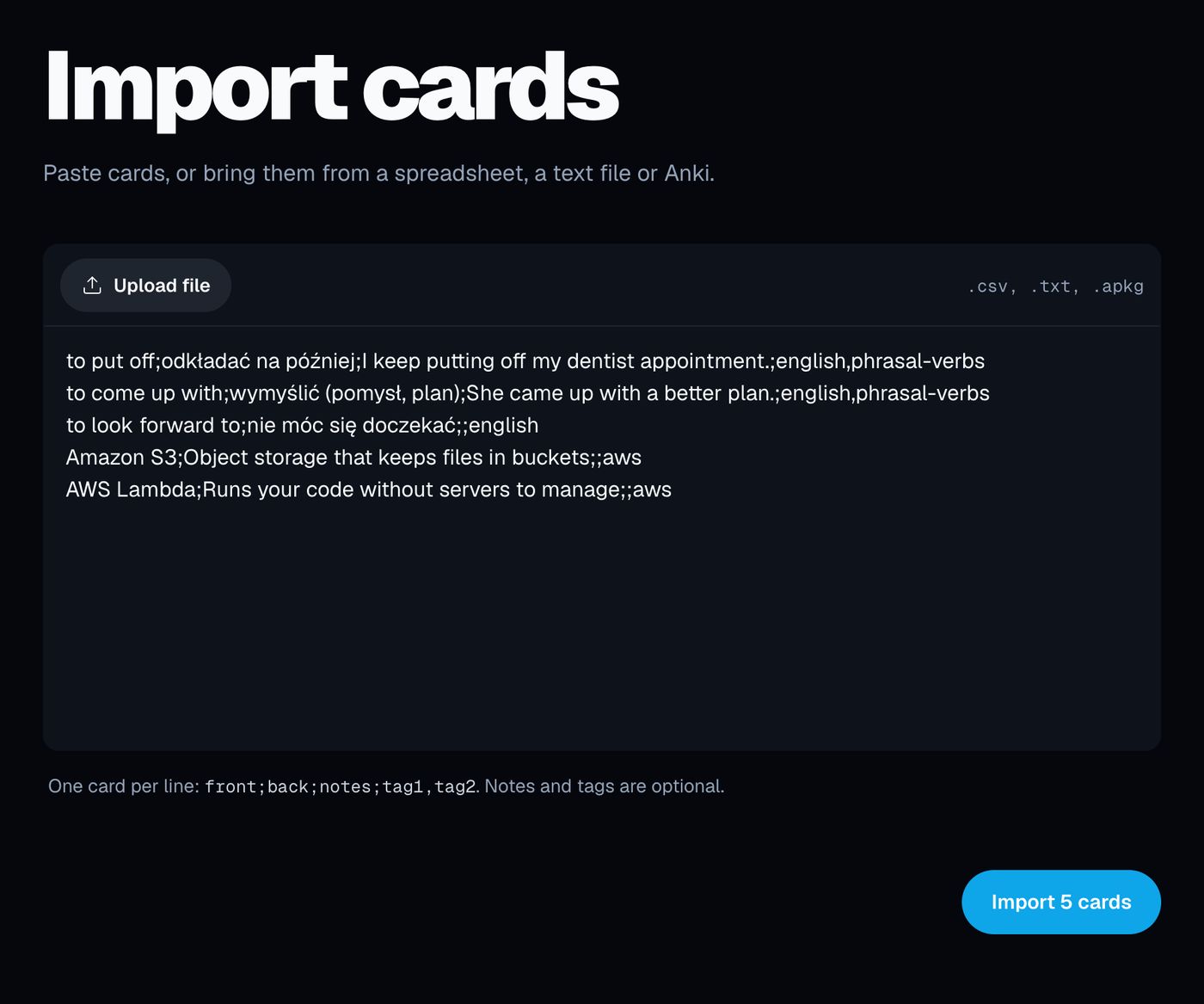
You do not have to type these one by one. On the import page, paste one card per line as front;back;notes;tags:
At the hotel desk. You booked a room online.;Hi, I have a reservation under the name Nowak.;They may ask: Can I see your passport, please?;trip
You didn't catch what someone said.;Sorry, could you say that again more slowly?;Also: Could you write it down, please?;trip
In a restaurant: you want to pay.;Could we have the bill, please?;US: the check.;trip
The button counts the cards as you paste (Import 3 cards
), and every card gets the trip tag.
For a word you keep getting wrong inside a phrase, add a cloze card such as A {{c1::return}} ticket to London, please. The review shows the sentence with a blank for you to fill. For more on card writing, see how to make effective flashcard decks.
Or start from a ready-made deck
OxyLesson's Ready-made decks
include travel collections, and most of them hold single words, such as boarding pass
or check out
. Those help with signs and announcements, but they give you nothing to say at a desk.
The one built from sentences is Travel Info: six questions and requests for train travel, such as What time is the next train (to London)?
and Which platform does the train (to Edinburgh) leave from?
. The words in brackets are the part you replace with your own destination. The first card, I'd like a single / return ticket to (Edinburgh) please.
, offers a choice instead of one sentence you can say. Untick it in the card list and write your own version as above.
On the collection page you choose Card front language
and Card back language
. English is on the front by default; to get production cards, set your own language on the front and English on the back, or press the swap button between the two pickers. The side in your language is filled in with a machine translation, so read it before your first review. Tags (required)
starts with phrases; replace it with trip so these cards join the ones you wrote, then press Import selected
.
Review the trip tag out loud
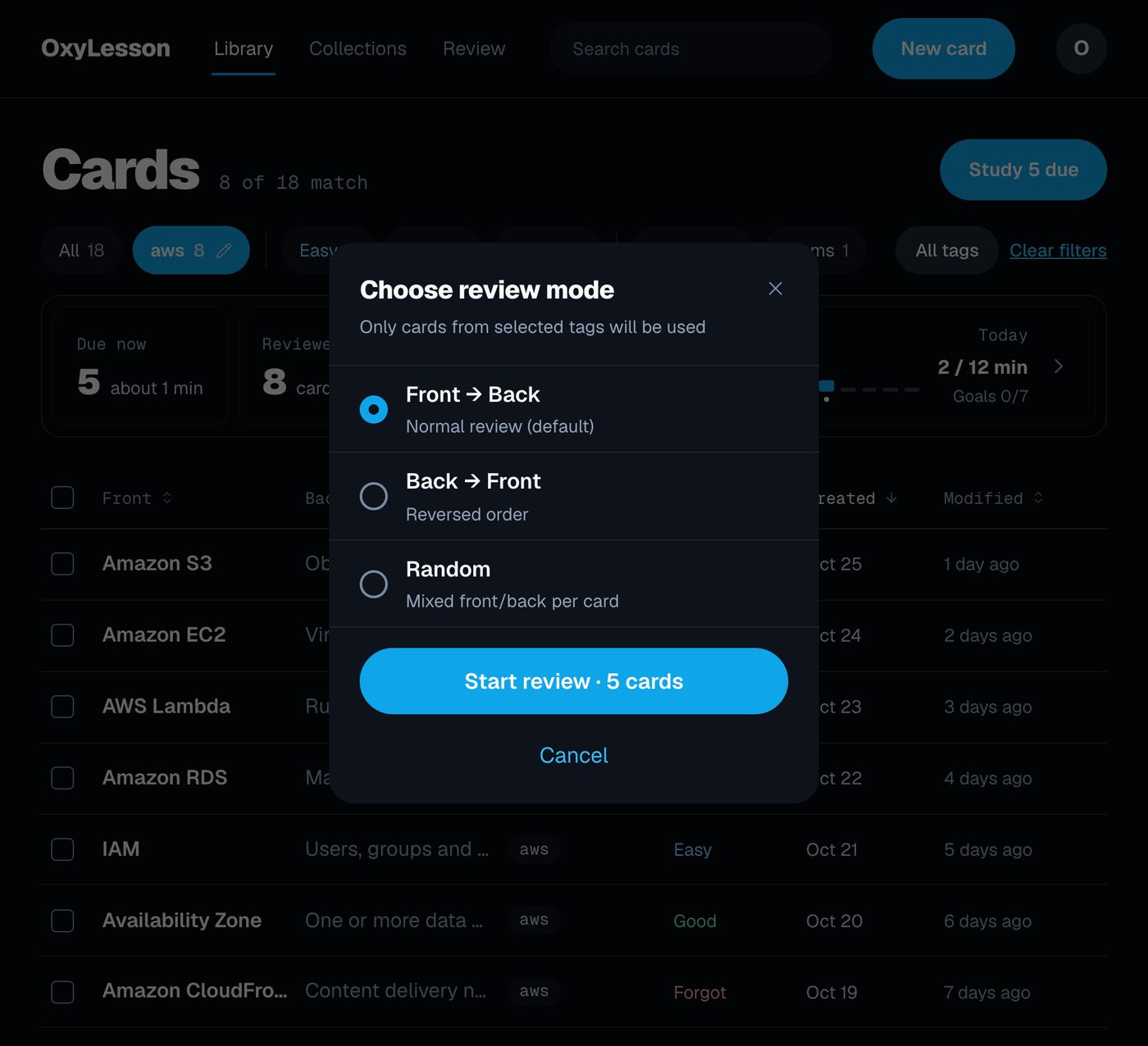
In the library, click the trip tag chip and press Study
. The Choose review mode
dialog then says Only cards from selected tags will be used
. With your language on the front, keep Front → Back
.
For each card:
- Read the situation and say the English phrase out loud.
- Press Space for
Show answer
and compare. - Press the
Akey, or the speaker marked A, to hear a generated voice read the phrase. From the third play of the same side each replay is a little slower, and the voice keeps its pitch. Repeat after it. - Grade what happened in step 1. If you could not say the phrase before the reveal, press
Forgot
, however well you repeat it afterwards.
Why the attempt comes before the audio is covered in Does reading aloud help you remember words?
When to start
The best gap between reviews depends on how long you need to remember. Cepeda and colleagues taught more than 1,350 people a set of facts, gave them one review after a gap of up to 3.5 months, and tested them up to a year later. The best gap grew with the test delay: for a test one week away it was about 20 to 40% of that week, and for a test a year away about 5 to 10% of the year (Cepeda et al., 2008). The study taught trivia facts, so its percentages do not transfer exactly to phrases. For a trip, where you need the phrases for a few weeks, it suggests reviews a few days apart rather than one evening of cramming.
In OxyLesson the scheduler sets those gaps for you. A review session shows only cards that are due. When none of your trip cards are due, it says No cards due for review for selected filters!
instead of letting you cram. My advice is to start two to three weeks before departure, so each phrase gets several spaced reviews in time. Keep reviewing during the trip: OxyLesson works on Android and, as a home-screen web app, on iPhone.
When you get home, write down the moments where you had no phrase and turn them into cards for the next trip. How do you learn from your mistakes in a foreign language? shows that routine.
Sources:
- Boers, F., Eyckmans, J., Kappel, J., Stengers, H., & Demecheleer, M. (2006). Formulaic sequences and perceived oral proficiency: Putting a Lexical Approach to the test. Language Teaching Research, 10(3), 245-261. https://doi.org/10.1191/1362168806lr195oa
- Cambridge Dictionary.
bill
(noun, sense COMMERCE: UK, US check). Cambridge University Press. https://dictionary.cambridge.org/dictionary/english/bill - Cambridge Dictionary.
return ticket
(noun, UK and US senses). Cambridge University Press. https://dictionary.cambridge.org/dictionary/english/return-ticket - Cambridge Dictionary.
round trip
(adjective examplea round-trip ticket
). Cambridge University Press. https://dictionary.cambridge.org/dictionary/english/round-trip - Cepeda, N. J., Vul, E., Rohrer, D., Wixted, J. T., & Pashler, H. (2008). Spacing effects in learning: A temporal ridgeline of optimal retention. Psychological Science, 19(11), 1095-1102. https://doi.org/10.1111/j.1467-9280.2008.02209.x
Cover photo by stux on Pixabay.