Can you learn a language in your sleep?
No. There is no good evidence that words played while you sleep become vocabulary you can use, bu...
By Kamil
7 mins read

No. There is no good evidence that words played while you sleep become vocabulary you can use, but sleep after studying helps you keep the words you learned that evening.
Sleep researchers have tested both ideas. When new words were played during sleep, a lab study found only an implicit trace that showed up in a forced-choice test. When people studied words awake and then slept, they remembered more of them. So the useful version of learning in your sleep
is a routine: study in the evening, sleep, and test yourself on the same words in the morning.
What happens to words played during sleep
Züst and colleagues played word pairs to young adults during a daytime nap. Each pair joined a made-up word with a real German word, such as Haus
. The researchers tracked slow waves, a rhythm of deep sleep, and compared pairs played at different points of that rhythm. Pairs that landed on the peak of a slow wave were more likely to leave a trace. After waking, the trace showed up in an implicit memory test, where the new links guided forced choices. The authors call this implicit learning, and their paper opens by calling the evidence for sleep learning in humans inconclusive (Züst et al., 2019).
A different line of research plays words people have already learned. Schreiner and Rasch had participants learn Dutch words with their German translations. During non-REM sleep, the researchers played some of the Dutch words again. Later, people remembered the German translations of the replayed words better than those of the words that were not replayed. Playing the same words to people who were awake did not help (Schreiner & Rasch, 2015).
Both studies took place in a sleep lab, where brain recordings (EEG) decided when each word was played. The first left only an implicit trace of new words, and the second reinforced words people had learned while awake.
What sleep does for words you studied awake
Gais, Lucas and Born asked high school students to learn lists of 24 English-German word pairs, either at 8 a.m. or at 8 p.m. Recall was tested 24 or 36 hours later. Students forgot much more after studying in the morning, when a full day awake came before their first night, than after studying in the evening. The length of the gap made no clear difference. In a second experiment, students learned at 8 p.m. and either slept or stayed up all night. Two days later, recall was better after sleep, even though the group kept awake had a full night of recovery sleep before the test (Gais et al., 2006).
Mazza and colleagues added a second session after the night. Forty people learned foreign vocabulary until they knew all of it, then relearned it 12 hours later. Half learned in the morning and relearned in the evening of the same day. The other half learned in the evening, slept, and relearned the next morning. The group that slept needed half as much practice to relearn the words and kept far more of them one week and six months later (Mazza et al., 2016).
Together, these studies point to a simple plan: study shortly before bed, and test yourself on the same words soon after you wake up.
The evening and morning routine in OxyLesson
The example cards in this routine are Spanish kitchen words, with the Spanish word on the front and the English one on the back, such as la sartén
(frying pan) and el cazo
(saucepan).
- In the evening, add tonight's words with a shared tag, for example
kitchen. In the card form, pressFreeze
next toTags
and save each card withSave and add next
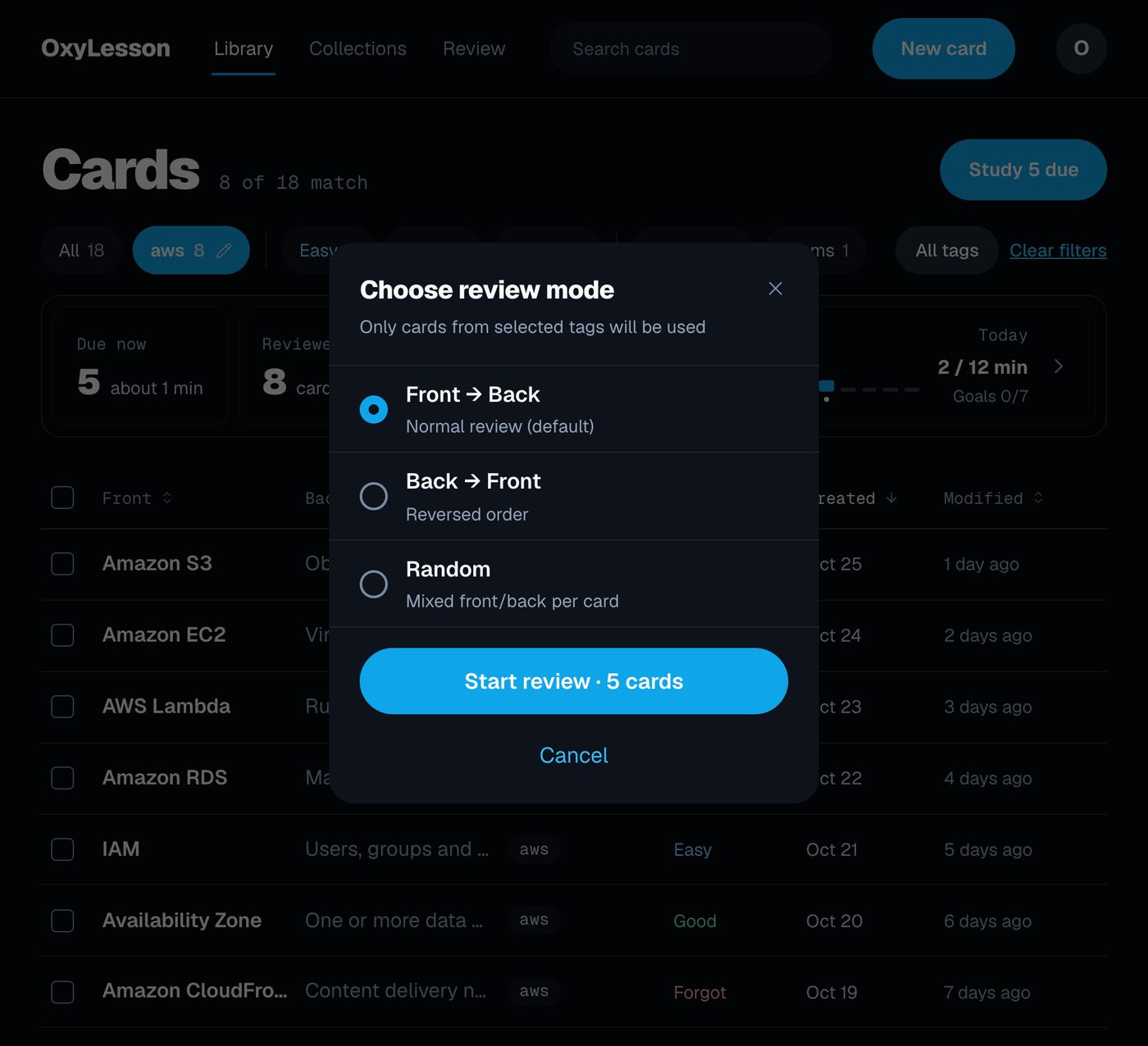
. The tag then stays filled in for every new card. - Start the review from the library filtered by that tag. Click the
kitchenchip, pressStudy
, and keepFront → Back
in theChoose review mode
dialog. The dialog confirmsOnly cards from selected tags will be used
. - After each reveal, press the speaker or the
Akey to hear the word. The audio is a generated voice, and it plays only when you ask for it. If you want to say the word aloud as well, Does reading aloud help you remember words? describes the order that works best. - Grade honestly. A new card, or one you graded
Forgot
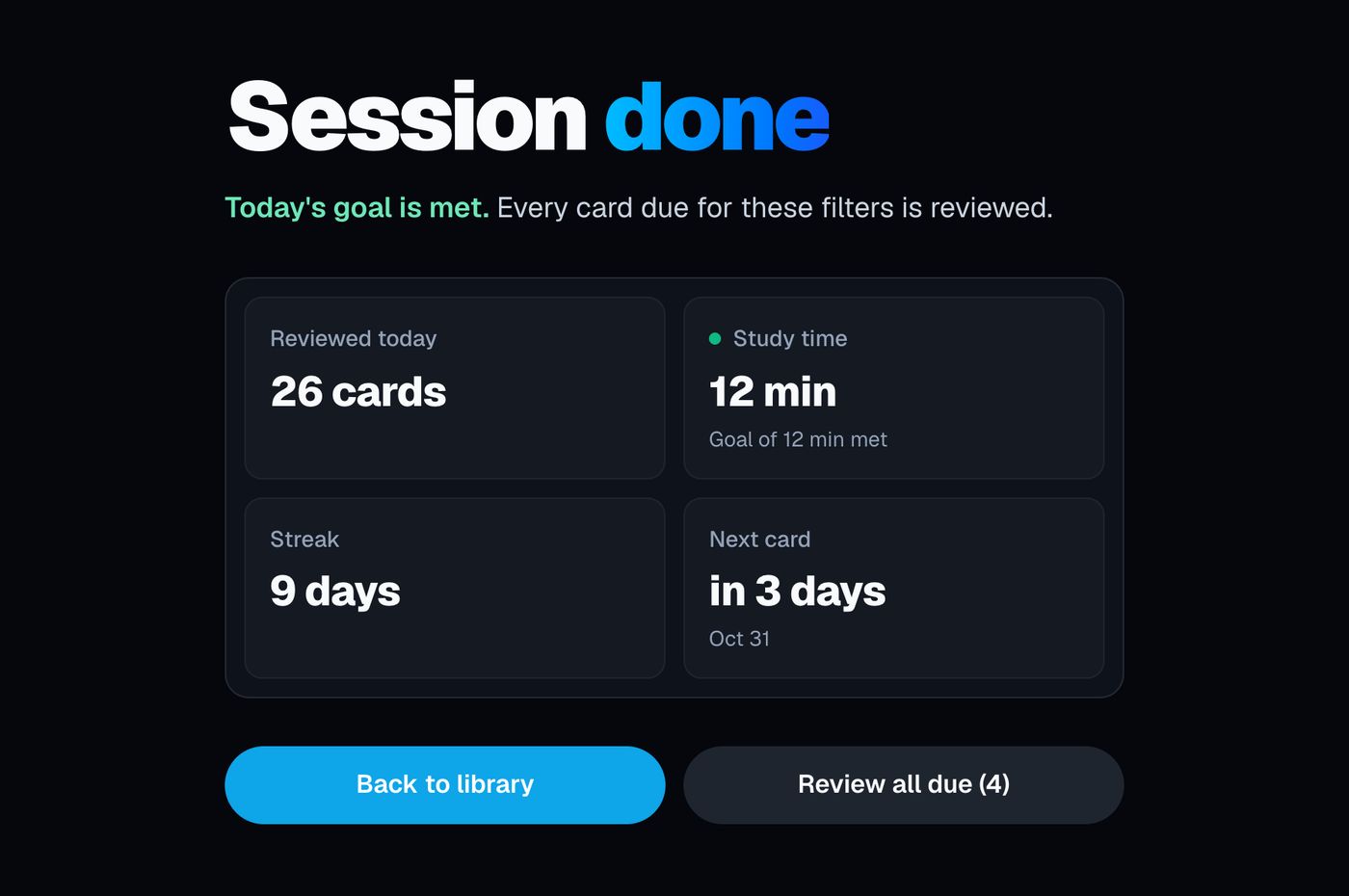
, comes back after a short step of minutes. It moves to a gap of days only after you get it right again. - When nothing is due right now, the session ends on
Session done
. Look at theNext card
tile. If it shows a few minutes andlater today
, some of tonight's cards are still in those short steps. You can stop there and go to bed.
- In the morning, before you look at any notes, filter the library by the same tag. The cards that were still waiting last night are now due, so
Study
shows how many there are. - This time pick
Back → Front
. The question showsfrying pan
and you have to come up withla sartén
yourself. In the evening you saw the Spanish word first, so this direction checks the harder half of the card. Which direction should flashcards go? explains why production is the harder skill to train.
The morning session holds only cards that are due. A word you answered Easy
in the evening has already moved days ahead, and FSRS, the scheduler OxyLesson uses, brings it back then without any settings on your side.
Why OxyLesson plays no audio while you sleep
OxyLesson has no sleep mode and no background playback. Card audio plays only when you press a speaker or the Q or A key during a review. We left it out on purpose, because of the studies above.
In the lab, new words played during sleep left an implicit trace that showed up in a forced-choice test, which is a long way from a word you can say. Replaying learned words helped when the sound was timed with an EEG to non-REM sleep, and a phone on your nightstand cannot read your brain waves. The third reason is sleep itself. In Gais and colleagues' study, losing a night of sleep after learning hurt recall. A playlist that keeps you awake or wakes you during the night works against the effect you were trying to use.
What the routine cannot promise
The studies were small. Gais and colleagues tested 12 and then 14 students, and Mazza and colleagues tested 40 adults. Mazza's learners also relearned whole lists until they knew every word. An OxyLesson morning session is a looser version: it repeats only the cards still due, in the order the scheduler picks. Sleep also helps only with words you studied while awake, so the evening session does the learning.
Sources:
- Gais, S., Lucas, B., & Born, J. (2006). Sleep after learning aids memory recall. Learning & Memory, 13(3), 259-262. https://doi.org/10.1101/lm.132106
- Mazza, S., Gerbier, E., Gustin, M.-P., Kasikci, Z., Koenig, O., Toppino, T. C., & Magnin, M. (2016). Relearn faster and retain longer: Along with practice, sleep makes perfect. Psychological Science, 27(10), 1321-1330. https://doi.org/10.1177/0956797616659930
- Schreiner, T., & Rasch, B. (2015). Boosting vocabulary learning by verbal cueing during sleep. Cerebral Cortex, 25(11), 4169-4179. https://doi.org/10.1093/cercor/bhu139
- Züst, M. A., Ruch, S., Wiest, R., & Henke, K. (2019). Implicit vocabulary learning during sleep is bound to slow-wave peaks. Current Biology, 29(4), 541-553.e7. https://doi.org/10.1016/j.cub.2018.12.038
Cover photo by stevepb on Pixabay.