How many words do you need to speak a language?
Plan on about 2,000 to 3,000 word families to follow everyday speech, and more to read. The first...
By Kamil
7 mins read
Plan on about 2,000 to 3,000 word families to follow everyday speech, and more to read. The first 1,000 words matter most, but they leave over one word in four unknown on a written page.
You will often read that 1,000 words cover 80% of a language
. That sentence mixes up two different numbers, and telling them apart changes how you should learn the first words.
What the 80% figure measures
Researchers count text coverage: the share of running words on a page that you know. Every the on the page counts again, so a few very common words add up fast. Nation and Waring (1997) note that the alone makes up about 7% of the words on a page of written English.
Their table for the Brown corpus, about a million words of written American English, looks like this:
| Most frequent words known | Share of running words covered |
|---|---|
| 1,000 | 72.0% |
| 2,000 | 79.7% |
| 3,000 | 84.0% |
| 5,000 | 88.7% |
These are lemmas (a word and its inflected forms), not word families. So in written text, 80% arrives closer to 2,000 words than 1,000. Speech repeats common words even more. The same chapter reports that about 2,000 words cover around 96% of informal spoken English, from a study published in 1956.
Later counts lowered that spoken figure. Adolphs and Schmitt (2003) checked a modern corpus of spoken British English and found that 2,000 word families covered less than 95% of it. About 5,000 individual words were needed for about 96%.
How much coverage you need to understand a text
At 80% coverage, one word in five is unknown, which is three gaps in a 15-word sentence. Studies that tested real readers put the bar much higher.
Laufer and Ravenhorst-Kalovski (2010) compared learners' vocabulary size, the coverage it gave them, and their scores on a national reading test. They proposed a minimal level of 95% coverage, which took 4,000 to 5,000 word families, and an optimal level of 98%, which took about 8,000. Hu and Nation (2000) also arrived at about 98% for reading. Kremmel and colleagues (2023) repeated that study with 104 adult learners in Sri Lanka and could not fully reproduce the original results, which came from 66 university students in New Zealand.
Schmitt, Jiang and Grabe (2011) tested 661 readers from 8 countries and found that comprehension rose roughly in a straight line as the share of known words went up, with no threshold where understanding suddenly switches on. For a learner, that means each word you add helps a little, and no single number marks the point where you know
a language.
Listening seems to need less. Van Zeeland and Schmitt (2013) played informal spoken stories to native and non-native listeners. At 90% coverage most of them understood the stories well enough, though the non-native listeners varied a lot. At 95% coverage the non-native listeners understood well and varied much less. The authors estimate that 95% coverage of speech takes about 2,000 to 3,000 word families.
Schmitt and Schmitt (2014) suggest treating the first 3,000 word families as high-frequency vocabulary that deserves direct study. For the larger estimates for reading and films, see do flashcards really help in language learning.
Why of | z
is a weak card
A frequency list starts with words like the, of, to, and, a, in. They make up much of every page, and they are the worst candidates for a two-word card.
Take of. A Polish learner might write of
on the Front and z
on the Back. That pair holds in made of wood (z drewna
). In a cup of tea (filiżanka herbaty
), Polish uses a case ending and no separate word. The card trains a pairing that fits some sentences and fails in others. A small word only means something in the phrase around it, so learn it in a phrase. That advice is my own reading of these cases, and the studies above did not test it.
Turn a bare word into a sentence with Improve
If your deck already has cards like of | z
, you can fix them in the card form. Open the card, or create a Basic card on the New card
page with the word on the Front and your translation on the Back. Improve needs text on both sides. With one side empty, it shows Please enter both front and back content before improving.
Press Improve
under the Front. Its instructions tell the language model to replace a lone word with one short, everyday sentence that uses that exact word. Then press Translate
under the Back and pick your language. It translates the new Front sentence into the Back. Read both before you save. Make sure the sentence uses the meaning you wanted, and edit it if not.
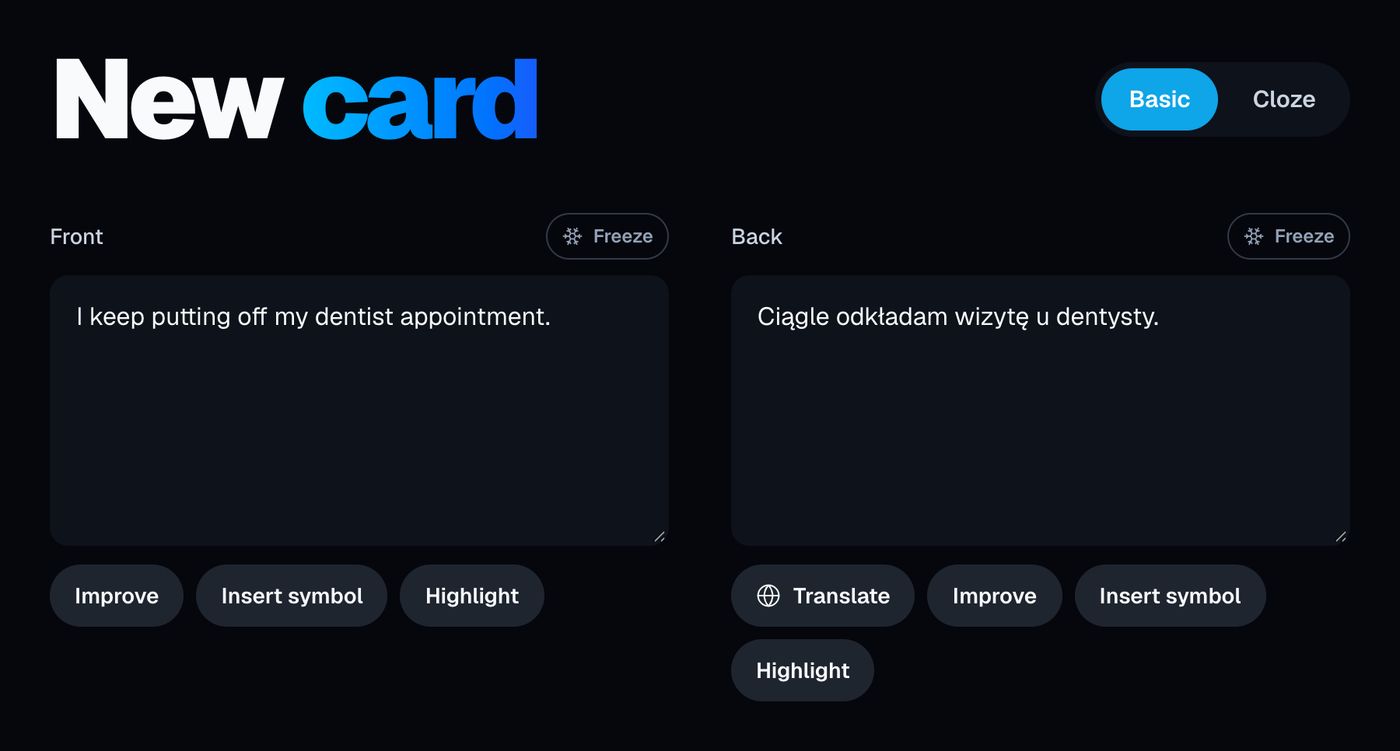
Then select of in the sentence and press Highlight
, or Cmd+U on a Mac and Ctrl+U elsewhere. The review underlines the word, so you know which part of the sentence the card is testing. Do the highlight last. Improve and Translate replace the whole text, and the text they return has no highlights.
Or hide the small word in a cloze
A cloze card makes you produce the word. Choose Cloze on the New card
page and write a sentence like this example:
I'd like a cup {{c1::of}} tea.
Put Poproszę filiżankę herbaty.
in Extra on the back
, so the answer shows how your own language handles the phrase. To make the blank, select the word and press Blank selected text
(Cmd+Shift+B on a Mac, Ctrl+Shift+B elsewhere). Suggest blanks with AI
is less useful here. Its instructions prefer nouns, verbs, adjectives and adverbs, so it tends to skip of.
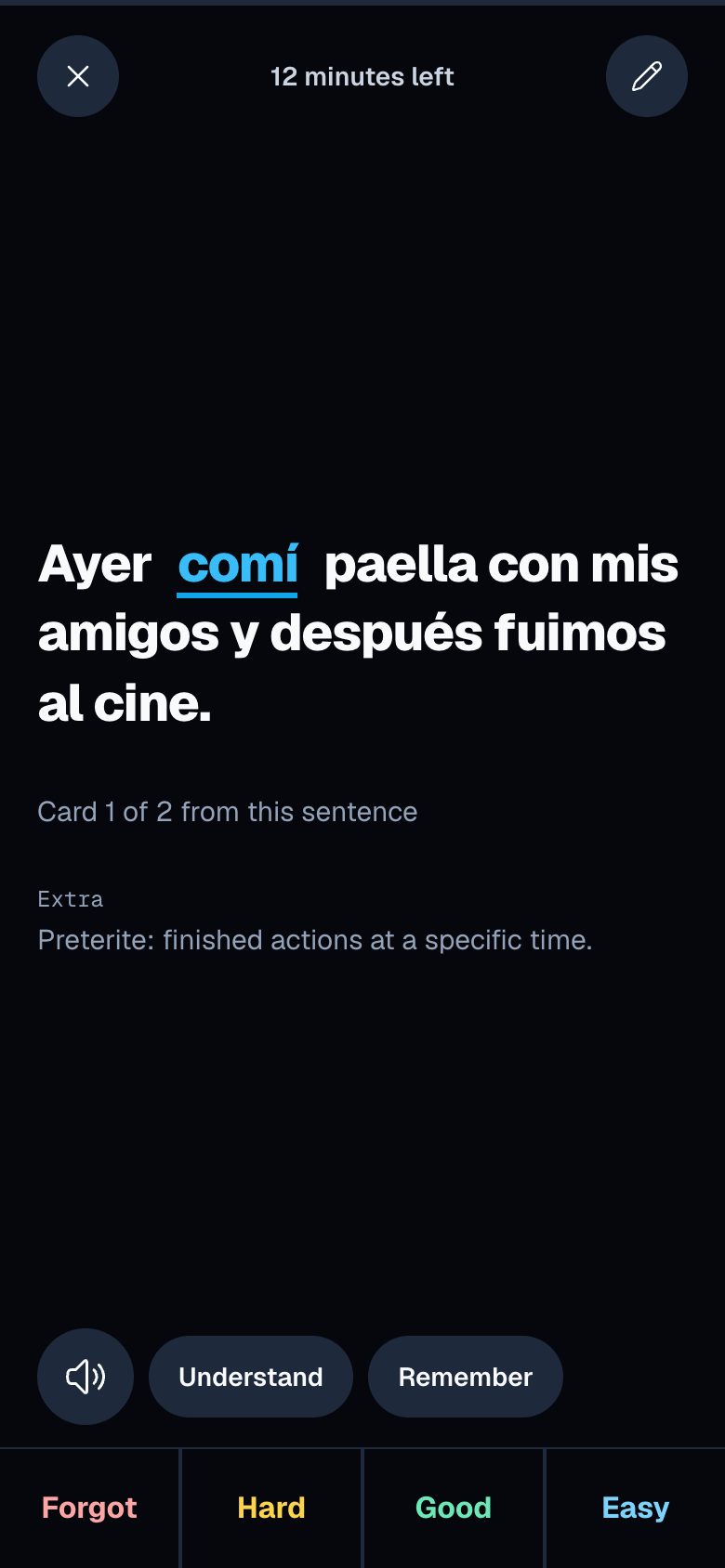
Cloze cards are never flipped in Back → Front
or Random
, so the blank always comes first. For how to choose the direction of your Basic cards, see flashcard direction.
Pacing the first few thousand
Add the most frequent words first, and give each one a sentence card or a cloze. Give them a tag such as core so you can study them on their own from the Library. Once a week, select that tag with the Forgot
difficulty chip to find the small words that keep catching you, and rewrite their sentences.
You do not set up any schedule, because OxyLesson's FSRS scheduler picks each card's next review date for you. The studies above measured people reading and listening, so keep doing both, and turn the useful lines you meet into cards. The subtitle import post shows how to do that with a film.
Sources:
- Adolphs, S., & Schmitt, N. (2003). Lexical coverage of spoken discourse. Applied Linguistics, 24(4), 425-438. https://doi.org/10.1093/applin/24.4.425
- Hu, M. H.-c., & Nation, P. (2000). Unknown vocabulary density and reading comprehension. Reading in a Foreign Language, 13(1), 403-430. https://doi.org/10.64152/10125/66973
- Kremmel, B., Indrarathne, B., Kormos, J., & Suzuki, S. (2023). Unknown vocabulary density and reading comprehension: Replicating Hu and Nation (2000). Language Learning, 73(4), 1127-1163. https://doi.org/10.1111/lang.12622
- Laufer, B., & Ravenhorst-Kalovski, G. C. (2010). Lexical threshold revisited: Lexical text coverage, learners' vocabulary size and reading comprehension. Reading in a Foreign Language, 22(1), 15-30. https://doi.org/10.64152/10125/66648
- Nation, P., & Waring, R. (1997). Vocabulary size, text coverage and word lists. In N. Schmitt & M. McCarthy (Eds.), Vocabulary: Description, Acquisition and Pedagogy (pp. 6-19). Cambridge University Press. Text: https://lextutor.ca/research/nation_waring_97.html
- Schmitt, N., Jiang, X., & Grabe, W. (2011). The percentage of words known in a text and reading comprehension. The Modern Language Journal, 95(1), 26-43. https://doi.org/10.1111/j.1540-4781.2011.01146.x
- Schmitt, N., & Schmitt, D. (2014). A reassessment of frequency and vocabulary size in L2 vocabulary teaching. Language Teaching, 47(4), 484-503. https://doi.org/10.1017/S0261444812000018
- van Zeeland, H., & Schmitt, N. (2013). Lexical coverage in L1 and L2 listening comprehension: The same or different from reading comprehension? Applied Linguistics, 34(4), 457-479. https://doi.org/10.1093/applin/ams074
Cover photo by blickpixel on Pixabay.