Do you need a fixed review schedule like 1 day, 1 week, 1 month?
No. In experiments, the total time between reviews mattered more than whether the gaps grew, stay...
By Kamil
8 mins read

No. In experiments, the total time between reviews mattered more than whether the gaps grew, stayed equal or shrank. An adaptive scheduler sets each card's next gap from your answers, so you never need a table.
The 1 day, 1 week, 1 month
plan is easy to remember, and it does spread your reviews out, which is the part that works. Its weak point is that it gives every card the same dates. Below is what the forgetting curve really measured, what the studies say about the shape of a schedule, and how OxyLesson decides when a card comes back.
What the forgetting curve measured
Forgetting-curve charts often say you lose half of what you learn within an hour. That figure goes back to Hermann Ebbinghaus, and his method explains why it does not transfer to your vocabulary.
Ebbinghaus was the only subject in his own experiments. He learned series of 13 nonsense syllables, waited, and learned the same series again. His measure of memory was savings: how much less time the second learning took. After an hour, relearning still took about half the original work. After a day the saving was 33.7%, and after 31 days about a fifth of the original work was still saved (Ebbinghaus, 1885). So the famous half
is time saved in relearning syllables with no meaning, which is a different thing from the share of words you can still recall.
Murre and Dros repeated the experiment with one subject, who spent 70 hours learning lists of nonsense syllables and relearning them after six intervals from 20 minutes to 31 days. The results were similar to Ebbinghaus's, and the curve was not smooth: it most likely jumps up at the 24-hour point (Murre & Dros, 2015). The authors also point out that savings is very different from the recall tests used in most memory research. The curve does replicate, and it shows that forgetting is fast at first and then slows down. It says nothing more exact about a deck of words you understand.
If you want the savings idea applied to a language you once knew, Can you forget a language you learned? covers it.
Growing gaps or equal gaps
A fixed table usually has gaps that grow, on the idea that each review should come a little later than the last. Two studies tested that idea directly.
Karpicke and Bauernschmidt had people study items until they could recall each one, then gave them three more recall tests on different schedules: expanding, equal or contracting gaps, with more or less total spacing. More total spacing had a large effect. Long gaps between tests gave a 200% improvement in long-term retention over tests with no gaps. The pattern of the gaps made no clear difference, and expanding schedules made later tests harder without improving retention (Karpicke & Bauernschmidt, 2011).
Kang, Lindsey, Mozer and Pashler ran a four-week study of foreign vocabulary with review sessions on separate days. On a final test eight weeks after training, expanding gaps and equal gaps gave the same recall. The expanding schedule did have one advantage: learners recalled much more on average during the training period (Kang et al., 2014). So growing gaps mean fewer failed recalls along the way, but neither study found a sequence of days that beats the others on the final test.
The best size of a gap also depends on how long you need to remember. How should you plan flashcard reviews before an exam date? covers that question with Cepeda's data.
Repeating until it is automatic
The other half of many fixed plans is drilling a new word many times in the first sitting, so the first gap starts from a strong memory.
Rohrer and colleagues tested this with 218 students who learned geography facts or word definitions, with different amounts of practice in the first session. One week later, the students who had overlearned recalled much more than those who had practiced less. Over the following weeks, up to nine, that difference shrank a lot. The authors called overlearning an inefficient strategy for long-term retention (Rohrer et al., 2005). The extra repetitions on day one mostly buy a better first week.
What a table cannot know
A table treats el ayuntamiento
and la mesa
the same way, although one of them is much harder for you. It has no step for a card you forgot on day 7, and when you miss a day, every date after it is off.
An adaptive scheduler handles all three. Here is how the two compare in practice:
| Question | Fixed table | OxyLesson (FSRS) |
|---|---|---|
| When does a card come back? | On the same dates for every card | When that card's chance of recall has fallen to a set target |
| What if you forget it? | The table goes on | The card comes back the same day |
| What if you knew it instantly? | Same dates anyway | Easygives it a longer gap |
| What do you configure? | The table | Nothing |
How OxyLesson replaces the table
OxyLesson schedules every card with FSRS, an open-source algorithm. Its authors credit the research of the language app MaiMemo and cite a paper by Ye, Su and Cao, which built a memory model from 220 million memory logs of students and a scheduler designed to keep the cost of reviews as low as possible; the paper reports a 12.6% improvement over the best earlier methods (Ye et al., 2022; FSRS on GitHub).
In the app you never see an interval setting. Each card carries its own estimate of how stable the memory is, and each review updates it from the grade you press on the answer side:
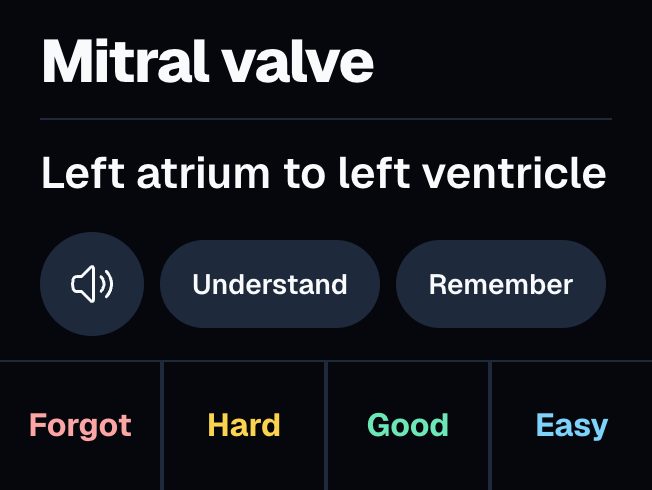
Forgot
sends the card into short relearning steps, so it comes back later the same day.Hard
gives a shorter gap thanGood
.Good
is the normal answer for a card you recalled with some effort.Easy
gives the longest gap. On a new card, it skips the short first steps and moves the card to a later day.
One detail in the formula matches the studies above: a correct recall raises a card's stability more when the chance of recalling it had dropped further, which fits the finding that total spacing matters. The next date also gets a little random spread, so cards you learned together are less likely to all come due on the same day.
The grade buttons do not show the next interval. The place to see the result is the Session done
screen at the end of a review, where the Next card
tile shows when the next card of your session comes back:
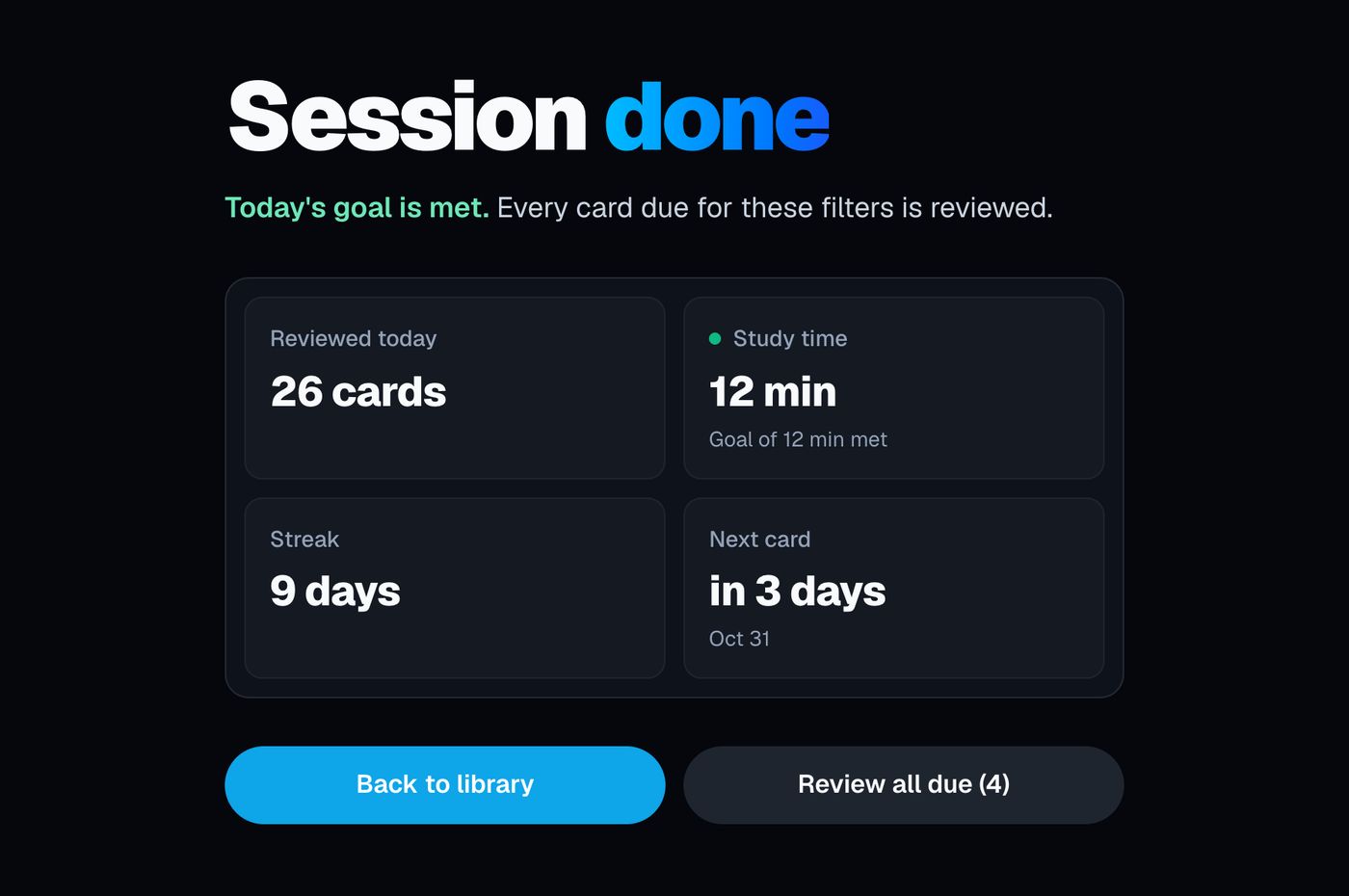
A review shows only the cards that are due. There is no study-ahead mode, so you cannot pull tomorrow's cards into today.
What to do instead of keeping a calendar
Review whatever is due on each day you study, and grade honestly. Easy
on a card you knew at once is how you save time, since that card stays away longer instead of coming back on a fixed date. Forgot
on a blank is what brings a weak card back before the gap grows. You do not need to drill new cards many times in the first sitting either. The short same-day steps and the later reviews do that work.
If you miss a few days, the overdue cards are waiting in the next review, and the scheduler takes the longer wait into account when you grade them. How to learn effectively using OxyLesson shows what the first week of that routine looks like.
Sources:
- Ebbinghaus, H. (1913). Memory: A contribution to experimental psychology (H. A. Ruger & C. E. Bussenius, Trans.). Teachers College, Columbia University. (Original work published 1885.) Chapter 7: https://psychclassics.yorku.ca/Ebbinghaus/memory7.htm
- Kang, S. H. K., Lindsey, R. V., Mozer, M. C., & Pashler, H. (2014). Retrieval practice over the long term: Should spacing be expanding or equal-interval? Psychonomic Bulletin & Review, 21(6), 1544-1550. https://doi.org/10.3758/s13423-014-0636-z
- Karpicke, J. D., & Bauernschmidt, A. (2011). Spaced retrieval: Absolute spacing enhances learning regardless of relative spacing. Journal of Experimental Psychology: Learning, Memory, and Cognition, 37(5), 1250-1257. https://doi.org/10.1037/a0023436
- Murre, J. M. J., & Dros, J. (2015). Replication and analysis of Ebbinghaus' forgetting curve. PLoS ONE, 10(7), e0120644. https://doi.org/10.1371/journal.pone.0120644
- Rohrer, D., Taylor, K., Pashler, H., Wixted, J. T., & Cepeda, N. J. (2005). The effect of overlearning on long-term retention. Applied Cognitive Psychology, 19(3), 361-374. https://doi.org/10.1002/acp.1083
- Ye, J., Su, J., & Cao, Y. (2022). A stochastic shortest path algorithm for optimizing spaced repetition scheduling. In Proceedings of the 28th ACM SIGKDD Conference on Knowledge Discovery and Data Mining (pp. 4381-4390). https://doi.org/10.1145/3534678.3539081
- Open Spaced Repetition. fsrs4anki (README). https://github.com/open-spaced-repetition/fsrs4anki
Cover photo by Alexas_Fotos on Pixabay.