Does reading aloud help you remember words? Shadowing with flashcard audio
Yes. Words you say aloud are remembered better than words you read silently, and saying a word fr...
By Kamil
7 mins read
Yes. Words you say aloud are remembered better than words you read silently, and saying a word from memory before you hear it works better than repeating it after a speaker.
Psychologists call the first finding the production effect, and the second comes from research on retrieval practice. Together they suggest an order for every card: recall the word, check the answer, then listen and repeat. Shadowing, which means repeating right after a speaker, fits at the end of that order.
What the production effect is
In 2010, MacLeod and four colleagues ran eight recognition experiments in which people studied a list of words, reading some of them aloud and the others silently. The words read aloud were recognized better later. Mouthing a word without making a sound still helped, and so did reading pronounceable nonwords aloud (MacLeod et al., 2010). The authors explain the effect by distinctiveness: a word you said carries an extra trace (I said that one
), which sets it apart at test.
In the first three experiments the effect showed up only when the same person read some words aloud and some silently, in one mixed list. When one group read every word aloud and another read every word silently, the effect did not appear. Saying a word aloud helps it stand out from the words around it, so reading a whole page aloud, where every word gets the same treatment, finds no support here.
Hearing your own voice also plays a part. Forrin and MacLeod compared four ways of studying words: reading them aloud, reading them silently, hearing another person read them, and hearing a recording of yourself reading them. Hearing yourself was worth less than saying the word, but more than hearing someone else say it (Forrin & MacLeod, 2018). When an app plays a word for you, say it back, because hearing someone else say a word was the weaker condition in this study.
There is a popular promise that reading a text aloud many times will make you fluent. The production effect is about remembering the particular items you said, measured with word lists and recognition tests. Nobody in these studies measured fluency.
Recall first, then repeat
Many language courses ask you to repeat a word after a teacher. Kang, Gollan and Pashler tested that habit against retrieval practice. Learners saw pictures of objects and heard their names in a new language. One group repeated each name right after hearing it. The other group tried to say the name before hearing it, then heard it as feedback. On tests right after training and two days later, the group that tried first understood and produced more of the words, and their pronunciation was no worse (Kang et al., 2013).
This is the same principle behind testing yourself with flashcards, covered in Do flashcards really help in language learning? With card audio, that means you try to say the word before you play the answer.
What shadowing does
In shadowing you listen to a recording and repeat it out loud a moment behind the speaker. It has been studied mostly as listening and pronunciation practice.
Hamada gave 43 Japanese university students of English nine shadowing lessons. Both the lower-level and the intermediate learners got better at hearing individual sounds, but only the lower-level group improved on a standard listening test (Hamada, 2016). Foote and McDonough had 16 learners shadow short dialogues on iPods for eight weeks, recording themselves. Twenty-two listeners rated their speech before, during and after. After the training their speech was rated easier to understand and more fluent, while the ratings of their accent did not improve (Foote & McDonough, 2017).
Both studies used sentences and dialogues recorded by people. A flashcard holds a word or a sentence, so shadowing on cards is a smaller version of the same exercise.
The routine in OxyLesson
Every card side in OxyLesson has a speaker button that plays a generated voice reading that side's text. It is text to speech, not a recording of a native speaker. Take an example card with el desayuno
on the front and breakfast
on the back.
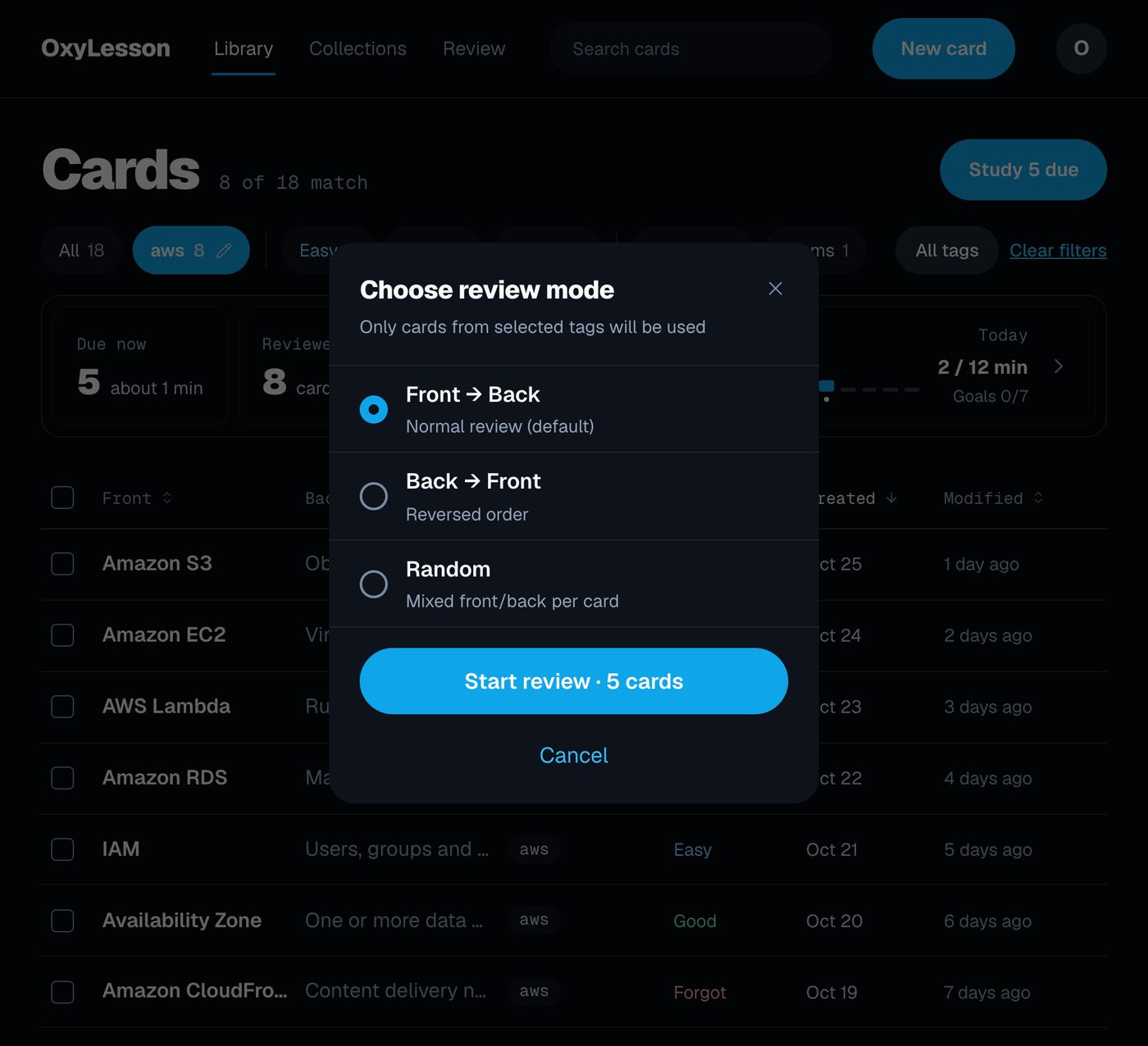
- Start a review and pick
Back → Front
in theChoose review mode
dialog. The question is nowbreakfast
, and the Spanish is the answer. - Say
el desayuno
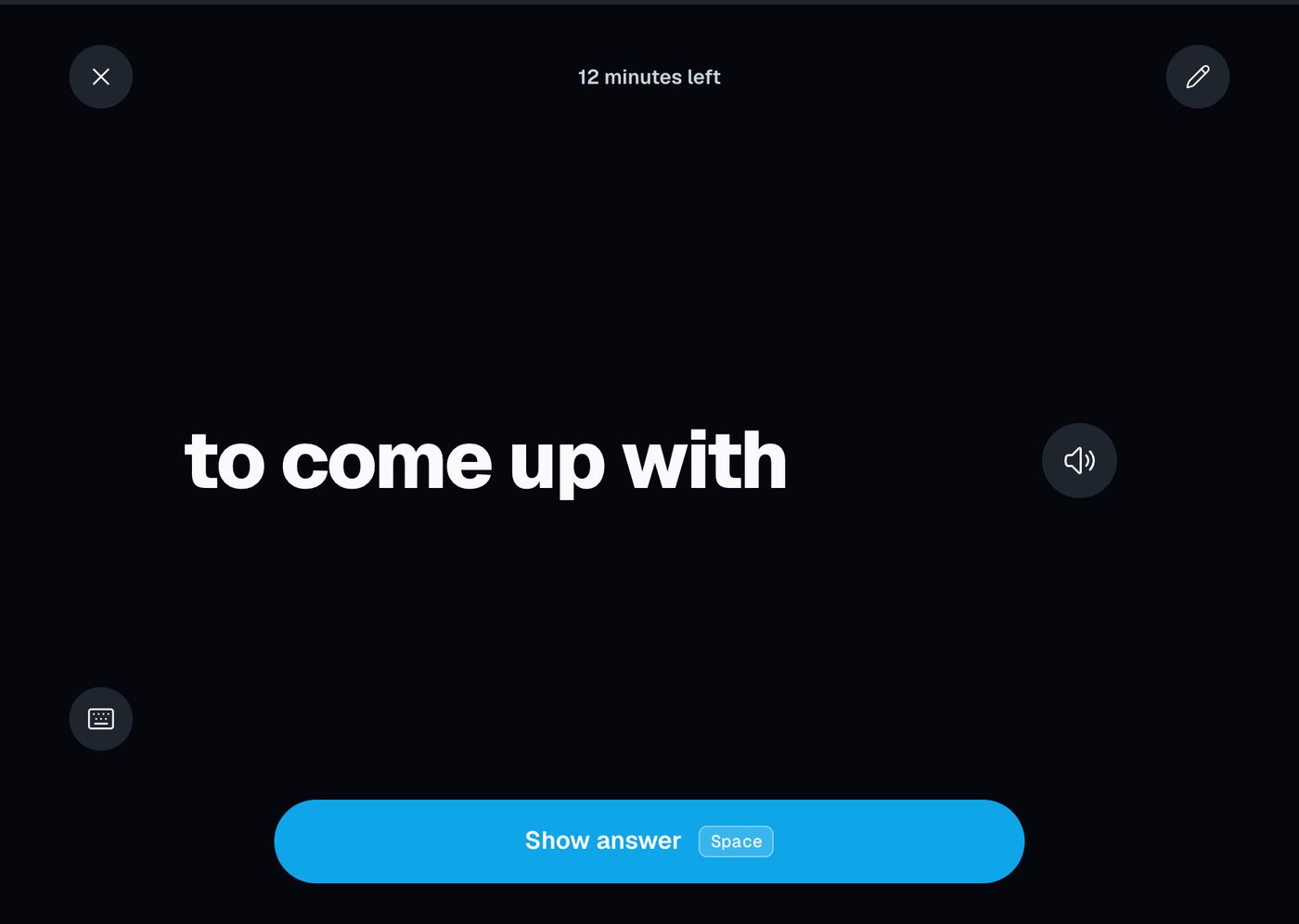
out loud before you reveal anything. This is the attempt that Kang's study found worth making. Before the reveal, theAkey plays nothing, so the answer audio cannot slip out by accident. - Press Space for
Show answer
. PressAto hear the answer side, orQto hear the question side again. The two speakers under the answer carry the same letters. - Repeat right after the voice. Press
Aagain to replay it. From the third play of the same side, each play is a little slower than the one before until it reaches the slowest speed, and the voice keeps its pitch, so the sounds are easier to follow. Stopping the audio halfway does not count as a replay, and the next card starts at normal speed again. - Grade the card on step 2:
Forgot
if you could not say the word before the reveal, however well you repeat it afterwards.
For whole sentences, use a cloze card. You write Tomamos {{c1::el desayuno}} a las ocho. and review it with the phrase hidden. A cloze question has no speaker, so the voice cannot read out the missing words. After the reveal, one speaker reads the full sentence, which is a good length for shadowing.
On a basic card you can mark the part you keep getting wrong. Select it in the card form and press the Highlight
button, or Cmd+U (Ctrl+U on Windows). The underline shows during review. The voice reads the plain text, so the underline is only a visual cue.
Where it stops
The voice is synthetic. It gives you a clear model to repeat, but a rare word or a name may come out with the wrong stress, so check those against a dictionary recording. The slower replays make each sound easier to hear, but no study has tested whether they improve your pronunciation. Short card audio also cannot train you for fast, natural speech. For that, shadow longer recordings by real speakers, such as the films covered in Breaking the advanced English barrier.
Sources:
- Foote, J. A., & McDonough, K. (2017). Using shadowing with mobile technology to improve L2 pronunciation. Journal of Second Language Pronunciation, 3(1), 34-56. https://doi.org/10.1075/jslp.3.1.02foo
- Forrin, N. D., & MacLeod, C. M. (2018). This time it's personal: The memory benefit of hearing oneself. Memory, 26(4), 574-579. https://doi.org/10.1080/09658211.2017.1383434
- Hamada, Y. (2016). Shadowing: Who benefits and how? Uncovering a booming EFL teaching technique for listening comprehension. Language Teaching Research, 20(1), 35-52. https://doi.org/10.1177/1362168815597504
- Kang, S. H. K., Gollan, T. H., & Pashler, H. (2013). Don't just repeat after me: Retrieval practice is better than imitation for foreign vocabulary learning. Psychonomic Bulletin & Review, 20(6), 1259-1265. https://doi.org/10.3758/s13423-013-0450-z
- MacLeod, C. M., Gopie, N., Hourihan, K. L., Neary, K. R., & Ozubko, J. D. (2010). The production effect: Delineation of a phenomenon. Journal of Experimental Psychology: Learning, Memory, and Cognition, 36(3), 671-685. https://doi.org/10.1037/a0018785
Cover photo by Pexels on Pixabay.