Which academic words do you need for IELTS or TOEFL?
Start with the Academic Word List, 570 word families like analyse and derive that are common ...
By Kamil
7 mins read

Start with the Academic Word List, 570 word families like analyse and derive that are common in academic texts. Learn each in a sentence with its other forms: both exams reward accurate use.
Topic words can come later, because neither exam expects you to know the subject in advance.
What IELTS and TOEFL say about vocabulary
On the IELTS Academic Reading page, the texts come from books, journals, magazines, newspapers and online sources, and they are written for a non-specialist reader. The topics are pitched at students at undergraduate or postgraduate level. When a text uses technical vocabulary, the test gives a simple dictionary definition. General words like assume and indicate get no such help, so those are the ones to learn ahead.
For Writing, IELTS names four criteria, and one of them is Lexical resource. The official preparation video says it covers the range of vocabulary you use, how accurate it is, and how appropriate it is
. The same video names precision of word choice, collocations, and how often you make spelling and word-formation errors. The full wording is in the official Writing band descriptors, linked from the IELTS Writing preparation page. So a rare word used wrongly costs you on accuracy, and a wrong noun or adjective form shows up as a word-formation error.
ETS describes the TOEFL iBT Reading section as everyday campus texts plus academic ones, and it says you need no prior knowledge of the topic. One reading task, Complete the Words
, asks you to fill in partly missing words in a short text, and ETS says it measures vocabulary knowledge and meaning from context. The other academic tasks are Read an Academic Passage
, Listen to an Academic Talk
and Write for an Academic Discussion
. The Writing section checks whether you use grammar and vocabulary accurately and write in an academic tone. For timings and the current format, see the TOEFL iBT test content page.
OxyLesson also has overview pages for IELTS and TOEFL.
What the Academic Word List covers
Coxhead (2000) built the Academic Word List from 3.5 million running words of written academic text. She left out the 2,000 most frequent words of general English, so the list holds only the words that come after them. Its 570 families made up about 10% of the words in academic texts, against only 1.4% in fiction.
The list is split into sublists by frequency. On the list's page at Victoria University of Wellington, Sublist 1 has 60 families and covers 3.6% of the academic corpus. Assuming 400 words to a page, you meet each Sublist 1 family again about every 4 pages. By Sublist 9, coverage drops to 0.2% and a family comes back only every 67 pages, which is why it pays to work through the sublists in order.
A family is the base word with its inflections and derived forms. The analyse family holds analysis, analyst, analytical and the American analyze. In the writing tasks, picking the right form matters as much as knowing the meaning, so put the forms on the card.
Two later studies add limits to this. Hyland and Tse (2007) applied the list to a 3.3-million-word corpus from several disciplines. It covered 10.6%, but the same word often behaved differently from field to field, in frequency, collocation and meaning. They suggest learning the vocabulary of your own discipline. Gardner and Davies (2014) built a newer Academic Vocabulary List from a 120-million-word academic part of the Corpus of Contemporary American English. It covered about 14% of academic material in that corpus and in the British National Corpus. Either list is a reasonable start. IELTS and TOEFL test general academic English, so a general list fits the exam, and the words of your own field can follow once your course is closer.
How many words you know matters too. Stæhr (2008) tested 88 Danish lower-secondary learners of English. Their vocabulary size was strongly linked to reading and writing scores and moderately linked to listening. They were younger than most exam candidates, so the study says little about any one candidate's result.
Import a sublist with one tag
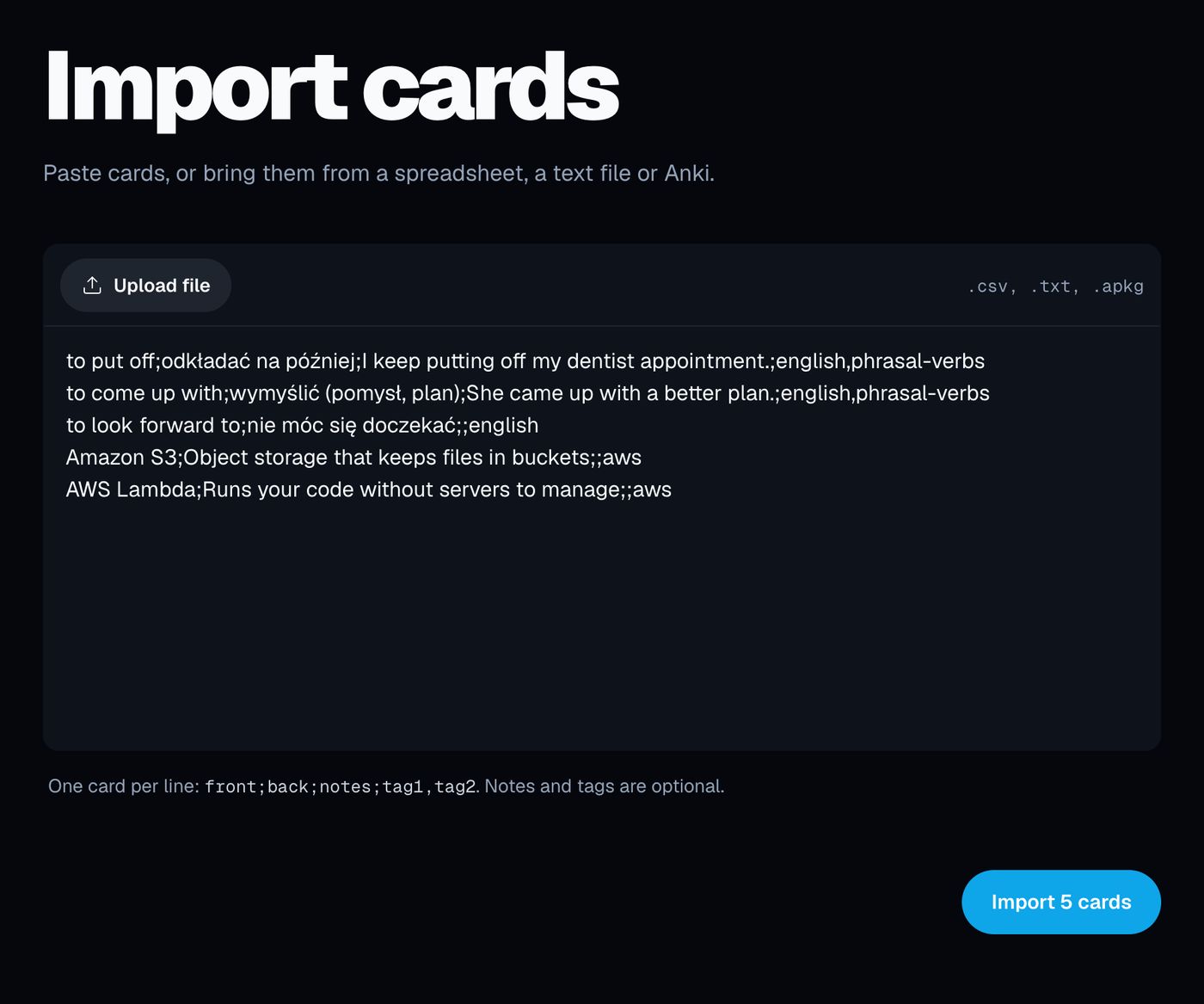
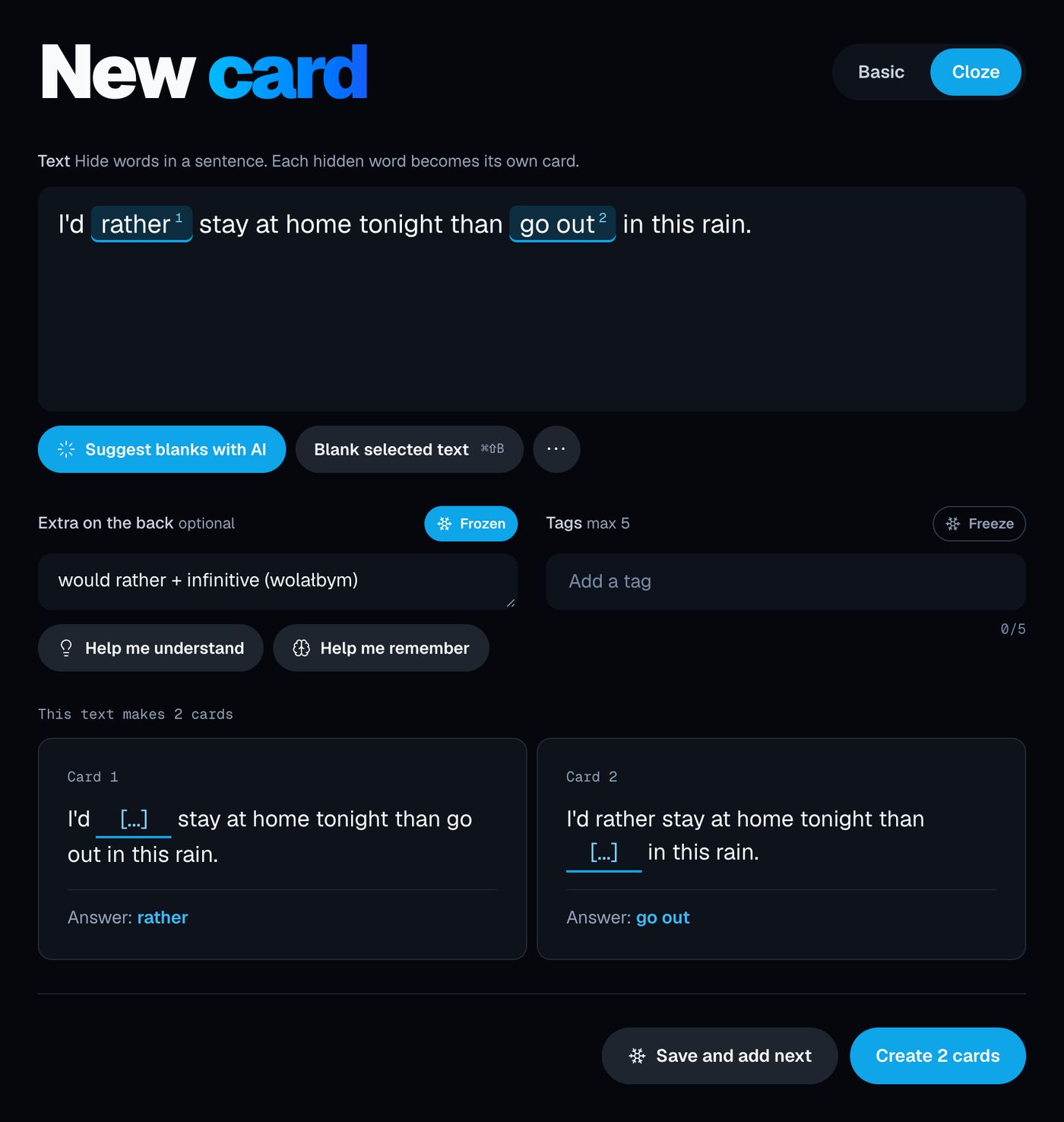
The OxyLesson import page takes one card per line in the format front;back;notes;tag1,tag2. If the front holds a cloze blank such as {{c1::word}}, that line becomes a cloze card. Its back goes into Extra on the back
. So you can write each word into a sentence of your own and keep the whole family in the Extra field. Here are three example lines written for this post:
Researchers {{c1::analysed}} the survey results.;analyse, analysis, analyst, analytical;;awl-1
The rise in prices was {{c1::significant}}.;significant, significance, significantly, insignificant;;awl-1
The method is {{c1::derived}} from earlier studies.;derive, derivation, derivative;;awl-1
Paste them on the Import cards
page and press the button, which shows the card count (Import 3 cards
). Each line makes one card. All of them get the tag awl-1.
A blank can also carry a hint after a second ::, as in {{c1::significant::sig...}}. The review shows the hint with the empty box. Giving yourself the first letters this way is a little like the TOEFL Complete the Words
task, though the two work differently.
Write the sentences yourself, ideally about articles you read for practice. Official IELTS and TOEFL passages are copyrighted, so keep your own wording on the card.
If you already have word pairs
Maybe your list already has cards like significant | istotny
. Open one and press Improve
under the Front. Improve needs text on both sides. Its instructions tell the model to replace a lone word with one short, everyday sentence that uses that exact word. Then use Translate
under the Back to translate the new sentence. Check whether the sentence uses the academic meaning. Improve aims for everyday sentences, so significant may come back in a casual sense. Highlight the word last, with the Highlight
button or Cmd+U (Ctrl+U on Windows). Improve replaces the text and drops highlights. The post on how many words you need walks through this flow step by step.
Or ask an AI assistant to add the next sublist
OxyLesson runs an MCP server at https://oxylesson.com/mcp. The account page section AI agents (MCP)
shows how to connect Claude, ChatGPT or a coding agent. Once it's connected, you can ask: Add Academic Word List Sublist 2 as cloze cards, one sentence per family, with the family forms in Extra, tagged awl-2.
The assistant creates the cards in your library. A card that matches an existing one is skipped, so asking twice adds nothing. Read the new cards before you study them, because the assistant writes the sentences and can pick a weak one.
Review one sublist at a time
In the Library, select the awl-1 tag. Study
opens Choose review mode
, which notes that only cards from the selected tags will be used. Cloze cards always show the blank first, whichever mode you pick. Once a week, add the Forgot
difficulty chip to the tag. That shows the families that keep slipping, and you can rewrite their sentences.
A review shows only cards that are due. OxyLesson has no study-ahead mode and no exam-date setting, so add each sublist several weeks before the test. The post on planning reviews before an exam covers that timing.
Sources:
- Coxhead, A. (2000). A new academic word list. TESOL Quarterly, 34(2), 213-238. https://doi.org/10.2307/3587951
- Gardner, D., & Davies, M. (2014). A new academic vocabulary list. Applied Linguistics, 35(3), 305-327. https://doi.org/10.1093/applin/amt015
- Hyland, K., & Tse, P. (2007). Is there an
academic vocabulary
? TESOL Quarterly, 41(2), 235-253. https://doi.org/10.1002/j.1545-7249.2007.tb00058.x - Stæhr, L. S. (2008). Vocabulary size and the skills of listening, reading and writing. Language Learning Journal, 36(2), 139-152. https://doi.org/10.1080/09571730802389975
- Victoria University of Wellington. The Academic Word List: the sublists. https://www.wgtn.ac.nz/lals/resources/academicwordlist/information/thesublists
- IELTS. IELTS Academic Reading format. https://ielts.org/take-a-test/test-types/ielts-academic-test/ielts-academic-format-reading
- IELTS. IELTS Writing test preparation resources. https://ielts.org/take-a-test/preparation-resources/writing-test-resources
- ETS. TOEFL iBT test content, Reading and Writing sections. https://www.ets.org/toefl/test-takers/ibt/about/content.html
Cover photo by garten-gg on Pixabay.